
The granite boulders at ground zero are a good example showing how weathering (breaking down into small fragments) by Lichens takes place.
Weathering Processes
There are different types of weathering processes which impacts on the eroding of rocks. They can be grouped as follows:
Mechanical Weathering
Mechanical weathering is the process of breaking big rocks into little ones. Temperature affects the land. The cool nights and hot days always cause things to expand and contract. That movement can cause rocks to crack and break apart. Roots and plants also push into the rocks and break them apart. They act like wedges and push the rocks apart. Little animals also help by burrowing and digging through the ground.
Scientists have observed a process called freeze-thaw. That process occurs when the water inside of rocks freezes and expands. That expansion cracks the rocks from the inside and eventually breaks them apart. The freeze-thaw cycle happens over and over again and the break finally happens. Another word for it is frost wedging. There are already some small cracks in boulders and water can get in the cracks. When that water expands, the rock is crunched between two expanding pieces of ice instead of being forced apart into separate pieces.
Another type of mechanical weathering is called salt wedging. When it rains and water flows everywhere, it usually has ions and salts dissolved inside. Have you seen salt water dry up? Salt crystals are left over. Those crystals happen in nature, too. The water flows in a rock and evaporates. Crystals slowly begin to grow. Those crystals act like a wedge and crack the rocks.
Chemical Weathering
Chemical weathering includes the effect of weathering on molecules and atoms. For these chemical reactions to happen in nature, moisture, and heat must be present.
Reactions such as oxidation, hydrolysis, and acidification can happen when all of the elements are together. Oxidation makes rocks softer. It is similar to an iron bar rusting. Since there is a lot of iron in many rocks, oxidation often happens. Hydrolysis usually causes rocks to expand and then mechanical weathering can begin. These chemical reactions are happening all of the time. When you see rocks next to each other that are different colours (often shades of red) then you know chemical reactions have taken place.
Biological Weathering
Biological weathering would include the effect of animals and plants on the landscape. This is more than roots digging in and wedging rocks. Biological weathering is the actual molecular breakdown of minerals.
Lichens live on rocks. Have you ever seen a lichen and knew that it was a lichen? Lichens are bizarre organisms and no two are alike.
Lichens are a complex life form that is a symbiotic partnership of two separate organisms, a fungus and an alga.
The dominant partner is the fungus, which gives the lichen the majority of its characteristics, from its thallus shape to its fruiting bodies. The combined life form has properties that are very different from the properties of its component organisms. The properties are sometimes plant-like, but lichens are not plants. They do not have any roots, stems or leaves and their chloroplasts are contained only in the algae on the top surface of the lichen.
There are thousands of known Lichens species occurring under all environmental conditions. The species such as these which grow on rocks, are divided into two major groups:
- Epilithic group which grows on the surface of rocks and;
- Endolihic group that grows inside the rock.
Lichens are found in many colours, for example yellow, brown, orange, red, green, grey and black.

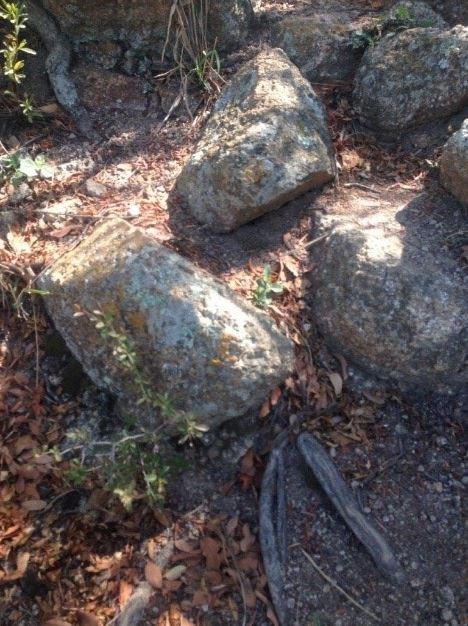
The various species of lichens on the rock in this area and the variations on the different sides of the rocks, that is the result of locally different temperature and moisture conditions, is clearly visible. The exfoliation process can also be seen.
The weathering process associated with Lichens result in exfoliation (peeling off) of thin layers from surface of the rock, and/or the disintegration of small pieces of the rock, eventually forming sand grains.
This is a very slow process biochemical process, which may destroy the whole rock.
Logging the EarthCache
Please submit the answers to the following questions to me via e-mail or the message centre to qualify your find:
- What type/s of weathering can you identify at ground zero ?
- How does the weathering process associated with Lichens work?
- What colour Lichens can you identify at ground zero?
Acknowledgements:
http://en.wikipedia.org/wiki/Lichen
http://www.fs.fed.us/wildflowers/beauty/lichens/whatare.shtml
Tswaing Meteorite Crater, Reimold, Brandt, De Jong & Hancox, 1999