Answer the following questions in order to log the Earth Cache:
- What type of erosion occurs at GZ?
- What part of the Kirkwood Formation do you think you are seeing at GZ?
- Name the three components that the Uitenhage Group consists of?
- What is the name of the well-known fossil dinosaur found in the area?
The first thing one see when walking towards GZ, is the erosion of the cutting along the road.
There are many chemicals in water and those chemicals can break down certain rocks, such as limestone or chalk. This type of erosion is better known as "Water Erosion".
Wind erosion is simple... light objects, such as rocks and pebbles are carried by the wind and can hit landforms, eroding materials off them, that are carried off in the wind.
Soil erosion pays the biggest price to farmers. Flooding, wind etc. can carry the topsoil away from farmlands, and make the soil unfertile.
Previously known as "Wood Beds and Variegated Marls", the Kirkwood Formation of South Africa has long been recognized as having the potential to fill an important gap in the Mesozoic terrestrial fossil record. The said formation stretches from Kirkwood to the Bushmans River and has a maximum thickness of 2210m.
The Kirkwood Formation is dated as late Jurassic to early Cretaceous when the sedimentation began towards the end of the Jurassic Period (140 to 150 million years ago). It represents an accumulation of fine-grained sediments under fluvial conditions. The reultant mudstone and subordinate sandstone also contains foliage and wood fossils. The fluvial deposition began to fill the Algoa Basin and was followed by marine ingression to form the Sundays River Formation.
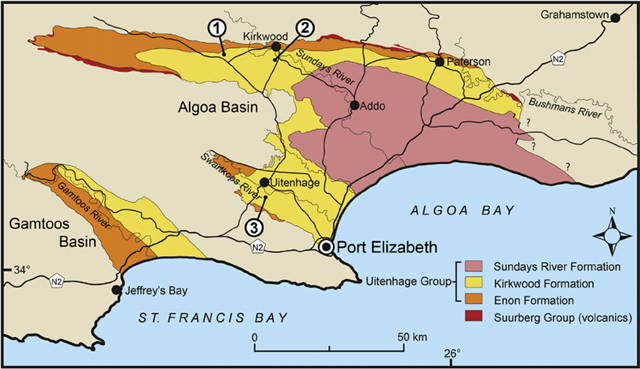
The Kirkwood Formation can be subdivided into 3 members:
The Basal Swartkops Member consists of non-fossilderous sandstones and is part fluvial part estuarine in origin. The Colchester Shale Member consists of dark greay shales, silstones and minor sandstones. The presence of marine fossils indicates an estuarine brackish water environment. And the youngest member of the Kirkwood Formation has no separate name but consists of overlain yellow, yellow-brown, white and pale grey interbedded sandstones and pebbly sandstones sometimes capped with red-brown and green-grey mustones and siltstones. It was formed due to fining upward cycles of subordinate conglomerate and grit lenses.
The Kirkwood Formation forms part of the Uitenhage Group that consists of (from youngest to oldest) the Enon, Kirkwood and Sundays River Formation.
Seeing as the Mesozoic Era, in which the Kirkwood Formation formed, was better known as the "Era of the Dinosaur", it is fit to throw in some history of the well-known dinosaur found in the area. Nqwebasaurus was a meat-eating dinosaur that lived during the early Cretaceous period. This coelurosaurid theropod had a very large claw on the first digit (finger). Seventy percent of a skeleton (nicknamed 'Kirky') was found in the Kirkwood Formation in the Algoa Basin, Eastern Cape, South Africa.
References:
http://www.odec.ca/projects/2004/derk4d0/public_html/differenttypesoferosion.htm
Early Cretaceous Alluvial Palaesols (kirkwood Formation, Algoa Basin, South Africa) and their Palaeoenvironmental and Palaeoclimatological Significance by Susan Frost (1996)
High diversity in the sauropad dinosaur fauna of the Lower Cretaceous Kirkwood Formation of South Africa: Implications for the Jurassic - Cretaceous transition by B.W McPhee, P.D Mannion, W.J de Klerk and J.N Choiniere (2016)
www.sanparks.org