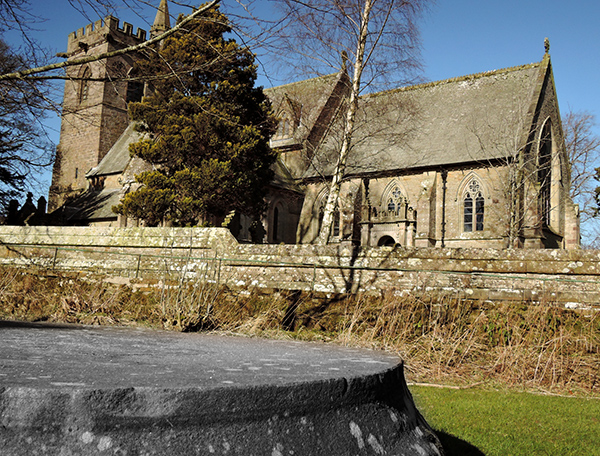
The given co-ordinates will actually bring you to a large circular piece of stone situated just outside the church. This is the Crosby Ravensworth Millenium Stone and although it was placed to celebrate a period of 2,000 years, this stone is actually around 250 million years old. So why is this stone worth seeing? Well, the reason we are focusing on this particular stone is the fact that it is completely natural - this may look to some like a man-made stone of some type, perhaps an old millstone or such, but this is not the case. This is a remnant of a wind sculpted sandstone pillar and it has not been altered by man in any way. It came from a local quarry (at Plumpton, near Lazonby) and was simply moved here exactly as it was discovered.
Questions to Answer
For this earthcache, there isn't much background information to read, it's more about observations of the stone and the church, and is designed to be straightforward and simple for anyone to complete.
To log this earthcache, you need to answer some simple questions about the stone at the given co-ordinates, and also make some comparisons by looking at the stone on the church. Please send answers to me by email/messenger via the link at the top of the page to my profile. Ideally please send your answers at the time of submitting your log, or at least soon after. Please don't be put off worrying that your answers may be wrong, I appreciate everyone has a different level of geological knowledge. I only ask that you make a reasonable attempt at the answers.
1) Please estimate the circumference of the stone pillar at the given co-ordinates. You can do this by walking around the stone taking strides of approximately one metre and seeing how many it takes to complete the circle. Also, estimate the height of the pillar.
2) Examine the stone pillar. Tell me what the prominent colour is and whether there is any variation in colour. Touch the stone and tell me what it feels like (smooth, rough etc). How big are the grains in the stone? Can you see any evidence to support the fact that the stone was shaped by the wind?
Turn your attention to the nearby church of St. Lawrence. We know this sandstone pillar came from a local quarry recently, but where did the stone for the church come from? Go up to the church and look at the stone closely. Look for a clean bit of stone and examine the colour, compare the texture of the stone, and look closely at the size of the grains in the stone. If they approximately match, it is likely to be the same local stone. If they don't, it's probably not. Obviously, please show every respect for the church building.
3) Using guidance from the previous paragraph, do you think the main church is made from either sandstone (like the pillar outside) or is it something else? Your answer to this question can be simply yes, or no.
4) Look around the church exterior and roof, it has been altered and extended at different times in it's long history. Do you think all the stone is the same or can you spot any that is different? If you do, what do you think you have seen? You can (optionally) look at the interior the church if you wish, (it is usually open and visitors are welcomed), here you might find examples of decorative stone.
Weathering is often a problem for buildings, especially when fine detail is carved into soft stones. This is usually a bigger problem in cities where pollution is more prevalent. There are many fine carvings here, including some great gargoyles leering down and the carved finial of a man swallowing a mouse. These examples are all found on the tower, although there are others all around the building.
5) Take a quick look at the carvings for evidence of weathering or wind erosion.
- Do you think these carvings are in any immediate danger?
- What does this tell you about this local stone? Is it hard or soft, and do you think there is any evidence that the area has a pollution problem?
6) A photograph of you with the church would be good additional proof of your visit. Also feel free to include photographs of interesting stone you have spotted. This is an optional task.
Brief History of the Church of St. Lawrence
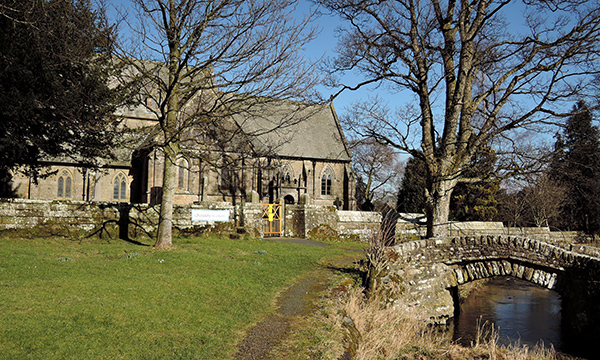
St Lawrence's Church is in the village of Crosby Ravensworth, Cumbria, England. It is an active Anglican parish church in the deanery of Appleby, the archdeaconry of Carlisle, and the diocese of Carlisle. The church is recorded in the National Heritage List for England as a designated Grade I listed building. In 2008 it was reported that the church might have to close as the costs for maintaining such a large church within such a small community were becoming impossible, however, for now, church life continues as normal.
Originally, the Church dedicated to St. Laurence was granted to and appropriated by the Abbot and Convent of Whitby. The first mention of a church where St Lawrence now stands is in 1109. It was probably a wooden building and may have been destroyed in a Scottish border raid. In 1150 a late Norman church was built. The evidence for this Norman church exists in the clustered piers at the corners of the crossing and in the north aisle's projecting capitals. The south doorway and arcades are from the 13th century. It is thought that there was originally a tower at the crossing, but this was dismantled towards the end of the 15th century, and replaced by the west tower, and transepts were also removed. The northeast chapel (the Threlkeld Chapel) does date from this time.
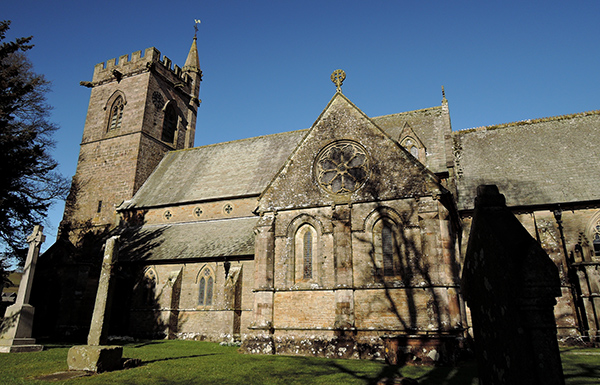
The church was remodelled twice during the 19th century. The first took place in 1811–12. This was carried out either by Robert Smirke, or by George Gibson advised by Smirke. Remaining from this remodelling are the south porch and the south doorway of the chancel. The second remodelling took place over a period extending from 1848 to 1887. It was commissioned by the incumbent Revd George F. Weston, and carried out by J. S. Crowther. New furnishings were introduced in 1850, and the whitewash was removed. In 1854 the chancel arch was installed, and a vestry was added. An additional stage was added to the tower in 1866–68, and in 1868 the clerestory was built. The former south transept was rebuilt in 1870–71, followed by the north transept in 1872–73. Finally the chancel was rebuilt, this being completed in 1886.
The church is constructed in stone with slate roofs. Its plan consists of a four-bay nave with north and south aisles, a clerestory, and a south porch, north and south transepts, a three-bay chancel with a south porch, and a west tower. The tower has three stages with an battlemented parapet. The windows in the aisles and chancel are in Decorated style, and the windows in the clerestory are small and round. In the gable end of the south transept are two lancet windows, above which is a rose window. Dormers have been inserted into both transepts to improve the internal lighting. Both porches are ornately decorated.
Inside the church are arcades with pointed arches in Early English style. Between the chancel and the chapel is an arcaded wooden screen. The chapel is floored with Minton encaustic tiles. The carved wooden reredos depicts the Last Supper. The stone pulpit dates from about 1850, and is elaborately carved. Dating from the same period are the much simpler altar, communion rail, and choir stalls. The font consists of a plain octagonal bowl dated 1662. Its cover has been removed from another font dating from 1818, which stands in the northwest corner of the church. The stained glass in most of the windows was made by Clayton and Bell, with other windows by Shrigley and Hunt, and the west window by William Warrington. In the chapel are monuments, the oldest of which dates from the 16th century or later, and another from 1835 to George Gibson. The two-manual pipe organ was built in 1852–53 by Wilkinson, and rebuilt by the same business in 1903. There is a ring of three bells, all cast in 1823 by Thomas Mears II of the Whitechapel Bell Foundry, but these are no longer ringable.
In the churchyard is a memorial to the family of George Gibson bearing dates including 1779 and 1811. It consists of a stone crocketed pinnacle on a square stone plinth, with cast iron urns on the corners. This is surrounded by railings 3 feet (0.9 m) high. The whole memorial stands 5 feet (1.5 m) high, and is listed at Grade II. Also in the churchyard are the remains of 7th century stone cross, said to be the focus of Christian worship by St Paulinus, consisting of three chamfered stone fragments standing on a socket stone. It is also listed at Grade II, and is a scheduled monument.
**************************************
For full information on how you can expand the Church Micro series by sadexploration please read the Place your own Church Micro page before you contact him at churchmicro@gmail.co.uk.
See also the Church Micro Statistics and Home pages for further information about the series.
*************************************
Please enjoy your visit to St. Lawrence's Church.