The Whitewater Formation in southeastern Indiana consists of interbedded thin-bedded, argillaceous, fossiliferous limestone, thin-bedded ostracodal limestone, medium-bedded, relatively unfossiliferous limestone, rubbly weathering, argillaceous limestone, and shale.
Fossils include brachiopods, bryozoans, and mollusks. Overlies the Saluda Formation and unconformably underlies the Silurian Brassfield Formation. The Whitewater is of Late Ordovician (Richmondian) age.
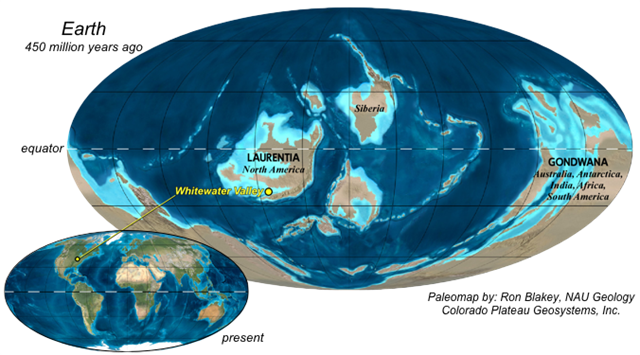
During the Late Ordovician, Indiana was located about 20 degrees south of the equator. Sea level was higher than it is today, and much of North America was covered by a shallow sea wracked by tropical storms. Also during this time, a volcanic island arc collided with the eastern edge of North America. This collision resulted in mountain building and the uplift of the Taconic Mountains, located in roughly the same place as the modern Appalachian Mountains. Sediment and volcanic ash washing off these mountains was deposited in the sea and eventually became the rock we see around the Whitewater Valley today.
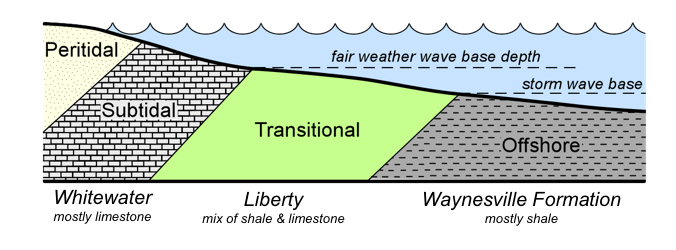
The rock found in the Whitewater Valley is the top of an alternating sequence of shale and limestone formations found in the area around Cincinnati. Deposited during the Richmondian time approximately 445 million years ago, the rock layers found in the Whitewater Valley are called the Waynesville, Liberty, and Whitewater Formations, from oldest to youngest. The Waynesville Formation is composed primarily of shale from a muddy, offshore environment. The water was deep enough that the sea floor would have been below the wave base. Consequently, the fossils found in the Waynesville Formation are often quite delicate, yet unbroken. The Liberty Formation is a mix of shale and limestone. It was deposited in a transitional environment reached by storm waves, but untouched between storms.
The Whitewater Formation is mostly limestone, indicating it was deposited in relatively clear, shallow water. It contains lots of fossils that show evidence of being battered and broken by wave action.
The abundant and diverse fossils preserved in these rocks show us what kinds of animals lived in this ancient sea. Brachiopods, bryozoans, crinoids, and corals anchored to the sea floor filtered fine particles of food from the water. Snails, clams, and other creatures burrowed into or lived upon the muddy sea bottom. Trilobites ranging from tiny ant-sized creatures to giant arthropods up to 2 feet long crawled over the sea floor. Cephalopods (squids) up to 15 ft in length cruised in the waters above. Although primitive fish likely lived in the late Ordovician, fish fossils have yet to be discovered in Cincinnatian rocks.

Logging requirements
- Where was Indiana located during the late Ordovician period?
- What kind of fossils do you see at this roadside location?
- What size are most of the fossils here?
- Post a picture of yourself (face not required) or a personal item at the roadcut.