All Saints Church - Honington.
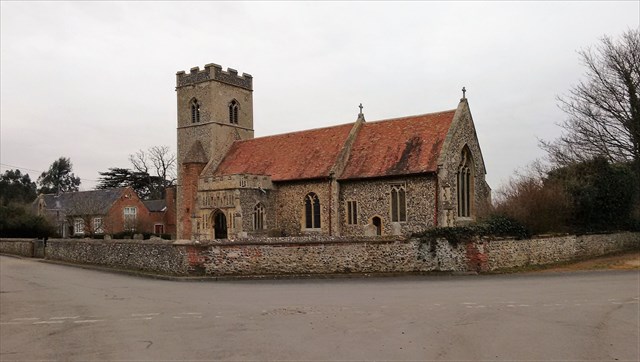
The following information comes from Simon Knott's Suffolk Churches website:
The church is off the main road, down what was once the high street, among old houses which have been carefully restored. In one of these, the poet Robert Bloomfield was born. Little-known today, his work The Farmer's Boy was a publishing sensation at the start of the 19th century. It sold more than 26,000 copies in less than three years. It is hard to imagine a poet today selling a tenth as much. There is a memorial to him inside the church.
This is not a big church. Externally, it is beautiful in the way that nearby Badwell Ash is, although the tower here is 150 years older. What they both share is a beautiful porch, replete with flint flushwork and Marian iconography, completed on the eve of the Reformation. This is the devotional English Church at perhaps its highest point. But this church is a much older one than its porch, as you see as you go through the outer doors, and find the great Norman doorway. It is one of the half dozen best in all Suffolk, and similar to that at nearby Sapiston; more awe-inspiring, perhaps, although less beautiful.
Inside, all is neat, bright and devotional. You might even think it a little tame and polite, after the grandeur of the porch, the mystery of the doorway. With its plastered ceilure, the grand Norman chancel arch is a rather curious thing. One could be forgiven for thinking, for a moment, that it is an 18th century classical conceit. It is interesting to compare it with less domesticated contemporaries at Eyke, Wordwell and Wissington.
However, despite its domestication, Honington church retains one fabulous survival. This is the 14th century font. It has familiar tracery patterns on 7 sides, but the 8th has a heart achingly beautiful crucifixion scene. Above the cross are the sun and moon in the sky, and Mary lifts her hands imploringly, while John holds his head in despair. If this was in the V&A, people would travel from all over the world to see it. Mortlock thought that, for it to have survived, it must have been plastered over; either at the Reformation, or when the Puritans started flexing their muscles.
Honington's new Millennium stained glass window is very good, a boiling of images from the joint parish of Honington and Sapiston, including wildlife, farming on the Euston estate, the airbase, and the vicar standing outside the Norman doorway of her church. The River Blackbourne trickles through it all.
Mortlock bemoans the whitewashing of the wall paintings that Cautley saw here in the 1930s. One of them was of St Thomas of Canterbury; a rare survival, since he was violently excised by the Anglican reformers. The whitewashing was probably an expedient measure, to protect them until such a time as there was money and a will to restore them. When Cautley saw them, they were already faded.
This church suffered one of Suffolk's very last destructive restorations, when all the medieval benches were removed on the eve of World War I. Some of the bench ends survived, and have been incorporated into the choir stalls in the chancel, where you'll find all manner of mythical beasts, as well as a bagpiper. They are part of the work of the same carver as at Ixworth Thorpe.
You are looking for a bison here. The cache is not within the church grounds.
From here take the road to the right in front of the church and carry on the road round to the green. Here you will see a wooden gate to the right with a 'Blackbourne Tree Group' sign on it. Go through the gate and down to the field. Cross the field diagonally to the opposite side and you will find a track - not in the corner - about a third up from it . Follow till you see a managed garden area to the right.
Parking information can be found at the waypoint listed in the first cache of the series.
****************** ********************
For full information on how you can expand the Church Micro series by sadexploration please read the Place your own Church Micro page before you contact him at churchmicro.co.uk
See also the Church Micro Statistics and Home pages for further information about the series.
****************** *******************