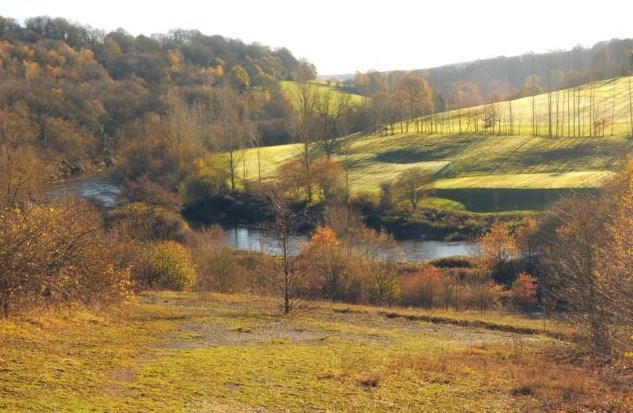
Severn Valley Country Park, officially opened in 1992, was reclaimed and created from the spoil and slag heaps generated by Highley and Alverley Collieries. Where you are standing is the top of one of the slag heaps. There is no need to descend any further down the slope. Take care it is steep and can be slippy.
From Highley colliery the miners worked the underlying coal seam from 1878 until 1963. This was a flourishing coal field of high grade Brooch coal. This coal seam had a thickness of between 1-2 metres. It was mined at a depth of 300 metres. As the seam was worked out in Highley it was extended under the River Severn and across to Alveley from 1957 where it was mined up to 350 metres below the surface. At the height of its production Alveley colliery had over 1000 miners generating 300,000 tons of coal. Production finally ceased in this area in 1969.
GEOLOGICAL BACKGROUND
The Highley and Alveley collieries were part of the Wyre Forest Coalfield which covered an area of 50 square miles. This coalfield was formed over 345 million years ago in the Carboniferous period. Coal typically forms in a delta environment. Coal is a sedimentary rock formed from the remains of trees and vegetation and requires specific conditions for its formation:- * There must be plenty of vegetation living and dying nearby * The dead plant material must accumulate in a swampy environment lacking in oxygen to prevent the breakdown of the dead vegetation into soil. * The accumulated vegetation must be sealed in by sediments above, such as sand or clay * The vegetation has to be deeply buried. It is the heat and compression imposed by deep burial that brings about the formation of coal This dynamic environment produces the sequence of rock types associated with coal formation, known as a Cyclothem.
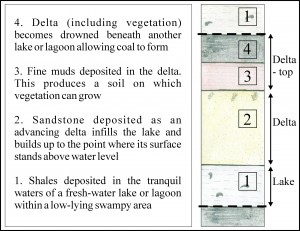
During the Carboniferous period, the area now known as Highley was sitting astride the equator experiencing a warm and humid climate. Lush vegetation grew in the resultant swampy conditions. Coal was not the only Carboniferous rock from this area that has been extracted for commercial gain over the ages. Sandstone too has been quarried and used as building stone and tiles. The sandstone formed around 300 million years ago from sand particles that travelled from the south in rivers before being deposited in the delta.
CLASSIFICATION AND RANK OF COAL
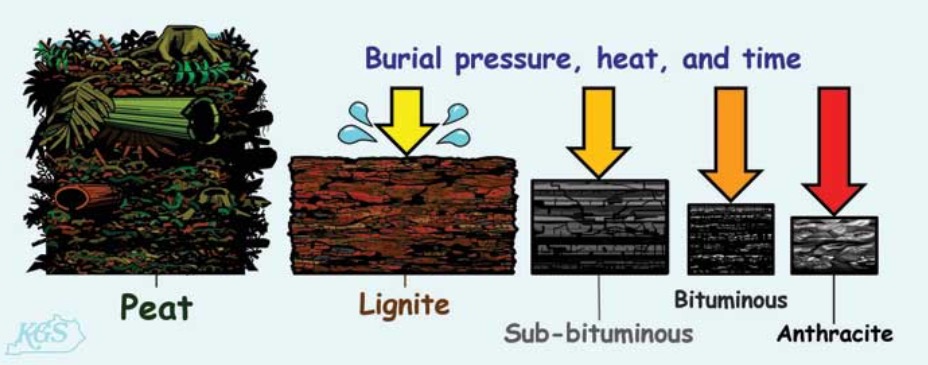
The kinds of coal, in increasing order of alteration, are lignite (brown coal--immature), sub-bituminous, bituminous, and anthracite (mature). Coal starts off as peat. After a considerable amount of time, heat, and burial pressure, it is metamorphosed from peat to lignite. Lignite is considered to be "immature" coal at this stage of development because it is still somewhat light in color and it remains soft. As time passes, lignite increases in maturity by becoming darker and harder and is then classified as sub-bituminous coal. As this process of burial and alteration continues, more chemical and physical changes occur and the coal is classified as bituminous. At this point the coal is dark and hard. The majority of coal mined in the UK was this classification. Anthracite is the last of the classifications, and this terminology is used when the coal has reached ultimate maturation. Anthracite coal is very hard and shiny.
To log this Earthcache you will need to email/ message the CO with the answers to the 4 following questions:-
Question 1 Observe and examine the surroundings at the listed coordinates what evidence is there of the mining heritage of this site?
Question 2 Coal requires 4 specific conditions for its formation, what are they?
Question 3 Now examine and describe the coal remnants which are evident under the tree root, what classification and rank of coal is present? (Please do not remove these remnants.)
Question 4 What is Brooch coal?
If you have time why not visit the Miners Memorial at waypoint N52 26.645 W002 22.502 an old winding wheel from a pit head. This memorial is centred on the heart of the colliery with evidence of the shaft entrance and the screening beds. The colliery office can still be seen by the entrance to the car park off Station Road, Highley.