A great proportion of the southern part of the North Island is formed of rather soft Tertiary rocks. The rocks are very similar in character throughout the area: blue-grey sandstone or mudstone, commonly known as "papa". They form a characteristic topography of steep slopes and sharp ridges, reflecting the easily erodible nature of the rock. Harder rock types, such as limestone, stand out prominently, particularly in Hawkes Bay and the Wairarapa.
Rock units are divided into three major classes based on their mode of formation.
Sedimentary rocks result from deposition and consolidation of particles mostly eroded from an adjacent land area. Different sources of material and depositional environments result in different types of sedimentary rock, such as sandstone, mudstone, and limestone.
Igneous rocks form when molten rock (magma) from deep within the Earth's crust cools after being intruded into existing rocks or sediments, or after being extruded on to the surface.
Metamorphic rocks such as schist and gneiss, have been recrystallised under conditions of high temperature, pressure, or both. They vary depending on the nature of the parent rock (either sedimentary or igneous)
In this area, the Wairoa district, northern Hawke’s Bay the Pliocene Limestones describe this sedimentary geology of shallow-marine limestone deposits.
The focus is three cool-water “Te Aute type” limestone units in the succession:
1) the early Opoitian age Opoiti Limestone (5-10 m thick),
2) the late Opoitian age Whakapunake Limestone (30-100m thick) and
3) the Waipipian age Tahaenui Limestone (10-30 m thick)
These 3 “Te Aute type” limestone units form locally spectacular outcrops in the Wairoa district.
The massive Opoiti Limestone comprises poorly sorted, variably sandy, barnacle, epifaunal bivalve and locally brachiopod debris which is well-cemented.
The late Opoitian Whakapunake Limestone comprises (cross) bedded and differentially cemented interbeds of fossiliferous and more siliciclastic-rich facies. The limestones are typically poorly sorted bivalve-barnacle biomicrite to biosparrudite cemented by variable amounts of fringe and later equant limestone ,sandstone and mudstone.
Waipipian age Tahaenui Limestone is a bivalve-barnacle biosparite to biosparrudite with some neomorphosed former aragonite skeletons and a moderately open fabric.
The calcite dominated cool-water skeletal make-up of these limestones, combined with their relatively shallow burial depths (150-700 m), has resulted in them retaining significant macroporosity (up to 20%). Consequently, as well as having application as a lime or hard rock resource they also have reservoir potential for hydrocarbons in the subsurface.
Limestone may have a dramatic effect on topography, commonly forming steep bare bluffs. It is soluble in water which enables erosion to take place along joints in the rock resulting in strange-looking "karst" landforms. This can have a significant effect on areas that have been modified such as in areas where roads have been carved into the land formations and artificial cliffs are made. Sinkholes occur where streams disappear below the surface to join extensive underground drainage systems, or where collapse of cave roofs has resulted from dissolving the rock. Caves, of course, are common in limestone country.
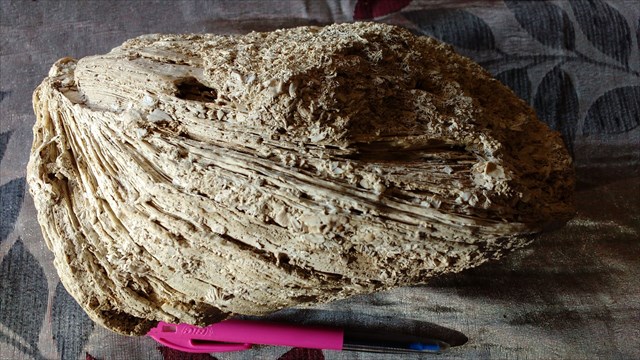
Over a long period of time there have been many excellent examples of ancient marine life found in these deposits. Some are classified as being up to 300,000 years old. Oysters, Mussels and Moluccas the size of dinner plates – each one enough for a meal for 1 family. There are various places which have these on display including the Museum in Napier. However for a local viewing you are most welcome (if the gates are open) at S 39 55.033 E 176 32.324. At this venue you will see fine examples of these marine specimans.
Please answer the following questions:
Question 1:
Which of the following best describes the class of rock you are looking at:
- Sedimentary rocks
- Igneous rocks
- Metamorphic rocks
Question 2:
Looking at the cutting, name the form/forms of cool-water “Te Aute type” limestone you consider would best describe the formation?
Question 3
In your opinion, what has caused this dominant ‘V’ shaped formation in the cutting?
Question 4.(Optional)
Please send me a photo of yourself with your GPS at the coordinates with the cutting in the background.
I hope you have enjoyed your visit to this very special place.