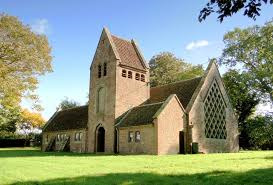
The Church
The Church of St Edward the Confessor in Kempley was built to the design of Randall Wells (1903-4) and is Grade II* listed. The small village has two notable Anglican churches, the other, older, is dedicated to St Mary. St Edward's was described by John Betjeman as a mini-cathedral of the Arts and Crafts movement.
The Church was built as a chapel of ease by the Lord of the Manor and major landowner, William Lygon, 7th Earl Beauchamp, because St Mary's was too far away from the main centres of population in the parish and liable to flooding. St Edward's became the Parish Church in 1975 following the redundancy of St Mary's.
Some of the foundations had already been put in before Wells was asked to design a church to fit upon them as nearly as possible, fulfilling requirements of Lord Beauchamp that there should be no east window, that most of the lighting should be from the west end and that the eaves should be kept low.
It was built from local materials by local labour. The red sandstone used was from the Forest of Dean quarries, about seven miles distant. The roof timbers were of unseasoned oak, cut on the Beauchamp estate. The church was roofed with local stone slates which remain on the lych gate; the church now has pantiles.
The church has three sculpted stone reliefs designed by Wells: above the entrance Christ carved by Wells and a local carpenter Walter James; within the porch, a Virgin and Child by Laurence Turner; and on the East wall, the Crucifixion, again by James.
The rood, carved by David Gibb, originally from Glasgow and said to have been the last ship's figurehead carver in London, was painted by Wells and his brother Linley, through whom Wells had obtained the commission. The seating, the prayer desk, the rails and the altar were designed by the architect and made in English oak by Peter Waals at Ernest Gimson's and Ernest Barnsley's Daneway Workshop, Sapperton, during their brief partnership. The lectern was designed by Ernest Barnsley., the candelabra and a pair of iron candlesticks were made by Alfred Bucknell, supplied by Gimson, with other ironwork by the Kempley village blacksmith, Jack Smallman.
The Cache
To find the cache, find the answers to the following questions:
Q1: Go to the stone carving above the door - How many words are there? = A
Q2: How many letters in the first word? = B
Q3: What position in the alphabet is the first letter of the first word? = C
Q3: How many letters in the last word? = D
Q4: Go round the corner and find the big window. How many half diamonds are there along the bottom? = E
The cache can be found at:
N51.57.(AxC)(E+C)(B-A) W002 28.(D-A)(C+E)(D-B)
*** Congratulations FTF Buttyboat ***
****************** ********************
For full information on how you can expand the Church Micro series by sadexploration please read the Place your own Church Micro page before you contact him at churchmicro.co.uk
See also the Church Micro Statistics and Home pages for further information about the series.
****************** *******************