Hogbacks on the Clyde
Medieval Viking Calling Cards in Govan
"Harald tucked his chin into his chest as he pulled on his oar; it made it easier to cope with the relentless rain that poured down on the ship as it cut through the choppy waters of the Clyde. He was part of a crew of thirty on his jarls ship the Gokstad and part of a fleet of seven long ships that ploughed their way up the bleak Scottish river. Harald looked at the low dark grey skies above, the slashing rain and the deep green rolling hills that faded into the distance and wished he was back in his native Denmark.
In the short distance to his right Harald could see a small fishing village and what looked like a Christian place of praying. There was a place for boats to berth. His Jarl shouted for the crew to put on their amour and prepare their weapons. Harald stood up from the chest upon which he used as a seat and which contained all of his personal belongings. He took out from it his axe and helmet. He was ready. Young Harald donned his helmet and prepared to land."
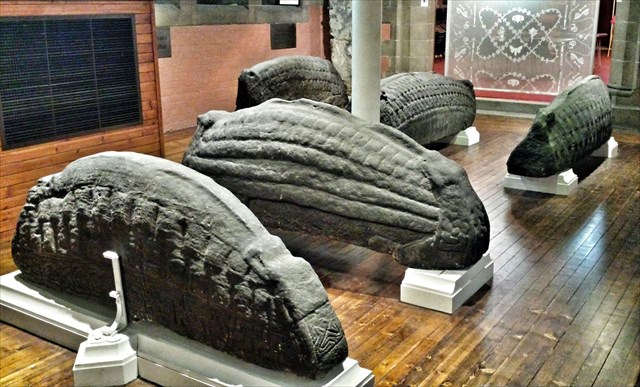
Over one thousand years later Govan in Glasgow is a vibrant community. During Govan’s remarkable history it at one time, was one of the great shipbuilding centres of the world. In the magnificent Govan Old Church, situated well out of the route of popular tourist travel, five Viking hogback stones bear testament to the striking Viking legacy of courage and seamanship that brought the Norse to Scottish shores. The exhibition also opens up the connection of shared skills and expertise in naval architecture that made both these countries world leaders in their time; although millennia apart.
Maybe there is a bigger story to tell about hogbacks on the Clyde.
The exhibition can be visited daily, April1st - October 31st, 1pm-4pm. Admission Free.
http://www.thegovanstones.org.uk/
Cache placed with the kind permission of - The Govan Stones Project.
To find the cache you need to solve this puzzle which will lead you to a virtual stage, associated with the above. You will get the final coordinates in the Geochecker.
If you can't read the text below, it must be because you are not a danish viking from the 10th century............