You are not entering the quarry, you are going to be on the county side road that runs along it's border.

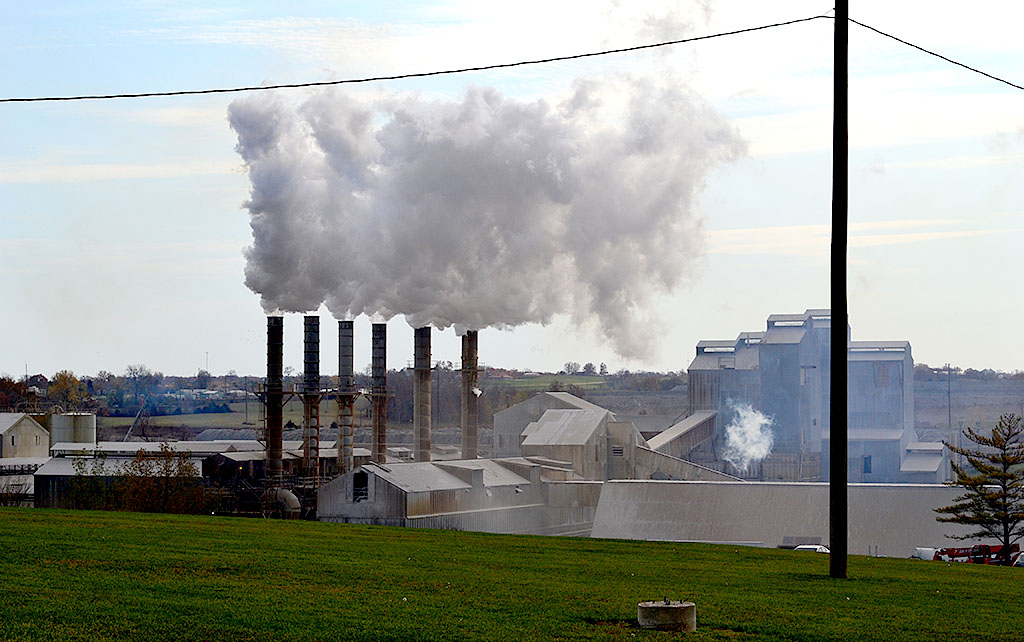
Located to the west of Ste. Genevieve off of highway 61 is the Mississippi Lime quarry. From the town of Ste. Genevieve take highway 61 north till you come to Lime Kiln Road (intersection is at N37° 58.740', W90° 4.723'). Then proceed to the posted coordinates, and park along the side of the road to make your observations.
This is Salem Limestone, +98% pure calcium carbonate. It is cross-bedded and Oolitic, which means it is composed mainly of tiny round carbonate grains, smaller than the head of a pin. This is the same type that the Mississippi Lime quarry is going after underground. They use this type of limestone to make quicklime and ground limestone that goes into foods and pharmaceuticals. So basically if you have had a tums tablet chances are high that you have eaten rock that has come from this quarry.
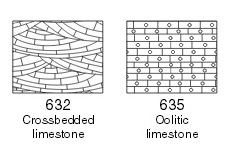
Limestone:
Limestone, a sedimentary rock that is dominantly composed of the calcium-bearing carbonate minerals calcite and dolomite. Calcite is chemically calcium carbonate (formula CaCO3). Dolomite is chemically calcium-magnesium carbonate (formula CaMg(CO3)2).
Calcite and Dolomite:
The minerals calcite and dolomite are the main ingredients of limestone. Both are calcium-bearing carbonate minerals, meaning that they contain the chemical elements calcium (symbol Ca), carbon (symbol C) and oxygen (symbol O). Each carbon atom is combined with three oxygen atoms to form what is called carbonate (formula CO3). In calcite, carbonate is chemically combined with calcium to form calcium carbonate (formula CaCO3). In dolomite, carbonate is chemically combined with calcium and the element magnesium (symbol Mg) to form calcium-magnesium carbonate (formula CaMg(CO3)2). In dolomite there is one magnesium atom for every calcium atom.
Facts:
- The amounts of calcite and dolomite in theoretically pure limestone range continuously from all calcite and no dolomite to all dolomite and no calcite.
- Limestone, however, is very rarely pure calcite, pure dolomite, or a pure mixture of the two. It typically contains a variety of accessory rock materials of which quartz, chert, clay and pyrite are among the noteworthy.
- Basically, commercial limestone is much richer in calcite and dolomite and poorer in other rock materials than most of the limestone as defined by the academic community. Because of its higher purity, commercial-grade limestone is generally stronger, holds up better as a building material, and is less susceptible to being degraded by weathering.
Classification of Limestone:
Limestone may be divided into four different kinds based on weight percents of calcite and dolomite in the total carbonate portion. They are listed below in order of increasing dolomite content and decreasing calcite content. They are also depicted on the accompanying ternary diagram.
- Calcite Limestone: Calcite > 90%, Dolomite < 10%
- Dolomitic Limestone: Calcite 50–90%, Dolomite 10–50%
- Calcitic Dolomite: Calcite 10–50%, Dolomite 50–90%
- Dolomite: Calcite < 10%, Dolomite > 90%
Calcite limestone is further divided into two high-purity categories as listed below and as shown on the ternary diagram.
- High-Calcium Limestone: Calcite > 95%, Other Rock Materials < 5%
- Magnesian Limestone: Calcite 90–95%, Other Rock Materials < 5%
Color:
Variable; typically white, gray or tan; can also occur in shades of yellow, green, blue, brown, pink and red. Some limestone is black.
Sedimentary Bedding
“STRATIFICATION refers to the way sediment layers are stacked over each other” (University)
Cliffs such as this can often tell you how the sediment making up the rock was deposited prior to diagenesis. All you have to do is look at the rock’s structure and appearance for a characteristic known as bedding. There are two types of bedding, graded and cross-bedding.
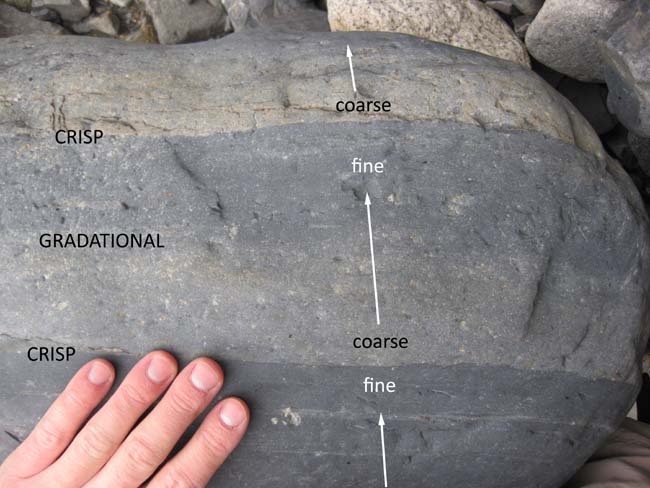
Graded Bedding is seen when the structure of the sedimentary rock appears to take on a horizontal sheet-like appearance. That is to say, the rock appears to be “layered” like pancakes, and often has larger particles underlying smaller ones. The term “graded” comes from the fact that the particles arrange themselves by relative size as they settle. Often there may be numerous beds of varying depth stacked horizontally on top of one another. Sometimes the grades or strata may be very thin and not easily seen. But color, amount of erosion in exposed surfaces, or even slight textural changes in the rock, may signify a change from one bed to another. (University)
Cross-bedding occurs when sediments are laid down at angles or arcs, sometimes cutting into one another, and not necessarily in even “layers”. This type of bedding often occurs in areas where a sandbar or dune existed prior to diagenesis. (University)
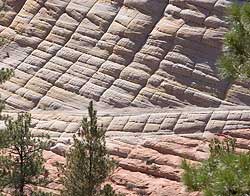
Source: http://www.scienceviews.com/parks/images/SIA2477.jpg
**Logging requirements**
DO NOT POST ANSWERS IN YOUR LOG.
Send the following answers to me via email.
- The text "GC6FH36 Salem Limestone" on the first line
- What color is this limestone?
- Is it easy to scratch with a key?
- What type of grading is visible here?
- How tall is the rock cut here along the road?