Huckford Quarry EarthCache
-
Difficulty:
-

-
Terrain:
-
Size:  (other)
Please note Use of geocaching.com services is subject to the terms and conditions
in our disclaimer.
This earthcache brings you to Huckford Quarry where stone was once extracted. It is now a local nature reserve.
Please keep to the paths and keep children and dogs closely supervised as the river Frome passes through as well as a few steep drops too.
Please e-mail the answers through our profile, we hope you enjoy your visit.
Closely associated with the coal measures in the Bristol area is the famous Bristol pennant stone, a hard sandstone that occurs either with a pleasing blue colour or as a slightly harder pink coloured stone, known locally as Red Pennant.
Over the course of many generations, the value of this material was appreciated by builders, architects, surveyors and engineers alike, who used it for a variety of purposes, and for centuries many buildings erected in the Bristol area were constructed using pennant stone. Although brick and other materials gradually displaced pennant in house and wall building, up until World War Two it was still being widely employed for such things as street kerbs and paving stones as it is very durable and is not slippery when worn. Similarly, its weather-resisting properties, uniformity of colour and very fine grain have also endeared it to monumental masons over the years.
Quarries producing pennant were concentrated in the north of the Bristol coalfield, with the vast majority being located in, or near, the side of the valley of the River Frome, in Fishponds, Stapleton, Frenchay and Winterbourne.
The quarries themselves were usually nothing more than large holes in the ground with inferior stone near the top layers, but with fine layers of Bristol pennant to be found in heavy seams up to eight feet deep lying from a depth of about 30 feet down to as far as it was practical to extract the stone.
In 1858 there were about 16 pennant quarries in operation north of the River Avon, and their total annual production amounted to over 24,000 tons. The main products at that time were paving stones, block stones for facing buildings and rough house building stone. By 1890 this number had dropped to about eight, but the industry was still being run by individual quarry masters in direct competition with each other.
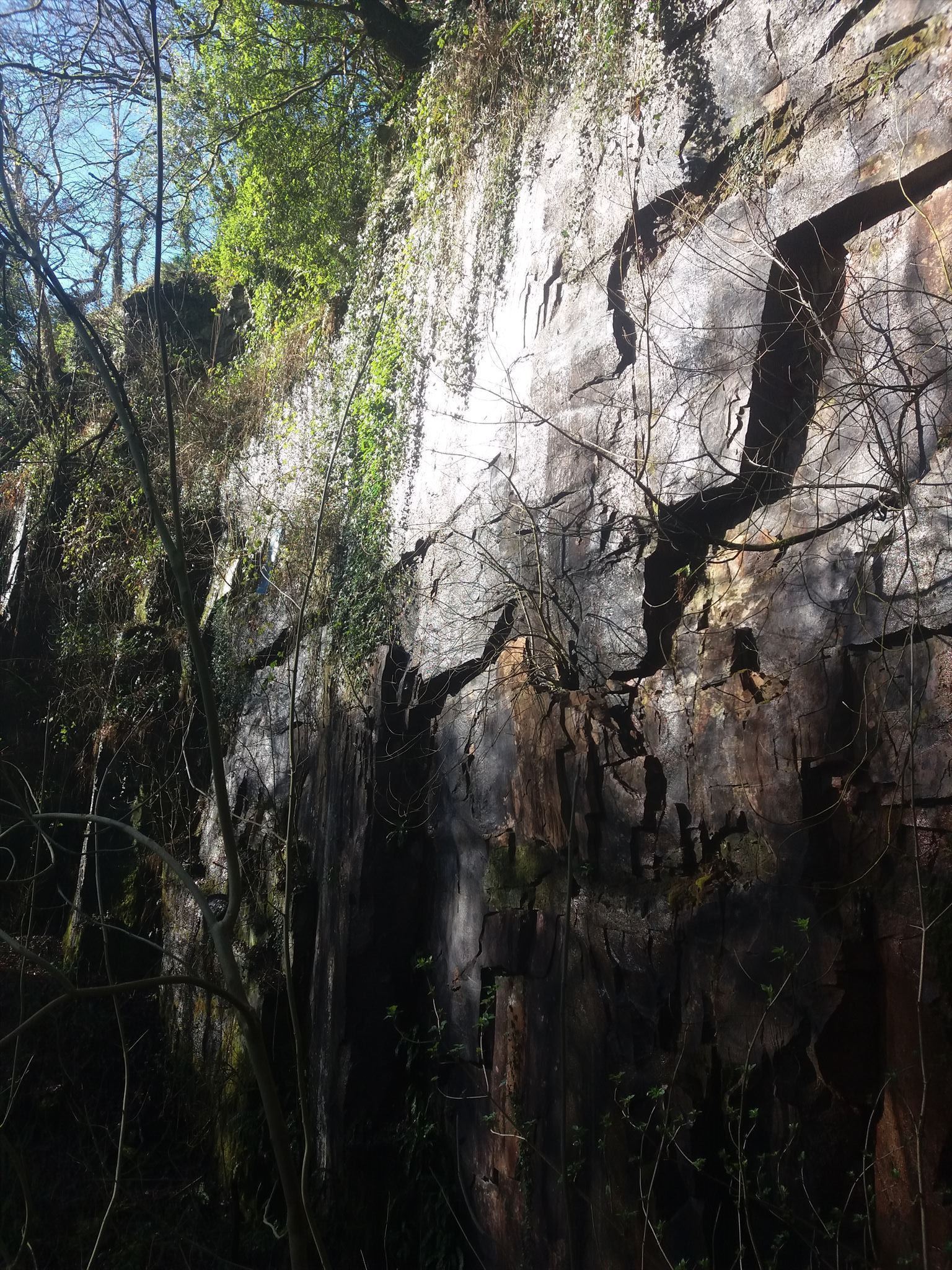
Question 1 at the start coordinates: Look at the layers of stone. How do they differ at the top and at the bottom of the rock face? Please give a reason for this.
Question 2: Observe the texture of the rock face, describe what it feels like.
Question 3:What color is the rock face here? What might cause the stone to be this colour?
Question 4 at stage 2: Here, count the layers in the rock face. How many large layers can you see?
Question 5: In which geological period was the red pennant stone formed?
Additional Hints
(Decrypt)
Oevat n cra naq abgrcnq gb wbg qbja lbhe nafjref!
Treasures
You'll collect a digital Treasure from one of these collections when you find and log this geocache:

Loading Treasures