|
![]()
 In Cooperation With

Welcomes You To The El Mirage Dry Lake Bed
Beyond the northwest area of the Shadow Mountains heading southeast towards the El Mirage Visitors Center and ending just east of there lies the Mirage Fault. Most earthquakes occur along cracks in the planet's surface called faults. These cracks may be small and localized or can stretch thousands of miles where tectonic plates meet. Usually, the rocks on either side of the fracture are moving past each other too slowly for us to notice, but sometimes stress (pressure) builds up and they'll suddenly slip, making a big move all at once. The effect of that sudden shift depends on the type of fault the movement occurs in.
![]()
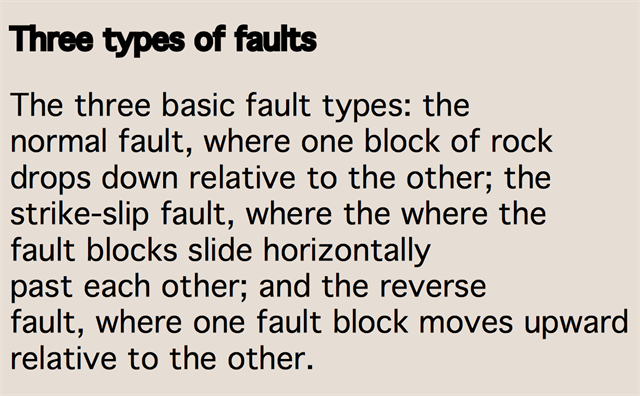
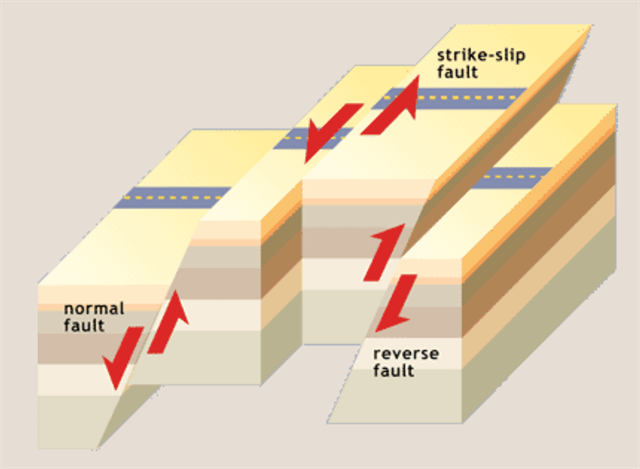
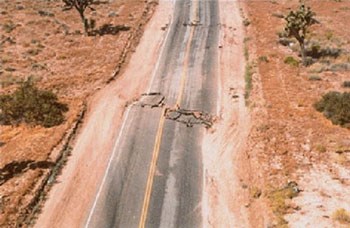
The Mirage Fault is comprised of two fault blocks that are moving past each other horizontally. Strike-slip faults tend to occur along the boundaries of plates that are sliding past each other. After a quake along a strike-slip fault, railroad tracks and fences can show bends and shifts. And, of course, the motion can cause bridges and buildings to collapse.
![]()
With both normal and reverse faults, movement occurs vertically. A normal fault is usually associated with plates that are diverging. Tension weakens the crust until the rock fractures, and one block of rock moves downward relative to the other. A reverse fault is usually associated with plates that are colliding. Compression forces a fault block upward.
![]()

Rock may seem brittle, but it’s actually quite elastic. Scientists have learned that this ability of rock to stretch and store energy like a spring is what enables earthquakes to happen. Earthquakes are now explained by the elastic rebound theory, which goes something like this: Stress is applied to rock or to an existing fault over a period of time. This usually happens at a plate boundary where two plates are moving in different directions, or in the same direction at different speeds. As the stress builds, strong rock or a locked fault (a fault where the two sides are held together by friction) deform elastically. Eventually, the stress overcomes the rock's strength or the fault's friction, and either the rock fractures or the fault slips. The energy that's released sets an earthquake in motion. The rock or fault rebounds, and the process may begin again.
![]()
To log a find on this cache, you must E-MAIL me the correct answers. If any of your answers are wrong, I will email you and let you know.
![]()
1. Put "El Mirage Dry Lake Bed - Mirage Fault" in the subject line of your email.
![]()
2. Of the three types of faults mentioned above, which one do you think Mirage Fault is?
![]()
3. What was the name of the June 28, 1992 earthquake that ruptured faults across a large area east of El Mirage Lake?
![]()
4. What force of nature caused the erosion at the posted coordinates?
![]()
5. Optional: Post a picture of you at El Mirage.
![]()
Works Cited
https://www.exploratorium.edu/faultline/basics/faults.html
![]()
http://www.blm.gov/ca/st/en/fo/barstow/mirage.html
![]()
http://pubs.usgs.gov/of/2000/0222/
![]()
https://en.wikipedia.org/wiki/El_Mirage_Lake
![]()
http://pubs.usgs.gov/of/2000/0222/of00-222_2b.eps
![]()
|