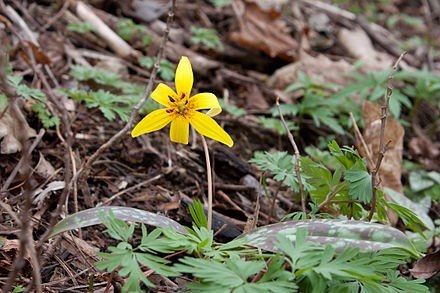
Erythronium americanum (trout lily, yellow trout lily, yellow dogtooth violet) is a species of perennial spring ephemeral flower native to North America and dwelling in woodland habitats. The common name "trout lily" refers to the appearance of its gray-green leaves mottled with brown or gray, which allegedly resemble the coloring of brook trout.[2][3]
Trout lily blooms in early spring with nodding one-inch yellow flowers, the petals (3) and petal-like sepals (3) recurved upward. Each plant sends up a single flower stem with a pair of leaves, but for the first 7 years of the plants life it will not flower.[3][4][6] In North America E. americanum does not reproduce very effectively via sexual reproduction with only 10% of pollinated flowers developing seeds.[7]
In North America trout lilies grow in colonies that may be up to 300 years old.
[1][2] The individuals within a colony will often reproduce asexually via a "dropper" or from small corms budding off of the main corm. A dropper is a tubular fleshy stem that grows out from a parent corm, up toward the surface and then penetrates deep into the soil where another corm is formed from the tip of the dropper. Once the the daughter corm and the stem connecting the daughter and parent corm dies.[7]
Trout lily is a myrmecochore, meaning ants help to disperse the seeds and reduce predation of the seeds. To make the seeds more appealing to ants they have an elaiosome which is a structure which attracts the ants.
The cache is a small "small" camoed pill bottle, the Push and Turn kind. It's tied in. Rolled log with rubbar band and tiny plastic zip lock bag. Please BYOP and remember to put the rubber band on your finger to avoid losing it.