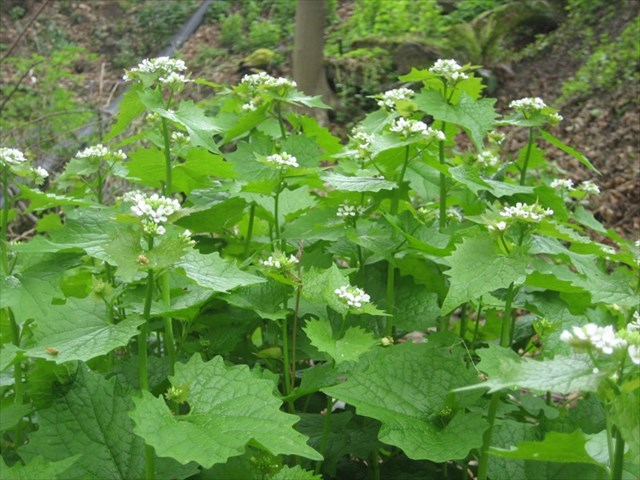
In the first year of growth, plants form clumps of round shaped, slightly wrinkled leaves, that when crushed smell like garlic. The next year plants flower in spring, producing cross shaped white flowers in dense clusters. As the flowering stems bloom they elongate into a spike-like shape. When blooming is complete, plants produce upright fruits that release seeds in mid-summer. Plants are often found growing along the margins of hedges, giving rise to the old British folk name of Jack-by-the-hedge. Other common names include Garlic Mustard,[2] Garlic Root, Hedge Garlic, Sauce-alone, Jack-in-the-bush, Penny Hedge and Poor Man's Mustard. The genus name Alliaria, "resembling Allium", refers to the garlic-like odour of the crushed foliage. Some people give the species name Alliaria officinalis for this plant.[3]
All parts of the plant, including the roots, give off a strong odour. In 17th century Britain it was recommended as a flavouring for salt fish. It can also be made into a sauce for eating with roast lamb or salad.[4] Early European settlers brought the herb to the New World to use as a garlic type flavoring, and as a good source of vitamins A and C. The herbs medicinal purposes include use as a disinfectant, a diuretic,[5] and sometimes being used to treat gangrene and ulcers. The herb was also planted as a form of erosion control.[6
The plant is classified as an invasive species in North America. Since being brought to the United States by settlers, it has naturalized and expanded its range to include most of the Northeast and Midwest, as well as southeastern Canada. It is one of the few invasive herbaceous species able to dominate the understory of North American forests and has thus reduced the biodiversity of many areas.
Garlic mustard was introduced in North America as a culinary herb in the 1860s and is an invasive species in much of North America.
As of 2006, it is listed as a noxious or restricted plant in the US states of Alabama, Connecticut, Massachusetts, Minnesota, New Hampshire, Oregon, Vermont, West Virginia and Washington.,[13] and occurs in 27 midwestern and northeastern states in the US, and in Canada.[14] Like most invasive plants, once it has an introduction into a new location, it persists and spreads into undisturbed plant communities. In many areas of its introduction in Eastern North America, it has become the dominant under-story species in woodland and flood plain environments, where eradication is difficult.[15]
The insects and fungi that feed on it in its native habitat are not present in North America, increasing its seed productivity and allowing it to out-compete native plants.
The cache is a big "micro" camoed pill bottle. It is tied in and has only a rolled log with a rubber band to hold it tight and a tiny zip lock plastic bag to keep it dry. Please BYOP and put everything back as you found it.
You can park at either end of the trail. The Mitchel St. P is close to the cache.