The Broad Family
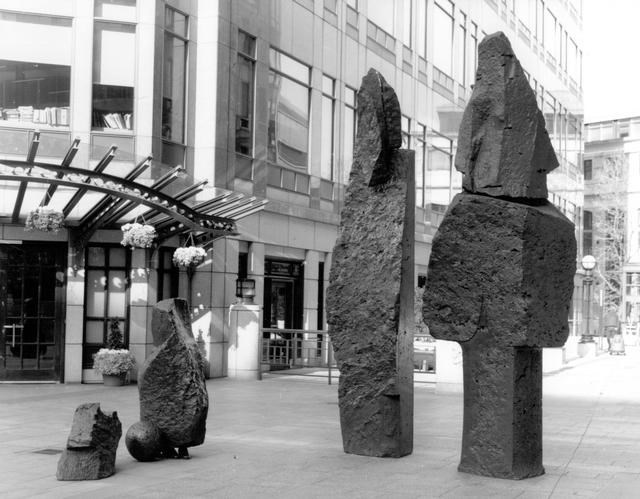
Xavier Corbero’s witty 1988 sculpture shows a family, including the pet dog. The most recognisable feature is the highly polished a pair of child’s shoes that peep out from beneath one of the smaller blocks.
(More information further down. BUT first the earth lesson.)

What are Igneous Rocks?
Igneous rocks are formed from the solidification of molten rock material. There are two basic types.
Intrusive igneous rocks crystallize below Earth's surface, and the slow cooling that occurs there allows large crystals to form. Examples of intrusive igneous rocks are diorite, gabbro, granite, pegmatite, and peridotite.
Extrusive igneous rocks erupt onto the surface, where they cool quickly to form small crystals. Some cool so quickly that they form an amorphous glass. These rocks include andesite, basalt, obsidian, pumice, rhyolite, scoria, and tuff.

What Is Basalt, How Does It Form and How Is It Used?
Basalt
Basalt is a fine-grained, dark-colored extrusive igneous rock composed mainly of plagioclase and pyroxene minerals.

Basalt is one of the most common igneous rocks and is major constituent of the upper layer of the ocean floors (usually as pillow lava), and hot spot volcanoes. It is a finely crystalline basic volcanic rock which is sometimes glassy. It is recognized primarily by its dark color and are essentially composed of plagioclase feldspar and pyroxene. It most commonly forms as an extrusive rock, such as a lava flow, but can also form in small intrusive bodies, such as an igneous dike or a thin sill. Vesicular varieties are typically terrestrial, forming either on volcanic islands or on the continents.
When cooled slowly it forms larger crystals and called dolerite or gabbro.
Colour: black, very dark grey; paler and greenish or reddish if altered.
Mineralogy: essential plagioclase and pyroxene in variable amounts, with olivine, spinel, ilmenite, magnetite or apatite.
Classification: basic igneous rock.
Occurrence: widespread, seafloor crust, oceanic islands, continental volcanoes and flood plateau lavas.
Texture: usually large crystals (phenocrysts) set in finely crystalline matrix, may have vesicles (air pockets).
Structure: commonly vesicular or amygdaloidal, filled with zeolites, carbonates or sililca. May form columnarjoints on cooling, surafce forms of lava may be rough and clinkery (aa) or have a ropy appearance (pahoehoe).
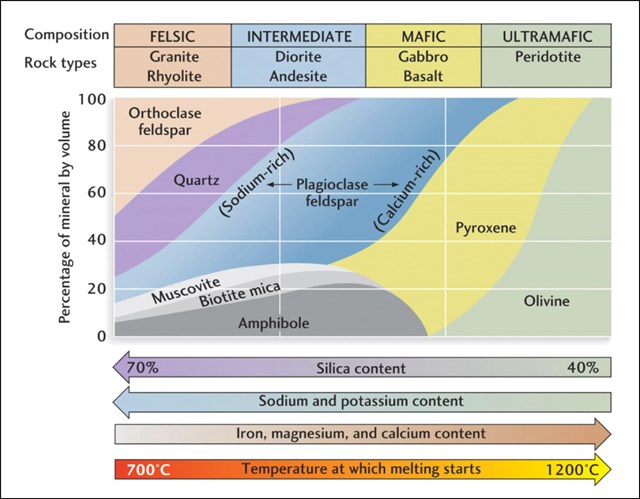
Photo: Igneous Rock Classification diagram
Basalt on Moon and Mars
Basalt is also an abundant rock on the Moon. Much of the Moon's surface is underlain by basaltic lava flows and flood basalts. These areas of the Moon are known as "lunar maria." Large areas of the Moon have been resurfaced by extensive basalt flows which may have been triggered by major impact events
Olympus Mons is a shield volcano on Mars. It, like most other volcanic features on Mars, was formed from basaltic lava flows. It is the highest mountain on Mars and is the largest known volcano in our solar system.
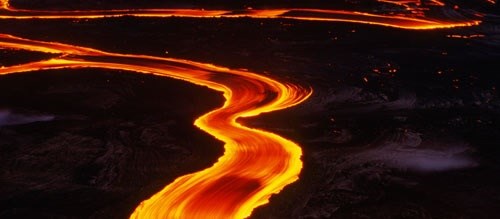
Basalt-Forming Environments
Most of the basalt found on Earth was produced in just three rock-forming environments:
1) oceanic divergent boundaries,
2) oceanic hotspots,
3) mantle plumes and hotspots beneath continents.
Uses of Basalt
Basalt is used for a wide variety of purposes. It is most commonly crushed for use as an aggregate in construction projects. Crushed basalt is used for road base, concrete aggregate, asphalt pavement aggregate, railroad ballast, filter stone in drain fields and may other purposes. Basalt is also cut into dimension stone. Thin slabs of basalt are cut and sometimes polished for use as floor tiles, building veneer, monuments and other stone objects.
To log this cache.
To get to log this cache you will have to visit and answer the questions which are related to the coordinates given the earthcache.
When answers are collected, send them to CO for verification.
As I own over 200 earthcaches there are MANY mails/messages to answer back on, and I will not always be able to answer right-back, BUT I READ ALL SENT ANSWERS AND LOGS, so if anything is not correct or need an upgrade, you will indeed hear back from me.
Thanks for your understanding, and for picking one of my caches.
You can log immediately answers are sent CO. If there are any questions about your answers CO will contact you.
Logs without answers to CO or with pending questions from CO will be deleted without any further notice.
Please do not include pictures in your log that may answer the questions.
Questions
1. Answer the questions under by visiting the Coordinates.
A. What stone from the photos under is it that you will find at gz?
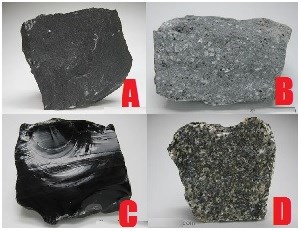
B. Have a close look at the stone! As you now know what stone it is out from question A, describe the texture, color, grains, and what two minerals is it mainly composed of? And that makes it a Intrusive igneous rock or a Extrusive igneous rock?
C. Have a look at the stone, and use the diagram: Igneous Rock Classification diagram (can be found in the cache text above!)
-What composition would you say the stone is classified in under?
-What approx temperature will the stone start melting at?
D. What height is the tallest and smallest stone? (Not the circular one)
2. Take a photo of yourself, the group or your GPS when logging the cache.
Without revealing any answers!
(It’s voluntary to post a photo in your online log)
The Broad Family
Corberó’s family members evoke a range of human feelings we all share
– togetherness and separation, safety and vulnerability, innocence and
experience. Approaching from a distance, you’d be forgiven for thinking
they were hunks of rock. As you come closer the individual characters
take shape, closer still and you’ll see a gentle humour woven into the
work – in the ball, the dog and a pair of polished, lace-up shoes peeking
out. Of great interest to visiting sculpture students, the scale of the
basalt pieces is impressive, yet the distance between each figure is also
important - a family group where each individual has its own space –
something we all welcome at times.
Considered by many to be Spain’s premier living sculptor, Corberó’s
roots are firmly in the Catalan artistic tradition. The son and grandson of
artists and artisans, he is now based in Barcelona, a city he has perhaps
influenced more than any artist since Gaudí. Many of his massive works
line major boulevards, and he created the medals for the 1992 Barcelona
Olympic Games
