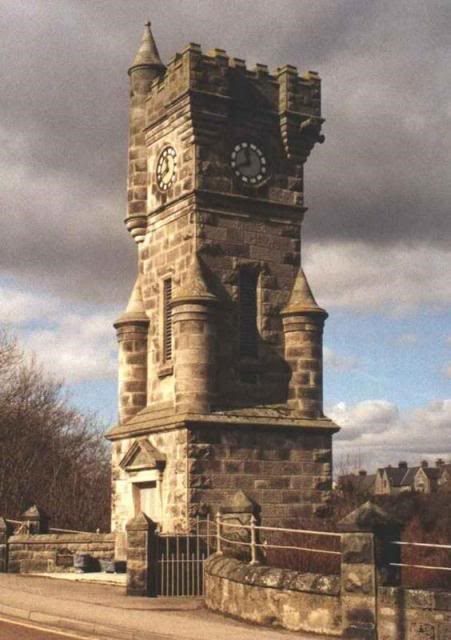
On this 100th anniversary of the Battle of Jutland we thought it appropriate to bring this Memorial to your attention.
The decorative Memorial has a mock castle architectural structure including a clock on each face, and stone inserts with the names of the local people who gave their lives in the World Wars of the last century. This is very much more elaborate than the usual War memorials and made of local stone and was dedicated on Christmas Day (December 25) 1922. It can be found in the centre of the village next to the road bridge beside the A9 and is item 40 on the Bora Village trail. There are several public car parks close to the Memorial.
Sorry to say that owing to Logs being placed without sending the necessary information any log placed without sending the information within 2 weeks will be deleted.
Now here is the Earth Lesson and the info needed to log the cache.
Granite
Granite has long been used for its strength and durability as well as its attractive appearance. Few stone types have been used for such a wide range of purposes, from structural and engineering foundations to decorative building interiors. Granite was quarried in all corners of the British Isles, initially from coastal locations and transported by sea to the major urban centres. Granite forms from the cooling of large magma bodies at depth in the crust, the slow cooling allowing the growth of large and interlocking mineral crystals. Granites typically contain 55-75% silica and are commonly pale coloured with medium to coarse grained crystals discernable to the naked eye. The interlocking crystals provide cohesion which adds strength and makes them suitable for polishing. Finer grained granite were typically used for structural purposes (e.g. foundations, walling, plaques, setts and paving), while coarser grained and porphyritic (i.e. with large crystals usually of feldspar) varieties were valued for ornamental work. The predominance of silica and other relatively stable minerals in granite make it particularly strong and durable. Granite is hard and not very porous and is composed of several different materials.
Sandstone
Sandstone is a sedimentary rock composed of sand-sized grains of minerals, rocks, or organic materials. It also contains a cementing material that binds the grains together and may contain silt- or clay-sized particles that occupy the spaces between the grains. The formation of Sandstone involves two principal stages:
1. First, layers of sand-sized grains accumulate as the result of settling particles, either from water (as in a stream, lake, or sea) or from air (as in a desert).
2. Once particles have accumulated, they become sandstone when the layers are compacted by pressure of overlying deposits and cemented by the precipitation of minerals within the pore spaces between sand grains. Like sand, Sandstone may be any colour, but the most common colours are tan, brown, yellow, red, gray, pink, white and black. Sandstone is commonly used in construction because it is abundant and relatively soft, making it easy to carve.
The local type of Sandstone is the white sand coloured Clynelish Sandstone, quarried from the Clynelish quarry about 1.3km west-north-west of the village. It was formed in the Collovian/Oxfordian age of the Middle Jurassic Period between 166 and 157 Million years ago. At that time Scotland was part of an Archipeligo with shallow warm seas allowing the sandstone to form. This type of stone was also used to build London Bridge (Now in Lake Hawasu, Arozona), Liverpool Cathedral and the nearby Dunrobin Castle. Initially the rock is quite soft but on exposure it becomes quite hard and tough making it ideal for building.
To get to log this cache you will have to visit and answer the questions which are related to the coordinates given the earth cache.
Learning Tasks to log the Earth Cache
When the answers are collected, send them to the CO using our profile address for verification.
You can log the cache immediately, once the answers are sent to the CO. If there are any questions about your answers CO will contact you.
Logs without answers to CO or with pending questions from CO will be deleted without any further notice.
Please do not include pictures in your log that may answer the questions.
1. The monument is mainly made of one type of stone with plaques set into the face, Can you describe the contrasting type of rock providing names for them and suggest the reason why these rocks were used. Some of the plaques are of differing colours can you explain why this might be?
2. There is a special Item in the Rock on the left of the monument below the plaque for Sgt Donald Bruce Kinnear. Can you describe what this item is and give an approximate size of the item and explain why/how the item might have got into the rock, and how does it help determine how this rock was formed?
3. There is an odd occupation for one of the names listed on the second World War list. What is this occupation and can you offer any reason why he might have been included on the memorial?
4. You can optionally include a photograph of you or your GPSr if you wish, please do not include the item for question 2.
Congratulations to Beno& Dandy to be the First to Find on the day it was published.