Caminhada turística pelo centro de SP. Não recomendada a noite. Prefira ir de metrô.
Touristic walking routes in São Paulo. Please DON'T take the tour at night. Prefer to use the subway.

Jardim da Luz
Criado originalmente como Horto Botânico, em 1825 foi aberto ao público como Jardim Público da Luz. É o mais antigo parque público do município e foi tombado pelo CONDEPHAAT em 1981.
Tem uma gruta com cascata e mirante, área para apresentações, coreto, playground, espelhos d’água, aquário subterrâneo, equipamento de ginástica, pista de Cooper, paraciclo, áreas de estar, sanitários, antigo ponto de bonde, ruína arqueológica, lagos, chafariz, exposição permanente de esculturas e mais.
Apresenta uma vegetação exuberante com lindas árvores centenárias, 73 espécies identificadas de animais no parque sendo 67 aves, cágados, peixes e até uma família de bichos-preguiça.
Na região central do parque destaca-se o lago em formato de cruz de malta, rodeado por oito belas esculturas que representam as quatro estações do ano.
Mas vamos nos concentrar no objetivo deste EarthCache, a gruta com cascata. Esta gruta foi construída na década de 1880 e é uma típica instalação no estilo de Jardim Paysager, que produz elementos naturais de forma estilizada. A gruta também é uma caixa d’’dagua com capacidade para 25.000 litros.
Essa gruta foi construída com armação de ferro revestida em cimento e é uma recriação muito boa de uma gruta natural.
Provavelmente você deve estar se perguntando como um objeto artificial feito de cimento pode ser um EarthCache.
Concordo que pode parecer estranho, mas vamos analisar em detalhe esse monumento.
Entrando em seu interior vemos várias estalactites (formações que se originam no teto crescendo para baixo), estalagmites (opostas às anteriores, se originam no chão crescendo para cima), colunas (formações geradas a partir da fusão de uma ou mais estalactites com uma ou mais estalagmites) e até duas represas de travertinos (represamentos naturais de água ocasionados pelo crescimento vertical de paredes em depressões onde ocorrem acúmulo de água).
Estas formações, mesmo artificiais, já servem para pessoas que jamais tiveram contato com uma caverna natural aprenderem como são esses ambientes sem sequer saírem da cidade. Mas essa gruta reserva muito mais conhecimento sobre o processo espeleogênico (processo de formação de cavernas) que somente essas feições.
Segundo a espeleologia, ramo da ciência que estuda o assunto, caverna é toda cavidade natural rochosa com dimensões que permitam o acesso de seres humanos. Elas podem existir em vários tipos de rocha, inclusive em recifes de corais, lava vulcânica e até no gelo. O tipo mais comum de caverna no mundo ocorre em calcários.
Como se forma uma caverna no calcário:
A água da chuva ao penetrar no solo vai ficando naturalmente ácida. Essa água vai descendo até que eventualmente entra em contato com a rocha calcária. Essas rochas são muito sensíveis ao ácido dissolvendo com grande facilidade. Esse processo repetido por milhares ou até milhões de anos vai criando buracos e espaços vazios na rocha. Esses buracos vão crescendo e se juntando formando cavidades cada vez maiores.
A partir de um certo tamanho essas cavidades podem crescer também auxiliadas por outros processos como desmoronamentos ou desgaste mecânico proporcionado por rios subterrâneos que são tão comuns nesse tipo de ambiente.
Mas basta olhar para o teto, paredes e chão dessas cavernas para vermos que elas não são exatamente um tubo liso na rocha. Elas tem diversas "decorações" na forma de estalactites, estalagmites, colunas e dezenas de outras formas maravilhosas, algumas que desafiam a lei da gravidade.
O que acontece é que essas gotas de água ácida, que dissolvem a rocha, acabam ficando saturadas com os minerais que dissolveram e se cristalizam formando essas decorações de caverna. Esse é um processo incrivelmente lento que em média demora cerca de 0,3mm por ano em condições ideais.
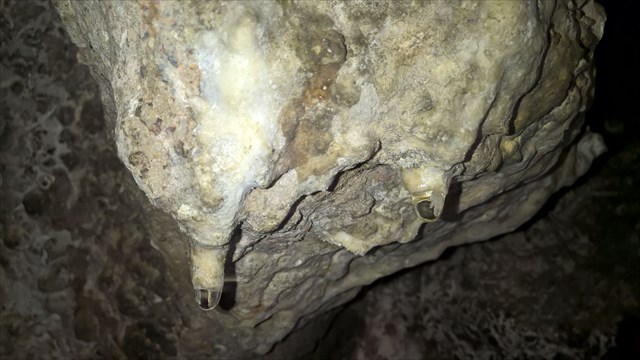
Observe a cristalização ocorrendo dentro da gota d'água da esquerda nessa Gruta.
Quimicamente o calcário mais abundante é formado por carbonato de cálcio. Excetuando-se alguns aditivos o cimento também é composto basicamente por carbonato de cálcio.
Como vimos, a Gruta da Luz tem acima dela uma caixa d’água enorme. Com o passar dos anos essa caixa d’água começou a vazar, muito lentamente, por algumas fissuras e eventualmente esse gotejamento chegou no nível da gruta. Essa água tem um pH ligeiramente ácido.
O que ocorre nesta gruta é que esse gotejamento está provocando o processo NATURAL de formação de cavernas, ou como os espeleólogos dizem, esta caverna está viva.
Em vários locais podemos achar cortinas, minúsculas estalactites, corrimentos de calcita (mineral de que o calcário calcítico é composto) entre outros. Algumas estalagmites artificiais têm sua ponta revestida por calcita natural originada da água saturada que pingou do teto.
É incrível o poder da natureza que está se impondo sobre essa construção. Aliás esse processo ocorre em muitas garagens subterrâneas de prédios. Basta procurar nos cantos e vigas dessas garagens para acharmos diversas estalactites e estalagmites.
Para logar esse EarthCache você precisa ENVIAR para mim por e-mail ou mensagem as seguintes respostas (NÃO COLOQUE AS RESPOSTAS NO LOG):
1. Entre na gruta pela entrada Sul e procure na parede do seu lado esquerdo a cerca de 1,5 metro de altura pela feição da foto abaixo. Isso não é uma estalactite, é uma cortina. Como você acha que esse tipo de estrutura se formou?
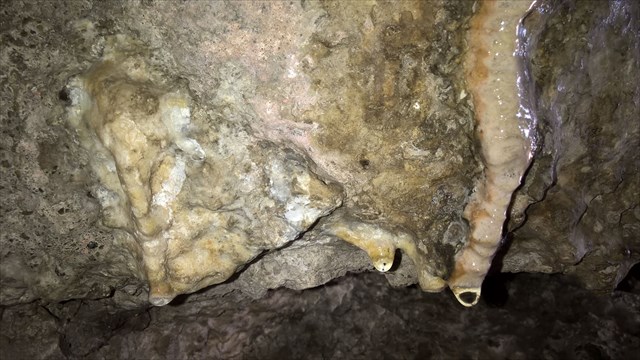
2. Agora dê a volta e entre pela entrada Norte. A menos de 1 metro da entrada olhe para a sua direita. Aqui nós temos outra bela cortina e uma estalagmite abaixo completamente recoberta por cristais de calcita (veja a foto abaixo). Bata levemente a sua unha na cortina. Agora bata levemente a sua unha na parede ao lado da cortina ou mesmo na parte mais baixa da estalagmite que não tem calcita recobrindo. O que você percebeu de diferença nos dois sons? Porque eles são diferentes?
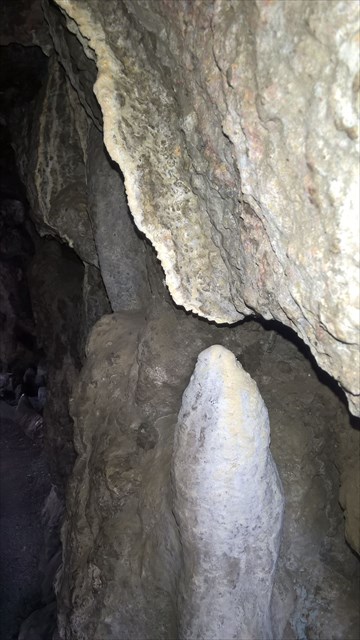
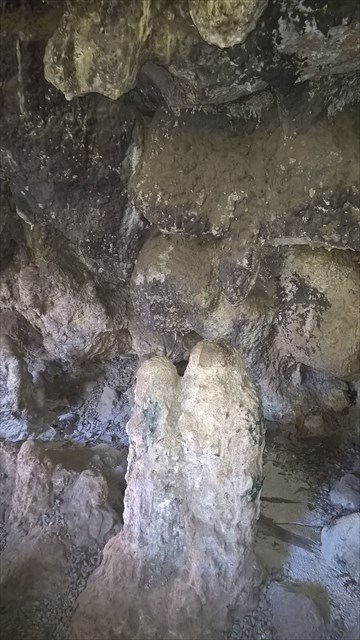
3. Agora veja na parede oeste, bem atrás da peça central da gruta, duas estalagmites juntas com cerca de meio metro de altura (foto abaixo). Note que a ponta das duas estalagmites não são iguais. Posso te garantir que elas não foram feitas diferentes, elas ficaram assim com o tempo. Observe bem esse local, olhando o teto acima e também abaixo e me diga o que você acha que causou essa diferenciação?
4. No centro da gruta existe uma peça central. Sem discutir se ela é brega ou não responda quantas colunas sustentam essa peça e quantas estalactites ela possui?
5. Tarefa opcional: Tire uma selfie dentro da gruta ou na frente dela e COLOQUE NO SEU LOG (NÃO É PARA ME ENVIAR)
Originally created as a Bothanic Garden, in 1825 it was opened to the public as of Light Public Garden. It is the oldest municipal public park and was listed by CONDEPHAAT in 1981.
It has a grotto with waterfall and viewpoint, area for presentations, gazebo, playground, water features, underground aquarium, fitness equipment, jogging track, paracycle, seating areas, toilets, old point tram, archaeological ruins, lakes, fountain, permanent exhibition of sculptures and more.
It features lush vegetation with beautiful centennial trees, 73 identified species of animals in the park are 67 birds, turtles, fish and even a family of sloths.
In the central region of the park stands the lake in Maltese cross-shaped, surrounded by eight beautiful sculptures representing the four seasons.
Let’s focus on the goal of this EarthCache, the grotto with waterfall. This cave was built in the 1880s and is a typical installation in Paysager Garden style, which produces natural elements in stylized form. The cave is also a water tank with a capacity of 25,000 liters.
This cave was built with iron frame coated in cement and is a very good recreation of a natural cave.
Probably you must be wondering how an artificial object made of cement can be an EarthCache.
I agree that it may seem strange, but let’s analyze in detail this monument.
Entering inside it we see many stalactites (formations that originate in the ceiling growing down), stalagmites (prior to the opposite, originate in the growing ground up), columns (formations generated from the fusion of one or more stalactites with one or more stalagmites) and up to two travertine dams (natural impoundments of water caused by the growth of vertical walls in depressions which occur accumulation of water).
These formations as artificial as they can be already serve for people who never had contact with a natural cave to learn how these environments are without even leaving the city. But this cave reserves much more knowledge about the speleogenic process (process of caves formation) that only these features.
According to spelunking, branch of science that studies the subject, cave is all rocky natural cavity with dimensions that allow access of human beings. They can exist in various rock types, including coral reefs, volcanic lava and even ice. The most common type of cave is in limestone.
How a limestone cave forms:
The rainwater penetrate the soil and gets naturally acidic. This water goes down until eventually comes into contact with limestone. These rocks are very sensitive to acid and dissolves with great ease. This process is repeated by thousands or even millions of years to create holes and gaps in the rock. These holes grow and ended up joining with each other to form ever larger cavities.
Up from a certain size these cavities can also grow aided by other processes such as landslides or mechanical wear provided by underground rivers that are so common in this type of environment.
But just by looking at the ceiling, walls and floors of these caves you can realize that they are not exactly a smooth tube in a rock. They have different "decorations" in the form of stalactites, stalagmites, columns and dozens of other wonderful forms, some that defy the laws of gravity.
What happens is that these acidic water, which dissolves the rock, eventually becomes saturated with minerals and crystallizes forming these cave decorations. This is an incredibly slow process that on average takes about 0.3 mm per year under ideal conditions.
Note the crystallization occurring within the drop of water in this cave.
Chemically the most abundant limestone is formed by calcium carbonate. Cement except for some additives is also composed of calcium carbonate.</ p>
As we have seen, the Cave of Light has above it a water tank. Over the years this water tank started leaking, very slowly, through some cracks and eventually this water arrived at the cave level. This water has a mildly acidic pH. This constant dripping is causing NATURAL processes of cave formation, or as cavers say, this cave is alive.</ P>
In many places we can find curtains, tiny stalactites, discharge of calcite (mineral that limestone consists) among others. Some artificial stalagmites have its tip coated with natural calcite originated from the saturated water that dripped from the ceiling. </ P>
It's amazing the power of nature that is being imposed on this construction. By the way this process takes place in many underground garages buildings. Just look at the corners and beams of these garages and you can find several stalactites and stalagmites. </ P>
To log this EarthCache you need TO SEND me by email or message the following answers (DO NOT PUT THE ANSWERS IN YOUR LOG):
1. Enter the cave by the south entrance and look for the wall on your left about 1.5 meters high by the feature of the photo below. This is not a stalactite, is a curtain. How do you think this structure formed?
2. Now turn around and enter by the north entrance. Less than 1 meter from the entrance look to your right. Here we have another beautiful curtain and a stalagmite below completely covered by calcite crystals (see photo below). Lightly tap your nail on the curtain. Now lightly tap your nail on the wall next to the curtain or even at the lowest part of the stalagmite which has calcite covering. Did you notice the difference in the two sounds? Why are they different?
3. Now look on the west wall, right behind the central part of the cave, two stalagmites together with about half a meter high (photo below). Note that the tip of the two stalagmites is not equal. I can guarantee you that they were not made different, they were so over time. Take a good look at this spot. Look above and below and tell me what you think caused this difference?
4. In the center of the cave there is a centerpiece. Without discussing whether it is tacky or not answer how many columns support this piece and how many stalactites it has?
5. Optional Task: Take a selfie inside the cave or in front of it and PUT ON YOUR LOG (DON’T SEND TO ME)