There is plenty of parking in Cobh town centre, the first hour is free, after that it is €1 per hour, maximum stay 3hours. You can park for longer than this in the Heritage Centre which is about 5 mins walk, west of the town centre. If there is a cruise liner docked the town will be very busy. There is a ferry service that operates from Kennedy Pier in Cobh

Spike Island
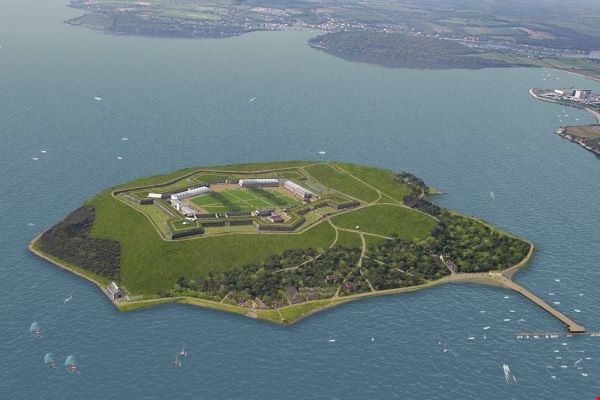
Spike island occupies a key strategic location within Cork harbour which is the second largest natural harbour in the world after Sydney. The multicultural island has hosted a monastery, a fortress and a prison within its 42 hectares, all of which have left their mark.
The Monastery
The well known Munster Saint, St, Mochuda of Carthage is said to have founded a monastery here in AD635 and spent one year here. On his departure he left three deciiples, Gobhan, a bishop, Srafan, a priest and Holy Laisren together with the saintly bishop Dardomaighen to watch over his monastic settlement
The Fort
In the 1770s, during the turmoil of the American War of Independence, Cork harbour replaced Kinsale as the principal Royal Navy base on the south coast. Fort Westmoreland was built here on Spike Island and was completed in 1779. The British military realised the strategic importance of Spike and decided to replace the old fort with a much larger structure.
The foundation stone was laid on 6 June 1894. It consisted of six bastions connected by ramparts and surrounded by a dry moat. Outside the fort artificial slopes known as Glacis were constructed as additional defences. The fort was completed in 1860.
During the Great War Spike was the headquarters of the South Irish Coast Defence. The military presence spread outside the confines of the fort itself with officers' quarters, chaplains quarters and other administrative buildings located on the west and north sides of the island. The families of some of the married soldiers lived in the cluster of houses near the pier on the north side of the island.
The transfer of Spike to the Irish Government finally took place on 11 July 1938 on the anniversary of the Anglo-Irish Treaty of 1921. The Irish Army manned the fort until 1979 when the regulars became part of the First Field Artillery Regiment in Ballincollig.
The Prison
Spike Island has a long history of detention and punishment earning the name of 'Ireland's Alcatraz' In the 1640s during Cromwell's campaigns the island was used as a holding centre for the transportation of thousands of dispossessed Irish people to the West Indies. In the nineteenth century convicts awaiting transportation to Australia and Tasmania were held on Spike. In 1847, during the height of the Great Famine Spike became a convict depot. Many thousands were imprisoned here until it's closure in 1883.
In 1916 the captured crew of The Aud, a ship carrying a cargo of arms for Ireland to aid in the Easter Rising was held here briefly. During the War of Independence up to 500 members of the Irish Volunteers were held here in wooden huts.There were two daring escapes during this period.
From 1972 until 1982 it was used as a military detention centre. In 1985 A decision to open up a civilian prison here was taken. No cellular accommodation was available on Spike so the inmates were accommodated in dormitories only recently used for Naval Service personnel. This was a recipe for disaster and on the night of 31st August 1985 the enviable happened. During the riot 'A' block and the eastern end of 'B' block were destroyed.
The prison was rebuilt to modern standards and prisoners were involved in heritage projects on the island restoring guns, cannons and the convict graveyard. The cost of opperating an island prison and the availability of new cell blocks on the mainland led to its closure in 2004.
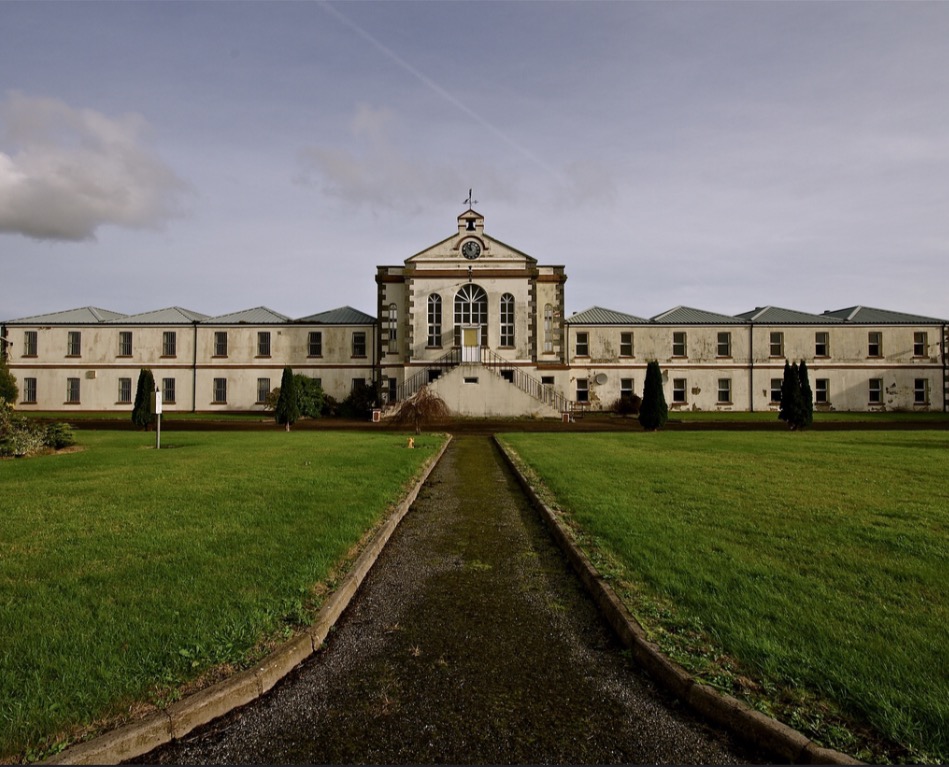 Mitchell Hall