Specchio di Venere (aka Lago di Venere, Mirror of Venus) is a volcanic crater located on the Italian island of Pantelleria within the Strait of Sicily, and one of the main tourist and picturesque locations on the island.
 Island habitation has been dated back 35,000 years with human artifacts found during archaeological digs. Several smaller archaeological digs still occur on the island mostly looking for Punic or Roman era items. Ownership/land claims of Pantelleria has changed over the course of thousands of years, mostly between Carthaginians (ancient city of Carthage on the Tunisia coast), Romans while expanding their empire and Arabs from North Africa. Several armed ground and naval battles have been fought around the island throughout history. Pantelleria island provides advantageous lookout positions within the Mediterranean Sea and positioned for trading between North Africa and mainland Italy.
Volcanic activity – Pantelleria island is the largest volcanic island of Sicily and was formed through volcanic activity and continental plate shifting. The last major volcanic eruption, and only eruption in historical records, occurred in 1891. While not a major eruption in geologic terms the seismic activity did cause the northeast coast to rise up just under 1 meter. Smaller volcanic activity can still be observed on the island through hot springs (heated ground water rising from earth crust) and fumaroles (opening in the earth crust near volcanoes which emits gases).
Types of volcanoes:
Composite (Strato) – High, steep sides formed from layers of ash and lava flows. Example would be Vesuvius, Krakatoa or St Helens.
Cinder Cone (Dome) – Steep sides with small crater on top and formed of loose, grainy cinders.
Shield – Low, gently sloping sides formed from layers of frozen lava. Example would be Mauna Loa in Hawaii .

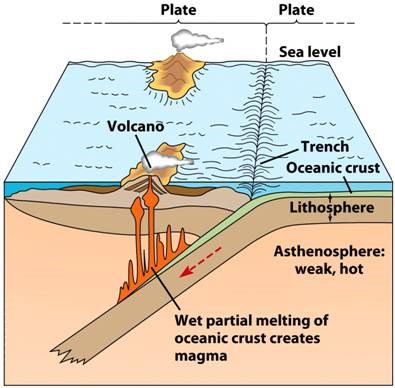
Formation of the island of Pantelleria (How volcanic islands are formed) – At boundaries of continental plates volcanic activity occurs. When these continental plates pull apart lava erupts and forms ridges. Layers and layers of lava eventually build up enough and break the surface of the water to form an island. Examples of volcanic island formation can be found in the two pictures below.

Over time volcanic islands, such as Pantelleria, erode. This can take place either from volcanic activity becoming dormant and/or from the gradual erosion process. As the volcano shrinks it will eventually fall below the waterline and the surrounding coral land mass forming an atoll. The life cycle can be seen in the graphic below.

The largest mountain on Pantelleria, Mantagna Grande, is thought to be slowly sinking from the combination of cooling of magma, carbon dioxide (CO2) gaseous release (known as degassing) and erosion. Over the course of thousands of years the island will progress through the life cycle.
How volcanic craters (calderas) are formed – Craters (also known as calderas), such as Specchio di Venere, can be formed through a large volcanic eruption or through a collapse of surface rocks. In the case of a volcanic eruption, the explosion sends large amounts of rock, magma and dust away from the site creating an empty space. In the case of a collapse, unsupported rock near magma chamber move away to form a crater. See the graphic for an illustration.

Logging requirements:
1. From the geocache description and graphics, what stage in the island life cycle is Pantelleria in?
2. Of the three main classes of rock - sedimentary, metamorphic and igneous - which type is present around the listed coordinates and lake? And how is this type of rock formed?
3. From the information sign at the listed coordinates: a) What is the surface of the lake?, b) What is the maximum depth of the lake?, c) What geologic feature maintains the water temperature higher than that of air? and d) How many languages are written on the information sign?
(Optional) Post a picture of you or your geocaching group with Specchio di Venere in background.
--------------------------------------------------------------------------------------------------------------------------------------------
No armchair virtual logging please
---------------------------------------------------------------------------------------------------------------------------------------------
More information on volcanoes, craters and the island of Pantelleria can be found here:
Pantelleria Wikipedia English Pantelleria Wikipedia Italiano Caldera Information Types of Volcanoes Life Cycle of Volcanic Islands
Italiano. Mi scuso per le cattive traduzioni italiane . Io non parlo italiano e sto usando Google Translate.
Specchio di Venere ( aka Lago di Venere , Specchio di Venere ) è un cratere vulcanico situato sull'isola italiana di Pantelleria nel Canale di Sicilia , e uno dei principali luoghi turistici e pittoreschi dell'isola.
Isola abitazione è stato datato 35.000 anni con artefatti umani ritrovati durante gli scavi archeologici . Diversi piccoli scavi archeologici si verificano ancora sull'isola per lo più alla ricerca di Punica o oggetti di epoca romana . rivendica la proprietà / terra di Pantelleria è cambiato nel corso di migliaia di anni , per lo più tra Cartaginesi ( antica città di Cartagine sulla costa Tunisia) , mentre i Romani in espansione il loro impero e gli arabi dal Nord Africa . Diversi terra armata e battaglie navali sono state combattute intorno all'isola nel corso della storia . Pantelleria offre posizioni di avvistamento vantaggiose all'interno del Mar Mediterraneo e posizionato per lo scambio tra il Nord Africa e l'Italia continentale.
Attivita Vulcanica Pantelleria è la più grande isola vulcanica di Sicilia e si è formata attraverso l'attività vulcanica e piastra di spostamento continentale . L' ultima grande eruzione vulcanica , e solo eruzione in documenti storici , si sono verificati nel 1891. Pur non essendo una grande eruzione in termini geologici l'attività sismica ha causato la costa nord-est a sollevarsi poco meno di 1 metro. Più piccolo attività vulcanica può ancora essere osservata sull'isola attraverso sorgenti di acqua calda ( acqua riscaldata terreno in salita dalla crosta terrestre ) e fumarole (apertura nella crosta terrestre nei pressi di vulcani che emette gas )
La Formazione dell ‘isola di Pantelleria (come isole vulcaniche si formano)A confini delle placche continentali si verifica l'attività vulcanica . Quando queste placche continentali separare erutta lava e forme creste . Strati e strati di lava casualmente accumulano abbastanza e rompere la superficie dell'acqua formando un'isola .
Come Crateri Vulcanici Sono Formati Crateri ( noto anche come caldere ) , come Specchio di Venere , possono essere formate attraverso una grande eruzione vulcanica o attraverso un crollo di rocce di superficie . Nel caso di una eruzione vulcanica , l'esplosione invia grandi quantità di roccia , magma e polvere lontano dal sito creando uno spazio vuoto . Nel caso di collasso , rock supportato pressi camera magmatica allontanarsi per formare un cratere
Requisiti di Registrazione:
1. Dalla descrizione geocache e grafica, quale fase del ciclo di vita dell'isola e Pantelleria in?
2. Delle tre classi principali di roccia - sedimentarie, metamorfiche e ignee - quale tipo e presente intorno alle coordinate indicate e il lago? E come e questo tipo di roccia formata?
3. Dal segno informaiton alle coordinate indicate - a) Qual e la superficie del lago?, b) Cio e la profondita massima del lago?, c) Cio caratteristica geologica mantiene la temperatura dell'acqua superiore a quella dell'aria? d) Quante lingue sono scritti sul segno informazioni?
(Facoltativo) Postare una foto di voi o il Vostro gruppo con Specchio di Venere
-------------------------------------------------------------------------------------------------------------------------------------------
Nessuna registrazione virtuale poltrona si prega
-------------------------------------------------------------------------------------------------------------------------------------------