Welcome to Wales, or if you are going the other way, welcome to England. Now you may feel footsore, or bottom chafed as you make your way along the cycle trail from Chester to Connah's Quay, but here is a chance to stop, and encounter some geology. Look, and you will see two standing stones, I doubt they are from the times of the druids, so no weird associations to quote or story to tell. Then again in your log would be good to have a bit of spice and interest, but it is not a logging requirement.
So what type of stone have we got?
What you can see is limestone. Limestone is a sedimentary rock composed largely of the minerals calcite and aragonite, which are different crystal forms of calcium carbonate (CaCO3). Most limestone is composed of skeletal fragments of marine organisms such as coral, crinoids and molluscs.
Fossil coral
Corals are marine invertebrates. They typically live in compact colonies of many identical individual polyps.The group includes the important reef builders that inhabit tropical oceans and secrete calcium carbonate to form a hard skeleton.
 An example of fossil coral.
Fossil crinoids
Crinoids live in the sea. Their name is derived from krinoeides (Greek) which means 'like a lily'. They are also called sea lilies or feather-stars.Crinoids have been around for a long time, about 480 million years ago. There are still crinoids alive today. A crinoid has three parts, a stem which it uses to stick to the sea floor, a calyx or body, and its arms which it uses to catch its food. Usually it's the stem which is found as a fossil.
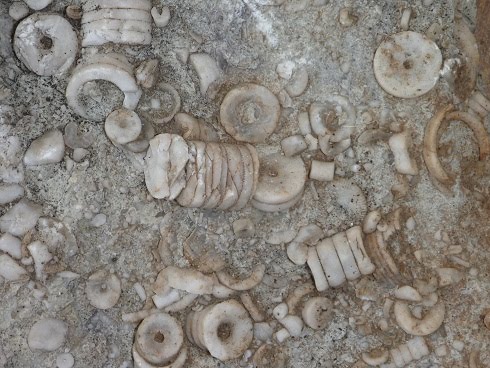 An example of fossil crinoid stems.
Fossil Molluscs
Molluscs are still common, snails, mussels, and oysters are all examples.
So what is a fossil?
Fossils are the preserved remains or traces of animals, plants, and other organisms from the remote past. The totality of fossils, both discovered and undiscovered, and their placement in fossiliferous (fossil-containing) rock formations and sedimentary layers (Strata) is known as the fossil record.
The process of fossilization varies according to tissue type and external conditions.
(1) Permineralization
This is a process of fossilization that occurs when an organism is buried. The empty spaces within an organism (spaces filled with liquid or gas during life) become filled with mineral-rich groundwater. Minerals precipitate from the groundwater, occupying the empty spaces. This process can occur in very small spaces, such as within the cell wall of a plant cell. Small scale permineralization can produce very detailed fossils. For permineralization to occur, the organism must become covered by sediment soon after death or soon after the initial decay process. The degree to which the remains are decayed when covered determines the later details of the fossil. Some fossils consist only of skeletal remains or teeth; other fossils contain traces of skin, feathers or even soft tissues.
(2) Casts and Molds
In some cases the original remains of the organism completely dissolve or are otherwise destroyed. The remaining organism-shaped hole in the rock is called an external mold. If this hole is later filled with other minerals, it is a cast. An endocast or internal mold is formed when sediments or minerals fill the internal cavity of an organism, such as the inside of a bivalve or snail or the hollow of a skull.
(3) Authigenic mineralisation
This is a special form of cast and mold formation. If the chemistry is right, the organism (or fragment of organism) can act as a nucleus for the precipitation of minerals such as siderite, resulting in a nodule forming around it. If this happens rapidly before significant decay to the organic tissue, very fine three-dimensional morphological detail can be preserved.
(4) Replacement and recrystallization
Replacement occurs when the shell, bone or other tissue is replaced with another mineral. In some cases mineral replacement of the original shell occurs so gradually and at such fine scales that microstructural features are preserved despite the total loss of original material. A shell is said to be recrystallized when the original skeletal compounds are still present but in a different crystal form.
(5) Adpression (compression-impression)
Compression fossils such as those of fossil ferns, are the result of chemical reduction of the complex organic molecules composing the organism's tissues. In this case the fossil consists of original material, albeit in a geochemically altered state. This chemical change is an expression of diagenesis. Often what remains is known as a phytoleim, in which case the fossil is known as a compression. Often, however, the phytoleim is lost and all that remains is an impression of the organism in the rock—an impression fossil.
Among the three major types of rock, fossils are most commonly found in sedimentary rock. Unlike most igneous and metamorphic rocks, sedimentary rocks form at temperatures and pressures that do not destroy fossil remnants.
This being an earthcache, in order to log it, I ask that you answer some questions. Please send them to me, and do not include them in your log. You can send them to me by using the message facility or email, both of which can be found by looking at my profile. Don't worry, not looking for PhD standard here, remember this is friendly Wales. 
1. How high are the standing stones?
2. Please describe what the limestone, feels like, and its colour.
3. Using the information in the cache description, please examine the limestone, can you see any fossils, which are the most common?
4. What process of fossilisation has taken place here?