이곳은 구상반려암뿐만 아니라 모든 구상암 가운데에서도 세계 최대규모의 노두가 있는 곳이다.
황령산 기슭에 분포되어 있는 구상반려암은 반려암 안에 구상구조를 이루는 암구가 발달되어 있다. 암구는 각각 무색광물과 유색광물을 포함하는 구핵을 중심으로 백색광물의 띠와 암색광물의 띠가 양파모양의 동심구각(Shell)이나 방사상조직을 가지고 대조적으로 섞어 배열되어 있는 하나의 암석 구조이다. 바위의 표면에서는 동심원이나 꽃모양 무늬로 나타난다.
이 암석은 제3기 초인 후기 백악기에 남천동층을 뚫고 발생했던 황령산의 화산활동으로 분출한 안산암류를 암주상으로 관입한 황령산의 반려암을 모암으로 하여 반려암 안에 배태되어 있다. 이곳에서 구상구조가 확인되는 노두는 여러 개인데, 그들의 총 지표면적은 약 0.14km2에 달한다.
이 구상반려암은 여러 면에서 뛰어난 가치와 특성을 가지고 있다. 먼저 산출 자체가 세계적으로 드물며, 동양에서는 한국에서 최초로 발견될 정도로 희귀암이다. 대륙의 이동을 설명하는 지판구조론의 이론 구성에 중요한 자료가 된다. 노두 면적이 세계 최대이며, 보존상태가 뛰어나다.
[로그하는 방법]
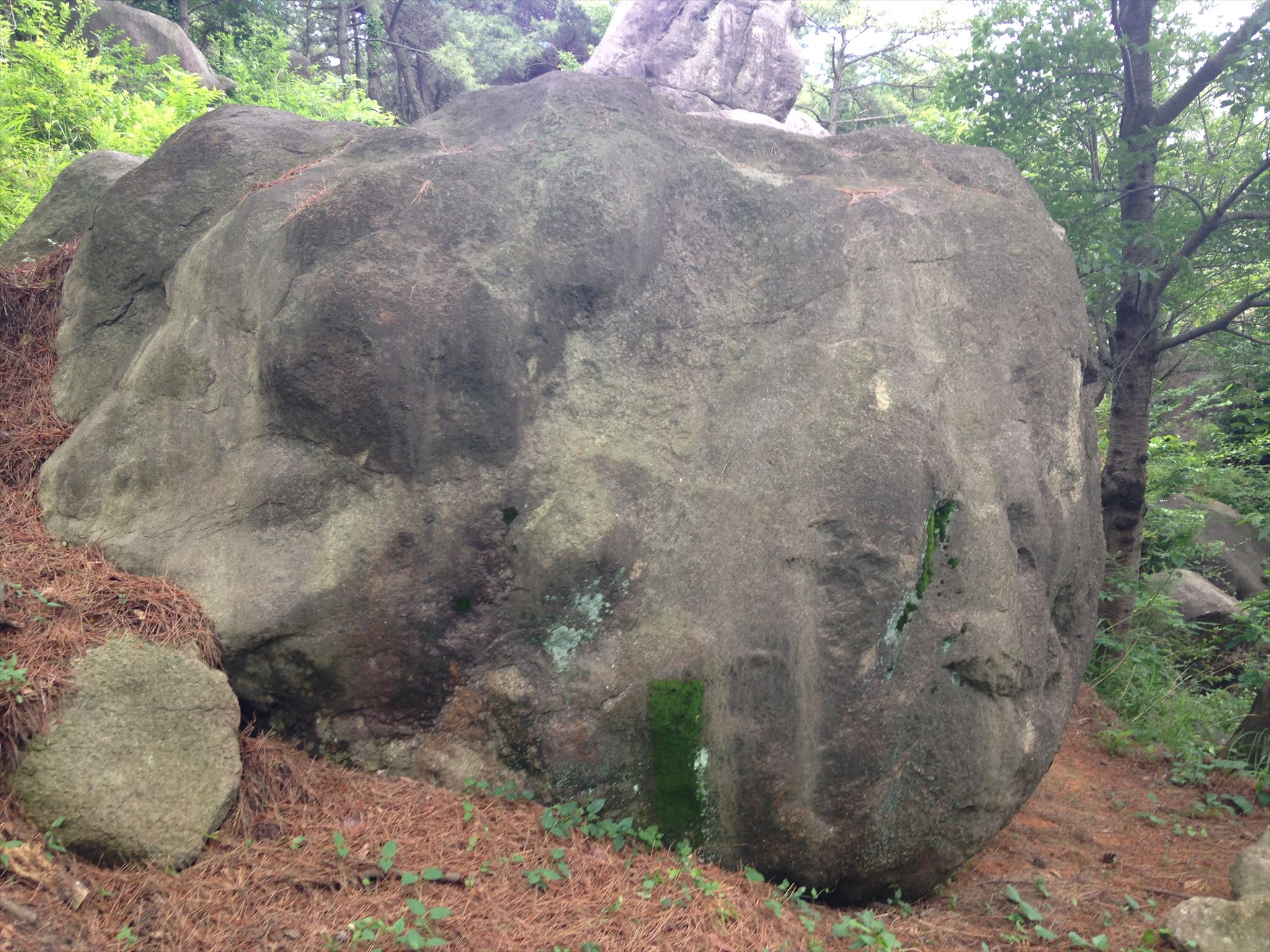
1. Waypoint를 방문하여 아래의 사진과 같은 바위의 표면에 위아래로 붙어있는 2개의 동심원 무늬를 찾아보세요 .
(1) 구상반려암이 생성되어 있는 기반암은 무슨 종류의 바위입니까?
(2) 동심원의 색상은 무엇입니까?
(3) 그 동심원 무늬중 아래쪽의 직경은 몇 cm 인가요?
(4) 땅바닥에서 그 동심원 무늬까지의 거리는 얼마인가요?
2. 캐시존을 배경으로 GPSr를 든 캐셔의 사진을 로그에 올려주세요. (선택사항이지만 사진을 올려주시기를 부탁드립니다.)
(English)
A ridge located about 2km north-west of Hwangnyongsan mountain and the surrounding areas is composed of gabbro, and there is an andesite area nearby to the north of the gabbroic areas. These circular rocks are found in the outcropping of( the basement gabbro, and also as boulders. While the circular gneiss and granite rocks are found in Muju and Sangju only as boulders, the circular gabbro rocks in Busan make their appearance in the basement outcropping too, and thus have special geological significance.
Orbicular rock is an uncommon plutonic rock type which is usually granitic in composition. Orbicular rocks occur in different types of rocks, such as granite, gabbro and diorite. These rocks have a unique appearance due to orbicules - concentrically layered, spheroidal structures, probably formed through nucleation around a grain in a cooling magma chamber. These orbicules show a wide variation in size and composition. The occurrences are usually very small. All of the orbicular rocks contain a core in the middle surrounded by radially grown crystals. The outer part of an orbicule shows concentric lines - called "shells". Some rocks have only got one single shell, but most of the rocks contain a lot of concentric shells.
[How to log]
1. Go to the waypoint where the rock in the picture is located and find two concentric circles shaped orbicular gabbros which are vertically neighboring!
(1) What is the name of basement rock on which concentric circles shaped orbicular gabbros are formed?
(2) What is the color of concentric circles shaped orbicular gabbros?
(3) What is the diameter of lower concentric circles shaped orbicular gabbro?
(4) Check the distance between the ground and lower concentric circles shaped orbicular gabbro!
2. Upload the photo of you or your GPS with the cache zone in the background! (The task is optional but I would highly appreciate if you would do so.)