
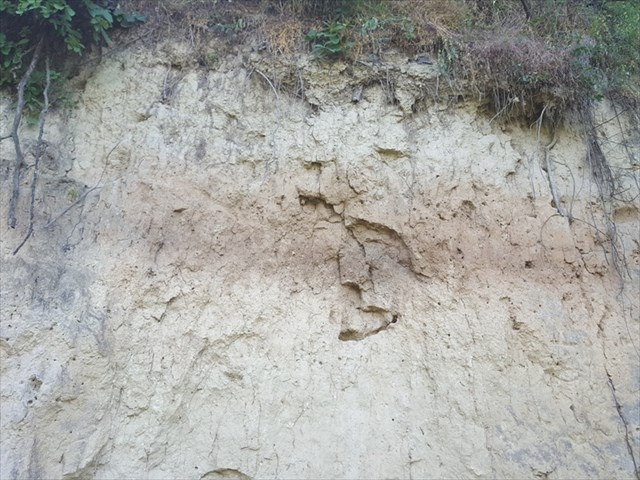
At the listed coordinates you will find nice example of loess-paleosol sequences, with several layers of loess and paleosol.
EarthCache
Loess-Paleosol Sequences
Loess-paleosol sequences at the EarthCache location contains several dark colored layers, or paleosols (paleosol is a layer of fossilized soil), within yellow loess deposits. These loess-paleosol sequences represent evidence of various climatic changes that occurred during the last 150,000 years. During that period of time, Quaternary glaciation or the current ice age took place. During the ice age, there are periods of severe glacial conditions - yellow loess layers are remnants from those glacial periods. And there are warmer, interglacial periods - dark paleosol layers are remnants from those periods.
Loess-Paleosol Sequences
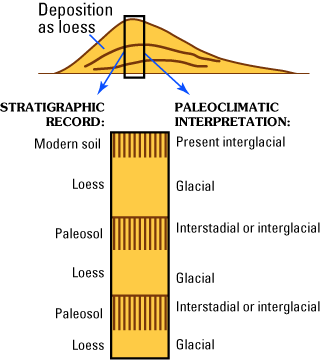 Source: U.S. Geological Survey (usgs.gov)
Loess is a type of material that is formed by wind activity, or as geologists would say it is an aeolian sediment. Loess can be of glacial or non-glacial origin. Loess at the EarthCache location is of glacial origin - it was formed during glacial periods. In these periods, during the summer, huge amounts of ice were melted down and huge areas were flooded. After the summer, in the autumn and winter, melting of ice ceased and flooded areas dried out. Once these areas become dry again the wind starts to carry away dry particles from these areas. These particles were then deposited further away in the direction of wind blowing.
During warmer, interglacial periods, this periodic yearly ice melting ceased, the climate became warmer, loess formation slowly ceased, and soil formation slowly started to occur. Soil formation is entirely different process from loess formation process. Geologists say there are three different forces behind soil formation - climate, biology, and material. Climate functions as a regulator of soil formation. Soil that is formed on top of loess deposits is not only of different origin, but also of different chemical composition. The final result is different color of paleosol layers when compared to loess layers.
Relative Age
Loess-paleosol sequences at the EarthCache location represent a nice illustration of the principle of superposition, one of several geological principles developed by Nicolas Steno, a Danish geologist from 17th century. According to this principle, in any section of undisturbed layers, the layers below are older than the layers above. Oldest layer is at the bottom and the youngest is at the top.
Principle of Superposition
 Source: Earth Science, Palo Alto: CK-12 Foundation, 2009.
This principle (and all other Steno’s principles as well) are important for relative dating of geological events. Relative dating determines relative age of some geological feature, i.e. its age in comparison with other geological features. This method of dating can say which geologic feature is older and which is younger, but it doesn't tell how many years some geologic feature is old. Other techniques are used for determining how many years some geologic feature is old. This numerical age is called absolute age and techniques for determining absolute age are called absolute dating. Radiometric dating is an example of absolute dating method that is used in geology.
Logging Tasks
To log this EarthCache answer the following questions:
1. How many light and dark layers can you see on this EarthCache?
2. Based on your observation of different layers, explain how the climate changed between glacial and interglacial periods?
3. Based on the transition between layers, do you think climate changes occurred fast or slow?
4. Perform relative dating on layers at EarthCache location. Report your findings.
Send your answers through my profile at geocaching.com (through e-mail or message center) and NOT in a log. You don't have to wait for me to approve your answers. Once you send your answers feel free to log this EarthCache as found. If there are problems with your answers, I will contact you.
Sources
1. Geologic Time, Course Notes, EarthCache Academy.
2. Alecia M. Spooner, Geology for Dummies, Hoboken: Wiley Publishing, Inc., 2011.
3. Earth Science, Palo Alto: CK-12 Foundation, 2009.
4. Geology.About.com
5. Wikipedia.org

Na izlistanim koordinatama pronaći ćete lijep primjer sekvenci prapora i paleotla, s nekoliko slojeva prapora i paleotla.
EarthCache
Sekvence prapora i paleotla
Sekvence prapora i paleotla na lokaciji EarthCachea sadrže nekoliko tamnih slojeva ili paleotala (paleotlo je sloj fosiliziranog tla) unutar svjetlog prapora. Ove sekvence prapora i paleotla predstavljaju svjedočanstvo različitih klimatskih promjena koje su se dogodile tijekom posljednjih 150.000 godina. Tijekom tog razdoblja dogodila se kvartarna glacijacija, odnosno tekuće ledeno doba. Tijekom ledenog doba postoje razdoblja oštre hladnoće - žuti slojevi prapora su ostaci iz tih glacijalnih razdoblja. Također, postoje toplija razdoblja, tzv. međuglacijalna razdoblja - smeđi slojevi paleotla su ostaci iz međuglacijalnih razdoblja.
Sekvence prapora i paleotla
Izvor: U.S. Geological Survey (usgs.gov)
Prapor ili les je materijal koji je formiran aktivnošću vjetra, ili kako bi geolozi to rekli - riječ je o eolskom sedimentu. Prapor može biti glacijalnog ili neglacijalnog porijekla. Prapor na ovom EarthCache-u je glacijalnog porijekla. Formiran je tijekom glacijalnih razdoblja. Tijekom navedenih razdoblja u ljeto bi dolazilo do topljenja leda i velika područja su bila poplavljena. Nakon ljeta, u jesen i zimu, topljenje leda se zaustavljalo te je dolazilo do sušenja poplavljenih područja. Jednom kada su se ta područja osušila vjetar je započinjao otpuhivati suhe čestice iz tih područja, te ih nanostiti dalje u smjeru puhanja vjetra.
Tijekom toplijih, međuglacijalnih razdoblja periodična godišnja topljenja leda se više nisu događala, klima je postajala toplija, formiranje prapora se polagano zaustavljalo i polagano je započinjao proces formiranja tla. Proces formiranja tla je u potpunosti drugačiji proces od procesa formiranja prapora. Znanstvenici su utvrdili da tri različite sile stoje u pozadini formiranja tla - klima, biologija i materijal. Klima funkcionira kao regulator formiranja tla. Tlo koje je formirano iznad slojeva prapora nije samo drugačijeg porijekla od prapora nego je i različitog kemijskog sastava. Konačni rezultat je razlika u bojama između slojeva paleotla i prapora.
Relativna starost
Sekvence prapora i paleotla na lokaciji EarthCachea predstavljaju lijep primjer načela superpozicije, jednog od nekoliko geoloških načela koje je definirao Nicolas Steno, danski geolog iz 17. stoljeća. Prema ovom načelu, u bilo kojem dijelu neporemećenih slojeva, slojevi koje se nalaze ispod su stariji od onih koji se nalaze iznad. Najstariji sloj se nalazi na dnu, a najmlađi se nalazi na vrhu.
Načelo superpozicije
Source: Earth Science, Palo Alto: CK-12 Foundation, 2009.
Ovo načelo (kao i sva druga Stenova načela) su važna za određivanje relativne starosti geoloških događaja. Relativno datiranje određuje relativnu starost nekog geološkog obilježja. Ova metoda datiranja može odgovoriti na pitanje koje geološko obilježje je starije, a koje mlađe, ali ova metoda ne može odrediti koliko godina je pojedino geološko obilježje staro. Druge tehnike se koriste za određivanje koliko je milijuna godina neko geološko obilježje staro. Brojčano određena dob se naziva apsolutna starost, a njezino određivanje se naziva apsolutno datiranje. Radiometrijsko datiranje je jedan primjer metode apsolutnog datiranja koje se koristi u geologiji.
Zadaci za logiranje
Kako biste logirali ovaj EarthCache odgovorite na sljedeća pitanja:
1. Koliko svjetlih i tamnih slojeva možete vidjeti na ovom EarthCacheu?
2. S obzirom na Vaše opažanje različitih slojeva, objasnite kako se klima mijenjala između glacijalnih i međuglacijalnih razdoblja?
3. S obzirom na prijelaz između pojedinih slojeva, mislite li da su se klimatske promjene događale brzo ili sporo?
4. Provedite relativno datiranje slojeva na lokaciji EarthCachea. Opišite svoje zaključke.
Odgovore pošaljite preko mog profila na geocaching.com, a NE u Vašem logu! Ne morate čekati na moje potvrđivanje Vaših odgovora. Jednom kada pošaljete Vaše odgovore slobodno logirajte pronalazak ovog EarthCachea. Ako Vaši odgovori budu pogrešni ja ću kontaktirati Vas.
Izvori
1. Geologic Time, Course Notes, EarthCache Academy.
2. Alecia M. Spooner, Geology for Dummies, Hoboken: Wiley Publishing, Inc., 2011.
3. Earth Science, Palo Alto: CK-12 Foundation, 2009.
4. Geology.About.com
5. Wikipedia.org