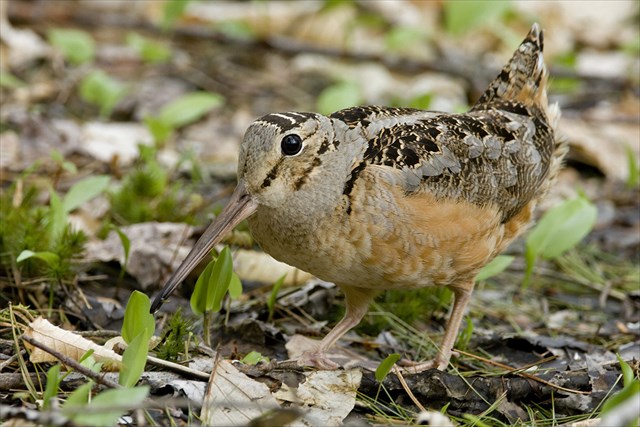
American Woodcocks (Scolopax minor), sometimes called Timberdoodles, are plump, short-legged shorebirds with very long, straight bills. Their large heads, short necks, and short tails give them a bulbous look on the ground and in flight. The wings are broad and rounded compared to most other shorebirds. They are well camouflaged in light brown, black, buff, and gray-brown tones on top, and the underparts are buffy to almost orange. American Woodcock spend most of their time hidden in fields and on the forest floor, where they probe the soil with its bill to search for earthworms, using its flexible bill tip to capture prey. The bird walks slowly and sometimes rocks its body back and forth, stepping heavily with its front foot. This action may make worms move around in the soil, increasing their detectablity. On spring nights, males perform very conspicuous displays, giving a buzzy peent call, then launching into the air. Their erratic display flight includes a distinctive, twittering flight sound and ends with a steep dive back to the ground. Look for American Woodcock in forests, forest edges, old fields, and wet meadows of eastern North America. The young aspen surrounding the grass field across the ditch is a good example.
The cache is a camouflaged container with some swag and a logbook. You will need to bring your own writing utensil. There is plenty of parking on the wide road shoulder. If you are going to do the whole series, it would be best to start from the north.