Those with children (young and old) may like to print the activity sheet before leaving home and bring a crayon and some tape with them to do bark rubbings and take a fallen leaf from the tree.
Hazel (Corylus avellana)
The hazel is a broad leaved deciduous native tree. Hazel is so bendy in spring that it can be tied in a knot without breaking. Bees find it difficult to collect hazel pollen and can only gather it in small loads. Hazel is often coppiced and can live for several hundred years. Leaf buds are oval, blunt and hairy. Hazel is monoecious, meaning that both male and female flowers are found on the same tree but must be pollinated by pollen from other hazel trees. The yellow male catkins appear before the leaves and hang in clusters, from mid-February. Female flowers are tiny and bud-like with red styles. In the UK hazel is often found in the understorey of lowland oak, ash or birch woodland, and is also found in scrub and hedgerows.
Height: 12m tall
Bark: It has a smooth, grey-brown, bark, which peels with age, and bendy, hairy stems.
Leaves: Round to oval, doubly toothed, hairy and pointed at the tip. Leaves turn yellow before falling in autumn.

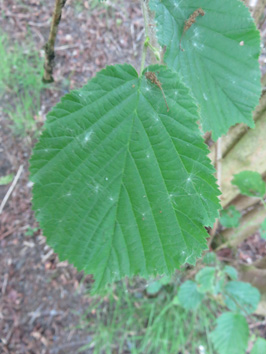
Hazel could be confused with elm which has similar leaves however elm leaves are roughly hairy unlike soft hazel leaves. Elm leaves have an asymmetric leaf base.
Hazel has a reputation as a magical tree. A hazel rod is supposed to protect against evil spirits, as well as being used as a wand and for water-divining. In some parts of England hazel nuts were carried as charms and/or held to ward off rheumatism. In Ireland hazel was known as the 'Tree of Knowledge’, and in medieval times it was a symbol of fertility.
Hazel wood can be twisted or knotted, and as such it historically had many uses. These included thatching spars, net stakes, water divining sticks, hurdles and furniture. Hazel was also valued for its nuts, or 'cobs'. Today, hazel coppice has become an important management strategy in the conservation of woodland habitats for wildlife. The resulting timber is used in many ways, and is becoming increasingly popular as pea sticks and bean poles, used by gardeners.