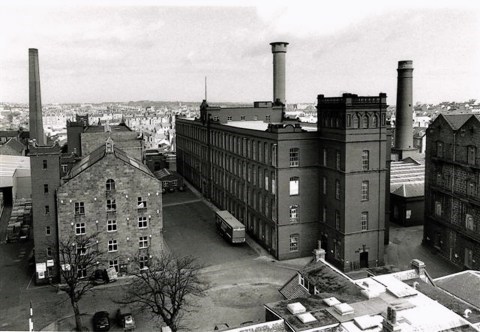
Part of the complex on Maberly Street has already been converted to apartments, known as the Bastille, and applications have been lodged by developers to create a new urban village on the remaining site consisting of over 800 new homes. Walk down Hutcheon Street and Maberly Street to explore the site and take in the vastness of this once important business hub of Aberdeen.
Opening in 1808, the Broadford Works became the longest running iron-frame mill in Scotland. Once Aberdeen’s single largest employer with more than 3,000 employees at the height of the 20th century, the building became an iconic city landmark. The factory was the last remaining textile mill in The Granite City before closing its doors in 2004.
It was first built for Scott Brown and Co of Angus, which went bankrupt in 1811, before being sold to entrepreneur, speculator and introducer of jute to the UK, Sir John Maberly MP. Maberly developed the works by adopting the first gas lighting of industrial factories in Scotland but suffered the same fate as previous owners and sold the works onto Richard and Co who became a public company in 1898.
Although there was a decline in traditional flax spinning activities, the mill did not face closure, and instead embarked on a new adventure. It moved to man-made fibres for carpet yarn which replaced the flax and continued to do so until the early 21st century. Generations of north-east families worked at the mill and at its time of closure, 196 staff were employed.