General Information and Warnings
Here at Cwmorthin you will find a stunning glacial valley but geologically it can be confusing due to the vast amounts of slate mining and surface quarrying that have taken place here. The earthcaches on this trail focus on both the original glacial features of the valley, and also the interesting slate that has been exposed from underground by the workings. Always remember that the huge piles of slate you will frequently walk over and past were not placed here naturally, this is all the work of man. As you walk around, try and keep an image in your mind of how the valley would have looked before the slate was quarried.
The Rhosydd Geology Trail follows the track up the south side of the lake and back around to Plas Cwmorthin, a former quarry managers mansion. It extends a little further on a less used path that can be boggy in places, the rangers have asked that you return via the same route from the farm, please don't try and cross the boggy area between the farm and the old mines. This trail is generally further away from the mines and spoil heaps but you will pass old buildings that may be unsafe and there could be other hidden dangers - please take appropriate care. Also be aware that slate can have a very sharp edge and can cut very deeply, so please treat this area with the respect it requires.
Information about Sedimentary Rocks
A lot of the Cwmorthin Valley consists of relatively mechanically-weak mudrock - siltstones, mudstones and shales of the Nant Ffrancon Group of mid to upper Ordovician age. If you have visited most of the earthcaches on the trail you will be more than familiar with the volcanic igneous rocks here in the valley, and you will also be familiar with slate, a metamorphic rock. This earthcache examines the third rock type in the cycle - sedimentary rocks.
The slate here could only have been formed if there was originally a sedimentary rock here, in this case, a mudrock. Earth movements can cause these mudrocks to be deeply buried or squeezed. As a result, the rocks are heated and put under great pressure. They do not melt (if they melted they would become igneous rocks), but the minerals they contain are changed chemically, forming metamorphic rocks.
The very best examples of sedimentary rocks are actually found in the boggy area between here and the slate mines. Where the stream crosses the bog, little waterfalls reveal very good sedimentary rocks. Because the wardens have asked us to avoid this area we are bringing you to the best example we can reach, and you can see here the layers in the rock, clear evidence of sedimentary formation.
Sedimentary rocks are formed from sediments that have settled at the bottom of a lake, sea or ocean, and have been compressed over millions of years. The sediment comes from eroded rocks carried there by rivers or ice, and from the skeletons of sea creatures. Every now and again an event takes place which breaks the formation of more sediment, and this creates the layers you see in the rock. Thick layers mean there was a long uninterrupted time where the sediment was dropped, many short layers mean the cycles were relatively short.
Mudrocks - A General Overview
Mudrocks are a class of fine grained sedimentary rocks. The varying types of mudrocks include: siltstone, claystone, mudstone, and shale. Most of the particles of which the stone is composed are less than 0.0625 mm (1/16th mm or 0.0025 inches) and are too small to study readily in the field. At first sight the rock types look quite similar; however, there are important differences in composition. There has been a great deal of disagreement involving the classification of mudrocks.
- Mudrocks are the least understood, and one of the most understudied sedimentary rocks to date
- It is difficult to study mudrock constituents, due to their diminutive size and susceptibility to weathering on outcrops
- There is not a universal classification scheme accepted by scientists
Mudrocks make up fifty percent of the sedimentary rocks in the geologic record, and are easily the most widespread deposits on Earth. With increased pressure over time the clay minerals may become aligned, with the appearance of parallel layering (fissility). This finely bedded material that splits readily into thin layers is called shale, as a distinction from mudstone. We will now have a brief focused study of the main mudrocks.
---------------------------
Siltstone
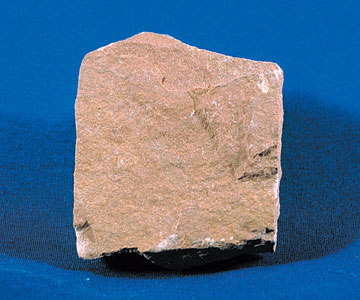
Siltstone is a sedimentary rock composed mainly of silt-sized particles. It forms where water, wind, or ice deposit silt, and the silt is then compacted and cemented into a rock.
Silt accumulates in sedimentary basins throughout the world. It represents a level of current, wave, or wind energy between where sand and mud accumulate. Sedimentary structures such as layering, cross-bedding, ripple marks, erosional contacts, and fossils provide evidence of these environments.
Siltstone is much less common than sandstone and shale. The rock units are usually thinner and less extensive. Only rarely is one notable enough to merit a specific name.
---------------------------
Claystone
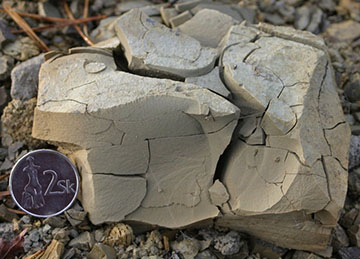
A claystone is compacted mudrock. In order for a rock to be considered a claystone, it must consist of up to fifty percent clay, which measures less than 1/256 of a millimeter in particle size. Clay minerals are integral to mudrocks, and represent the first or second most abundant constituent by volume. There are 35 recognized clay mineral species on Earth. They make muds cohesive and plastic, or able to flow. Clay is by far the smallest particles recognized in mudrocks.
For a size comparison, a clay-sized particle is 1/1000 the size of a sand grain. This means a clay particle will travel 1000 times further at constant water velocity, thus requiring quieter conditions for settlement. The formation of clay is well understood, and can come from soil, volcanic ash, and glaciation.
---------------------------
Mudstone
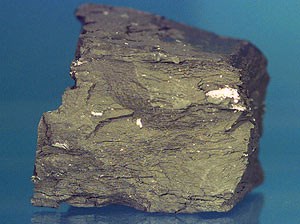
Mudstone, is a fine-grained sedimentary rock whose original constituents were silt and clay sized particles (at least 1/3 of each). Grain size is up to 0.0625 mm (0.0025 in) with individual grains too small to be distinguished without a microscope.
The lack of layering in mudstone may be due to either original texture or the disruption of layering by burrowing organisms in the sediment prior to being compacted. Mud rocks such as mudstone and shale comprise some 65% of all sedimentary rocks.
Mudstone looks like hardened clay and, depending upon the circumstances under which it was formed, it may show cracks or fissures, like a sun-baked clay deposit.
---------------------------
Shale
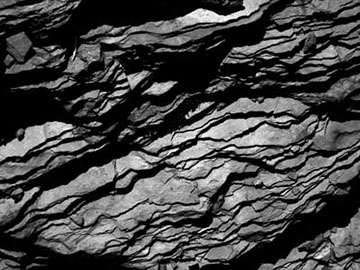
Shale is a specific type of mudstone. It is a fine-grained, sedimentary rock composed of mud that is a mix of flakes of clay minerals and tiny fragments (silt-sized particles) of other minerals, especially quartz and calcite. The ratio of clay to other minerals is variable.
With increased pressure over time, the clay minerals may become aligned, with the appearance of fissility or parallel layering. This finely bedded material splits readily into thin layers and is called shale, and this is the distinction from mudstone.
Shale is characterized by breaks along thin laminae or parallel layering or bedding less than one centimeter in thickness, called fissility. Fissility refers to the property of a rock which allows it to be split along planes of weakness into thin sheets. Mudstones, on the other hand, are similar in composition but do not show the layers, so could not be broken into thin sheets.
The Key Differences
- Siltstone – more than half of the composition is silt-sized particles.
- Claystone – more than half of the composition is clay-sized particles.
- Mudstone – hardened mud; a mix of silt and clay sized particles.
- Shale – Mudstone that demonstrates fissility; the ability to be broken into thin sheets.
Logging Requirements (Questions to Answer)
Please e-mail me the answer to the questions via my profile. I do read all answers and try to reply to them all; I may not reply immediately so please do not wait for a reply before posting your find. Ideally, please send your answers at the same time you submit your log, or within a few days of your visit. I do check answers have been sent for every log, if you do not send answers within a week your log may be deleted. You are not expected to have any previous geological knowledge, your best attempt at the answers is all that is required.
1. Describe the appearance of the rock. Mention the colour, the texture and any layering you see.
2. Which of the four rock types above does this most closely resemble?
3. In some parts of the valley, the rock could crumble or break with the human hand. Does this rock demonstrate this characteristic?
4. It could be that this rock has been slightly affected by metaphoric activity. If the process were complete, what type of rock would this become?
We always like to see photographs of you and/or your GPS device with the geological features - plus this also provides additional proof of your visit, so please include one with your log if you wish.
This cache has been produced especially for the