Like the larger Lal Lal Falls, the basalt base of the Moorabool Falls was formed by separate flows of viscous lava from a volcano near Clark's Hill, 20 kms to the north, between 2.5-5 million years ago. A layer of clay can be seen between the basalt layers. This was formed during the several thousand years between the eruptions that caused the lava flows. Although considered the lesser of the 2 waterfalls, the Moorabool Falls, unlike Lal Lal Falls, has a single drop and forms the longest cascade of the two falls.
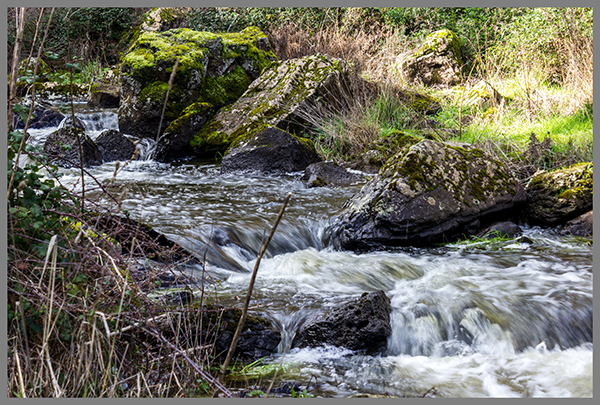
Basalt is a very common normally dark-coloured volcanic rock composed of calcic plagioclase (usually labradorite), clinopyroxene and iron ore. Basalt may also contain olivine, quartz, hornblende, nepheline, orthopyroxene, etc. Basalt is a volcanic equivalent of gabbro.
Basalt is usually black or dark grey and relatively featureless. It is composed of mineral grains which are mostly indistinguishable to the naked eye. Basalt may also contain volcanic glass. Basalt may contain phenocrysts (larger crystals within fine-grained groundmass) and vesicules (holes that were filled by volcanic gases).
Black colour is given to basalt by pyroxene and magnetite. Both of them contain iron and this is the reason why they are black. So this is iron again which is responsible for the coloration of basalt. Plagioclase, volumetrically usually the most important constituent, is mostly pale grey in colour.
Basalt is a major rock type that underlies more of Earth's surface than any other rock type.
What makes basalt so common? Basalt is the original constituent of the crust from which almost all other rock types have evolved.
Morphology and textures:
The shape, structure and texture of a basalt is diagnostic of how and where it erupted.
Subaerial:
Basalt that erupts under open air forms three distinct types of lava or volcanic deposits: scoria; ash or cinder and lava flows.
Columnar basalt:
During the cooling of a thick lava flow, contractional joints or fractures form. If a flow cools relatively rapidly, significant contraction forces build up. While a flow can shrink in the vertical dimension without fracturing, it can't easily accommodate shrinking in the horizontal direction unless cracks form; the extensive fracture network that develops results in the formation of columns.
Pillow basalt:
When basalt erupts underwater or flows into the sea, contact with the water quenches the surface and the lava forms a distinctive pillow shape.
Questions:
- What is the morphology and texture of the basalt visible from falls viewing area and why this is so? (hint the sign at the top of the steps tells you)
- Describe the face of the falls and why do you think it is this way?
- How high is the drop of Moorabool Falls?
Please feel free to log your visit at your convenience but be sure to send your answers to me.
Access:
Access is only permitted from the Harris Road car park (see additional waypoints.)
Please respect the conservation value of this area and remain on the designated path. Along the way there are seats situated to make the most of the view.
Distance:
5.6km return.
Time:
Approximately 1.5 hrs.
Classification:
Class 3 “Walking Track”
“Suitable for most ages and fitness levels. Some bush walking experience recommended. Tracks may have short steep hill sections a rough surface and many steps.”