Karura Forest #49: Valuable Viverrid
 The cache, a custom-made bottle-tops micro is hidden between two stumps at the side of, and approx 1.5m above, the trail in this north-western part of the forest.
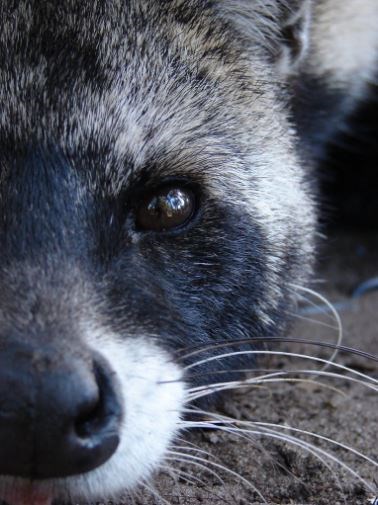
The creature which is the subject of this cache and also #47 and #50 is a resident of the forest which you will probably not see as it is a secretive nocturnalist. However it has been captured on one of the Karura Cams which are set up at various sites in the forest to record animal movements.
To reach the cache: Enter the Forest at Limuru Gate @ S 01 14.830 E 36 48.947, pay the entry fee and proceed to park at the KFEET Centre. From the boom at the KFEET junction @ S 01 14.446 E 36 49.146 head north to Junction 12 and then continue straight ahead along the Syke's Monkey Trail to Junction 12a. Turn left (NW) here and follow the trail down, across the river bridge and then up again to the junction at S 01 13.800 E 36 49.173. Turn right (NE) here and proceed the ~150m to Junction 33. Turn right (SE) and head ~200m through J32 to the cache location
Note: as always, kindly take care to replace the cache carefully so that it is properly concealed using the available materials
For background information on Karura Forest including access, fees, features, a detailed trail map and useful links, see GC4PD3V Karura Forest #1: Intro, Info & Entry
(Continued from GC6NP00 KF#47: Musky Omnivore)
. . . The African civet is the largest viverrid in Africa. There are no great discernible differences in measurements between sexes: weight 7-20kg (ave 12.5kg); length 67-84cm; tail 34-47cm; shoulder height around 40cm. It has a short broad neck, wide head, pointed muzzle, small rounded ears, small eyes and a long bushy tail. It is stocky with a long body and appears short-legged for its size but with hind limbs noticeably larger and more powerful. This arrangement holds the rump high  and the head low in an unusual posture characteristic of civets.
It has 5 digits per paw with the 1st toe slightly set back from the others. It has long, curved, semi-retractile claws. Its feet are compact and unsuitable for digging or climbing and the soles are hairless. Its musculature and strong mandible give it a powerful bite suited to its omnivorous diet.
Like many mammals, it has two types of fur - under fur and guard hairs. Its pelage is coarse and wiry and the coat is unique to each individual - like a fingerprint. The colouration provides a good camouflage.
Following the spine of the animal extending from the neck to the base of the tail is the erectile dorsal crest. The hairs of the erectile crest are longer than those of the rest of the pelage (up to 12cm). If it feels threatened, it raises its dorsal crest to make itself look larger, more formidable and dangerous to attack. This behaviour is a predatory  defence. When threatened, it produces surprisingly loud growls and fearsome coughs.
They have an excellent sense of smell and they can communicate with other civets via olfactory, and also visual and auditory cues. Its most common predators are the large cats like lions and leopards; others include snakes and crocodiles.
Videos: See here for a civet 'group hug', here for a baby civet being fed, and here for a civet family on a lawn.