The Sussex Branch Railroad showcases one of the premier rail trails in the Skylands regions of NJ. Formerly the Sussex Branch of the Delaware, Lackawanna, and Western railroad, this line is steeped in history as well as remarkable scenery. With only a few short interruptions, it is possible to trace this abandonment over twenty miles between the towns of Netcong and Branchville.
This section of the Sussex Branch Trail follows the route through Sussex County from Byram Township in the south to Branchville Borough. Providing service from 1848, the Sussex Branch evolved from the former Sussex Mine Railroad, which was used to transport high-grade iron ore from mines in Andover to the Morris Canal, in Morris County.
The Sussex Branch Railroad got its start in the late 1840s as the narrow-gauge, mule-drawn Sussex Mine Railroad, whose primary purpose was hauling iron ore from the mines in Andover to Waterloo Village on the Morris Canal. There, it was loaded onto barges and transported for processing. As iron mining faded away and towns and industries grew, the railroad began to transport farm products, freight, and passengers. The railroad was eventually upgraded and expanded before being merged into the Delaware, Lackawanna and Western Railroad in the mid-1940s. Though the railroad was out of service several decades later, the state of New Jersey—which owns much of the area parkland—preserved the right-of-way for trail use.
In the late 1800's, Cranberry Lake became a popular resort and day-trip area for its passengers traveling from eastern cities. The railroad ceased operations on the Sussex Branch line in stages during the late l950's and early l960's. The last train ran in 1966. The state acquired The right-of-way in two sections in 1979 and l982, converting it to a rail-trail.
This is an easy field puzzle, the first stage will bring you to a brass plaque embedded into a large rock where you will need to obtain the number to find the nearby final cache. The Final is a home made cache brought from home.
PUZZLE: N 40 55 (A=?) ~ A= WHAT YEAR? 1927 = 312, 1933 = 270, 1945 = 225
PUZZLE W 074 44 (B=?) ~ B WHAT NUMBER FOLLOWS THE LETTER "C"? 7 = 300, 10 = 307, 15, = 298
The Sussex Branch Trail follows a section of the route of the former Sussex Branch line of the Erie-Lackawanna Railroad that extends through Sussex County from Byram Township in the south to Branchville Borough. Providing service from 1848, the Sussex Branch evolved from the former Sussex Mine Railroad, which was used to transport high-grade iron ore from mines in Andover to the Morris Canal, in Morris County where it was loaded onto barges and transported for processing. As iron mining faded away and towns and industries grew, the railroad began to transport farm products, freight, and passengers.
In the lace 1800's, Cranberry Lake became a popular resort and day-trip area for its passengers traveling from eastern cities. The railroad ceased operations on the Sussex Branch line in stages during the late l950's and early l960's. The last train ran in 1966. The state acquired The right-of-way in two sections in 1979 and l982, converting it to a rail-trail.
The Sussex Branch Trail got its start in the late 1840s as the narrow-gauge, mule-drawn Sussex Mine Railroad, whose primary purpose was hauling iron ore from the mines in Andover to Waterloo Village on the Morris Canal. The railroad was eventually upgraded and expanded before being merged into the Delaware, Lackawanna and Western Railroad in the mid-1940s. Though the railroad was out of service several decades later, the state of New Jersey—which owns much of the area parkland—preserved the right-of-way for trail use.
The chronology of this railroad's lifespan is of particular interest. Its predecessor, the Sussex Mine Railroad, spanned only seven miles from Waterloo Village on the Morris Canal to Andover Iron Mine just northeast of the town of Andover. Completed in 1851, this line was narrow gauged, meaning the rails were only forty inches apart. The Mine Railroad relied on mules to pull the ore carts rather than steam engines. This line is referred to as a "predecessor" because the Sussex Railroad, built in 1854 and extended to Newton, utilized only about two miles of the "mine" railroad's right of way. Both lines were the brainchild of Abrahm S. Hewitt, a mining pioneer at Long Pond near Ringwood as well as co-founder of the Cooper-Hewitt furnaces in Phillipsburg. Most significantly, this was Sussex County's first railroad.
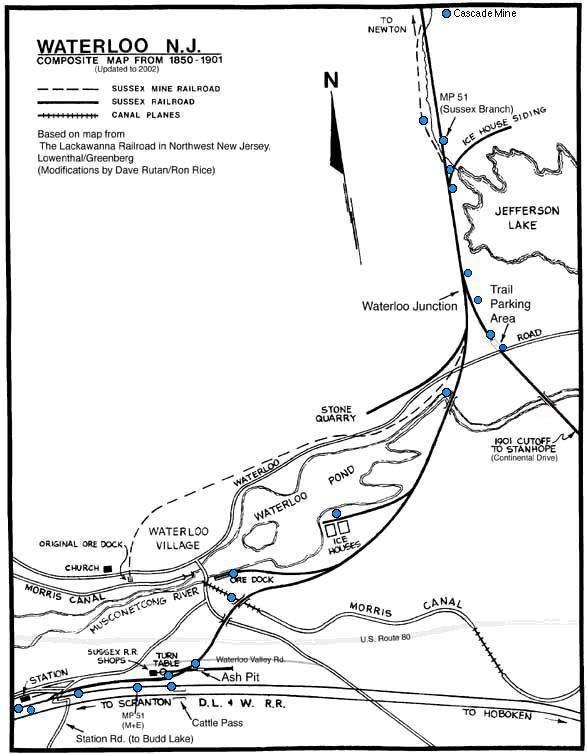
The Sussex Branch Trail as a State Park owned trail begins at the parking lot on Waterloo Road, but the first section of "trail" is actually along Continental Drive, just a bit north of International Drive in International Trade Center near the Holiday Inn. The southern section was actually not part of the main Sussex Branch, but rather the "cutoff" to Stanhope built in 1901 that rendered the older line obsolete. Though it's hard to reach, the section of the Sussex Branch from Morris Canal's Inclined Plane #4 West to the Musconetcong River is walkable, and passes by the ruins of the industrial ice company that once operated at Waterloo Lake.
Completed in 1851, this line was narrow gauged, meaning the rails were only forty inches apart. The Mine Railroad relied on mules to pull the ore carts rather than steam engines. This line is referred to as a "predecessor" because the Sussex Railroad, built in 1854 and extended to Newton, utilized only about two miles of the "mine" railroad's right of way. Both lines were the brainchild of Abrahm S. Hewitt, a mining pioneer at Long Pond near Ringwood as well as co-founder of the Cooper-Hewitt furnaces in Phillipsburg. Most significantly, this was Sussex County's first railroad.The Sussex Branch’s hard cinder path cuts through rock and woods on the southern end, skirts the shores of Cranberry Lake and widens into open fields north of Newton.Walk from the trail's main southern access point on Waterloo Road in Byram Township, across from International Drive at the Trade Center through a beautiful wooded area, skirting Jefferson Lake to the east. Some deviations the mine railroad had from the newer line are now part of Allamuchy Mountain State Park and can make interesting return routes for out-and-back hikes. In fact the Highlands Trail, marked with teal diamonds and linking New York State southwest across Sussex and Morris Counties to the Delaware River in Warren and Hunterdon Counties utilizes both the mine railroad bed and the main line.The trail continues to the beautiful former resort community, Cranberry Lake, as well as Kittatinny Valley State Park where a variety of circuit hikes are possible. It passes through the towns of Andover and Newton, traverses the swamps of the awe-inspiring Newton Meadows, meets the Paulinskill Valley Trail at Warbasse and heads for the quaint village of Lafayette. At its north end, the rail-bed traverses a great deal of farmland and offers beautiful scenery of the Paulinskill River and it's tributaries.Later, in 1869 the Sussex Railroad was extended to Branchville, the trail's northern terminus where you'll find an antique store, a weekend flea market, as well as plenty of eateries. While plans were made to extend the railroad through Culver's Gap, they never came to fruition.
The Sussex Branch Trail as a State Park owned trail begins at the parking lot on Waterloo Road, but the first section of "trail" is actually along Continental Drive, just a bit north of International Drive in International Trade Center near the Holiday Inn. The southern section was actually not part of the main Sussex Branch, but rather the "cutoff" to Stanhope built in 1901 that rendered the older line obsolete. Though it's hard to reach, the section of the Sussex Branch from Morris Canal's Inclined Plane #4 West to the Musconetcong River is walkable, and passes by the ruins of the industrial ice company that once operated at Waterloo Lake.