The "Franklinite" cache along the Sussex Branch Trail showcases one of the premier rail trails in the Skylands regions of NJ. Formerly the Sussex Branch of the Delaware, Lackawanna, and Western railroad, this line is steeped in history as well as remarkable scenery. With only a few short interruptions, it is possible to trace this abandonment over twenty miles between the towns of Netcong and Branchville. This section of the Sussex Branch Trail follows the route through Sussex County from Byram Township in the south to Branchville Borough.
This section of the Sussex Branch Trail also got its start providing service in 1848 as the narrow-gauge, mule-drawn Sussex Mine Railroad, whose primary purpose was hauling iron ore from the mines in Andover to Waterloo Village on the Morris Canal. The railroad was eventually upgraded and expanded before being merged into the Delaware, Lackawanna and Western Railroad in the mid-1940s. Though the railroad was out of service several decades later, the state of New Jersey—which owns much of the area parkland—preserved the right-of-way for trail use.
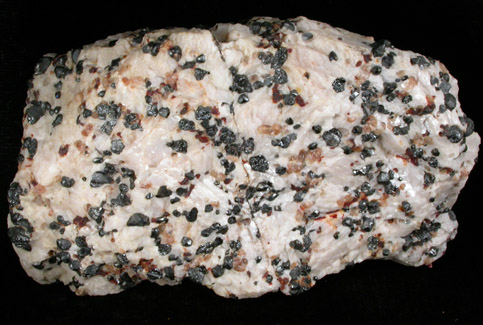 Franklinite
Franklinite was a minor ore of zinc, manganese, and iron. It is named after its local discovery at the Franklin Mine and Sterling Hill Mines in New Jersey. Franklinite is named after the locality of Franklin, New Jersey, where it is found. To date, this mineral is found only at Franklin and neighboring Ogdensburg, New Jersey. There are no other localities for Franklinite, but at these two localities it is quite abundant. Large crystals of previous mining eras are no longer found, and are considered classics that are highly sought-after by collectors.
Since Franklinite and zinc ores were carted ten miles to the Morris Canal or to the Morris & Essex Railroad at an expense of $2 per ton, the mine owners spent about $30,000 annually for cartage and the increasing demand for zinc paint and Franklinite iron was soon expected to double that sum. On May 17, 1862, the New York Herald promoted a railroad extension, expecting that “as the franklinite cures both the red and cold short qualities of other irons, the amount that might be used on the North [Hudson] river would soon reach one hundred thousand tons per annum.”
The battle between the ironclad gunboats, the Monitor and the Merrimac, at Hampton Roads in March 1862 generated considerable excitement around the world and predicated “a complete revolution in the construction of naval vessels ....” The War Department of Great Britain experimented upon two ironclad targets — one of the same thickness as the American Monitor and the other built to the specifications of the British man-of-war Warrior — proving that either could be riddled at a distance of 200 yards.
A single bar of Franklinite, tested by order of the French government at the National Forges of the Cussade, proved that its tenacity exceeded that of the best irons of England, Spain, Sweden or Siberia, all of which were tested at the same forges. The New Jersey Herald urged the Federal government to experiment with Franklinite as the best article for use in iron cladding its ships, for manufacturing cast and wrought iron for large caliber guns and for covering forts.