올림픽공원에는 '제24회 서울올림픽대회'라는 작품이 전시되어 있다. 이 작품에서 작가는 서울올림픽대회를 기회로 고대올림픽의 이상을 재현하고자 오륜을 상징하는 5개의 기둥이 무한히 상승하면 확장하는 공간성과 작품 내부구조가 형성하는 건축성, 그리고 화강암, 현무암 그리고 콘크리트 등의 재료가 선사하는 마티에르(표면상의 질감)의 다양성이 주변 환경을 변화시킨다는 주제로 작품을 만들었다고 설명하고 있다.
"There is a sculpture with the title 'Seoul XXIV Olympiad' in Olympic Park. The sculpture uses the 24th Seoul Olympics as an opportunity to reproduce the ideals of the ancient Olympic. The sculpture symbolizes architectural characteristic formed by its inner structure, and uses diverse materials such as basalt, granite and concrete. The surrounding environment changes the spatiality extended by the five pillars' infinite rise, the five Olympic rings." The artist explains his work of art.
화성암이란 무엇인가?
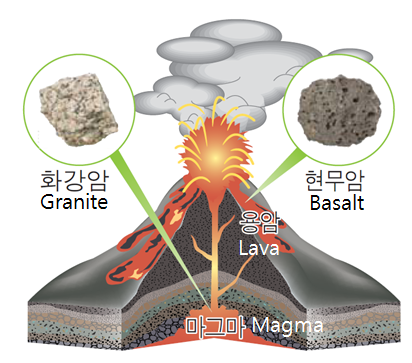
화성암은 녹은 바위가 굳어지는 과정에서 형성된다. 크게 두가지 형태가 있다.
관입화성암은 지표면 아래에서 굳어지며, 천천히 굳어져서 큰 결정을 이룬다. 관입화성암에는 섬록암, 반려암, 화강암, 화강암질 페그마타이트 그리고 감람암이 있다.
분출화성암은 용암이 지표면으로 분출하면 굳어진 암석으로 빨리 식어서 결정이 대체로 작다. 어떤 경우에는 너무 빨리 식어 비결정질 유리가 되기도 한다. 분출화성암에는 안산암, 현무암, 흑요석, 부석, 유문암, 화산암재 그리고 응회암이 있다.
여기서는 작품에 쓰여지기도 하였지만 관입화성암의 대표격인 화강암과 분출화성암의 대표인 현무암에 대해서 살펴보기로 한다.
 What are Igneous Rocks?
Igneous rocks are formed from the solidification of molten rock material. There are two basic types.
Intrusive igneous rocks crystallize below Earth's surface, and the slow cooling that occurs there allows large crystals to form. Examples of intrusive igneous rocks are diorite, gabbro, granite, pegmatite, and peridotite.
Extrusive igneous rocks forms when the lava erupt onto the surface, where they cool quickly to form small crystals. Some cool so quickly that they form an amorphous glass. These rocks include andesite, basalt, obsidian, pumice, rhyolite, scoria, and tuff.
Today we will learn about granite and basalt which are used in the sculpture.
화강암
화강암(花崗巖)은 대륙지각의 깊고 압력이 높은 곳에서 형성되는 규장질 심성암 중에 가장 흔히 발견되는 종류이다. 화강암은 주로 칼륨장석과 사장석, 석영, 흑운모 등으로 이루어지나 각섬석, 백운모가 들어가 있는 경우도 있고, 그 밖에 조광물로 자철석, 석류석, 저어콘, 인회석 등이 있다. 드물게 휘석이 있는 경우도 있다.
화강암의 색조는 분홍색, 밝은 회색을 띠는 경우가 대부분이다. 화강암내 칼륨장석은 분홍뱇 색상을 띠게 한다. 화강암은 괴상을 이루는 경우가 많기 때문에 내부구조가 없는 경우가 많고, 강도가 높아서 건축용으로 폭넓게 사용된다.
화강암은 작게 나타날 때는 100 km2 이하의 암주와 비슷한 덩어리로 나타나지만, 크게 나타날 경우에는 조산대에서 저반 형태로 산출된다. 화강암은 지질시대동안 계속 대륙지각을 관입해 왔으며 특히 대부분은 선캄브리아대에 형성되었다. 화강암은 대륙지각에 널리 분포하며 대륙 표면을 얇게 덮고 있는 퇴적물의 가장 흔한 기반암이기도 하다.
대한민국에는 중생대 쥐라기 대보 조산운동과 백악기 불국사 조산운동때 관입한 화강암이 전국적으로 분포한다. 화강암은 맑은 지하수의 수원이 되기 때문에 주변에 도시가 많이 발달하였다.
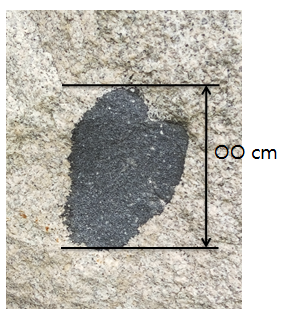
이곳 화강암에서는 포유암을 관찰할 수 있다. 포유암은 마그마가 미처 다 식기 전에, 더 뜨거운 염기성 마그마가 식어가는 기존 마그마에 침투해 폭발하면서 암석의 파편들이 기존 마그마속에 퍼져서 굳어진 것을 말한다. 이경우 기존화강암과 포유암의 주요 암석 성분은 비슷하다. Waypoint 2에 가면 모암인 화강암에 박혀서 불순물처럼 보이는 입자가 고운 검정색 암석을 볼 수 있다. 이것이 포유암이다. 더 자세한 내용은 불암산에 있는 이 어스캐시를 참고하세요
포유암은 포획암과 구분된다.포획암은 암석의 틈 사이로 마그마가 관입하면서 그 주변의 모암의 일부분 암편을 떼어내어 관입한 마그마 속에 포획되어 진 것을 이야기한다. 여기서 화강암과 포획암의 주요 성분은 당연히 서로 다르다.
Granite
Granite is a common type of felsic intrusive igneous rock that is granular and phaneritic in texture. Granites can be predominantly white, pink, or gray in color, depending on their mineralogy. The word "granite" comes from the Latin granum, a grain, in reference to the coarse-grained structure of such a holocrystalline rock. By definition, granite is an igneous rock with at least 20% quartz and up to 65% alkali feldspar by volume.
The term "granitic" means granite-like and is applied to granite and a group of intrusive igneous rocks with similar textures and slight variations in composition and origin. These rocks mainly consist of feldspar, quartz, mica, and amphibole minerals, which form an interlocking, somewhat equigranular matrix of feldspar and quartz with scattered darker biotite mica and amphibole (often hornblende) peppering the lighter color minerals. Occasionally some individual crystals (phenocrysts) are larger than the groundmass, in which case the texture is known as porphyritic. A granitic rock with a porphyritic texture is known as a granite porphyry. Granitoid is a general, descriptive field term for lighter-colored, coarse-grained igneous rocks. Petrographic examination is required for identification of specific types of granitoids.
Granite is nearly always massive (lacking any internal structures), hard and tough, and therefore it has gained widespread use throughout human history, and more recently as a construction stone.
Normally granite rocks mainly consist of potassium feldspar, plagioclase, quartz, mica and amphibole minerals. In some rocks around the falls you can easily find the rocks with pink color. It is the potassium feldspar that gives many granites a distinctive pink color.
You can observe a enclave in one of granites here. Enclaves are volumes of rock surrounded by emplaced host rock of related but distinct composition and of separated genesis (incomplete magmatic mixing). You can see a fine grained rock embedded in the host rock like impurity. That is 'Enclave'. When the magna that later became the host rock was cooling down the hotter mafic magna penetrated into it and made the explosion. Enclaves are the fragment of this explosion. Please refer to this earthche in the Bulamsan mountain for further information!
The xenolith is different from the enclaves. A xenolith is a rock fragment which becomes enveloped in a larger rock during the latter's development and hardening. In geology, the term xenolith is almost exclusively used to describe inclusions in igneous rock during magma emplacement and eruption. Xenoliths may be engulfed along the margins of a magma chamber, torn loose from the walls of an erupting lava conduit or explosive diatreme or picked up along the base of a flowing body of lava on the Earth's surface.
현무암
현무암(玄武岩, basalt)은 회색~흑색의 분출 화산암이다. 이산화규소의 함량(45~52%)이 상대적으로 낮은 특징이 있다. 지표에서 용암이 급속이 냉각되기 때문에 보통 세립질이거나 은미정질이다. 세립질의 석기에 큰 결정을 포함하고 있는 반상질이거나, 기공질, 혹은 거품이 많은 스코리아(scoria)으로 나타난다. 유색광물로는 휘석과 감람석이, 무색광물로는 사장석 등이 주요 광물이다. 풍화되지 않은 현무암은 흑색 혹은 회색이지만, 철분의 산화에 따라 붉은색이나 자주색이 되기도 한다.
현무암의 표면에는 구멍이 많이 있다. 이것은 용암이 식을 때, 용암 안에 있던 기체가 분리되어 압력이 약한 위쪽 또는 아래쪽으로 모인 후, 공기 중으로 날아간 흔적이다. 현무암 중에는 기포가 거의 없는 것도 있다. 어느 것이 현무암 용암층의 바깥쪽 부분이고, 어느 곳이 용암층의 안쪽일까? 표면이 거칠고 기포가 많은 곳이 용암층의 바깥쪽이고, 기포가 거의 없는 부분이 용암층의 안쪽이다.
Basalt
Basalt is a common extrusive igneous (volcanic) rock formed from the rapid cooling of basaltic lava exposed at or very near the surface of a planet or moon. Flood basalt describes the formation in a series of lava basalt flows.
Around the cache zone basalt rocks have air pocket on the surface.Some basalt has no air pocket. What is the reason? The drop in pressure that a magma experiences as it flows from underground to the Earth's surface allows water and gases in the lava to form bubbles. If the bubbles do not get large enough to pop, they are frozen in the lava as vesicles. These vesicles are concentrated mainly in outer layers of the lava formation. There are scarcely any vesicles deep inside the lava formation.
[로그하는 방법]
- 현무암은 용암이 지표면으로 분출하면 굳어진 암석으로 빨리 식어서 결정이 대체로 작다. (진실/오류)
- 현무암은 모두 표면에 많은 가스 구멍이 있다. (진실/오류)
- Waypoint 1에 있는 암석은 현무암이고 표면에 가스 구멍이 많다. (진실/오류)
- 화강암은 지하에서 빨리 식어서 굳어진 암석으로 그 결정이 대체로 크다. (진실/오류)
- Cache 좌표에서는 두가지 색상의 화강암을 볼 수 있습니다. 어느쪽에 있는 화강암이 핑크색을 띠나요?
- 위 화강암은 왜 핑크색을 띠나요?
- Waypoint 2에 있는 화강암에서 아래 사진의 포유암을 찾아서 그 크기는 얼마인지 측정하세요.
- 캐시좌표 위치에서 Cache zone을 배경으로 당신 또는 당신의 GPS를 찍은 사진을 로그에 올려주세요. 위 문제 7의 포유암이 사진에 포함되지 않도록 해주세요. (선택사항이지만 사진을 올려주시기를 부탁드립니다.)
- 답을 제 Profile에 있는 메시지창을 이용해 제게 보내주세요. 이제 로그하셔도 됩니다. 답에 문제가 있을 경우 제가 메시지를 드리겠습니다.
 [How to log]
- Basalt rocks form when the lava erupt onto the surface, where they cool quickly to form small crystals. (True/False)
- All the basalt rocks has a lot of gas pocket on the surface. (True/False)
- The rock at Waypoint 1 is basalt and it has a lot of gas pockets on the surface. (True/False)
- Intrusive igneous rocks crystallize below Earth's surface, and the quick cooling that occurs there allows large crystals to form. (True/False)
- You can observe two types of granites with different colors at publicized coords. Granite on which side has a tinge of pink?
- Why above granite has a tinge of pink?
- Please find a enclave in the picture at Waypoint 2 and check its size!
- Upload the photo of you or your GPS with the cache zone in the background at the cache coordinates! Do not include the enclave in Question 7 in the picture! (The task is optional but I would highly appreciate if you would do so.)
- Please send the answers to me by message on my profile! You may log as 'Found'. If the answer is not correct, I will contact you.
Reference:
https://en.wikipedia.org
http://bio-geo-terms.blogspot.kr
http://geology.com
https://ko.wikipedia.org
http://study.zum.com
| I have earned GSA's highest level: |
 |