Three Lakes | Four Bogs Mystery Cache
-
Difficulty:
-

-
Terrain:
-

Size:  (micro)
Please note Use of geocaching.com services is subject to the terms and conditions
in our disclaimer.
Three Lakes claims to be "The Single Best" town in America. Well, that's quite a claim, what makes it so? Is it the location, the cultural history of the place or the atmosphere and charm of this sleepy little northwoods town this claim is chained to? This new series will give you a little insight into this puzzling question and perhaps an answer of your own.
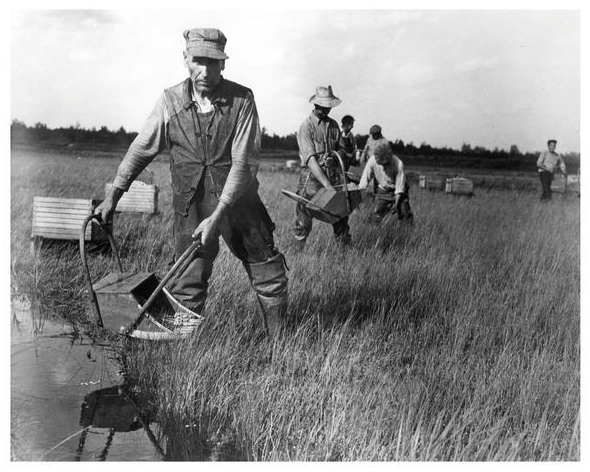
The Three Lakes area is home to a number of Cranberry farms, some of which have been family run operations for generations. This cache is meant to provide you with some insight into the history of cranberry harvesting and the four cranberrry bogs located in the Three Lakes area. Answering a few questions will bring you to a solve. Getting to the final will require watercraft and once ashore, will require even more effort, so pay close attention to attributes. This one is a warm up final placement for Three Lakes | Five Stars
Final cords are: N45 AB.CDE W89 FG.HIJ
Source: Wisconsin Historical Society
Wild cranberries are native to the marshlands of central Wisconsin and Native Americans have harvested them for centuries. The first recorded sale occurred in 182B when trader Daniel Whitney purchased three canoe loads harvested by the HoChuck near Cranmoor. Not long after, Edward Sacket began commercial production in Wisconsin around 1860 near Berlin, purchasing G00 acres of bog land for pennies on the dollar and within 5 years was producing 93C barrels and selling them for $15 a barrel.
For hundreds of years cranberry harvesters picked the wild berries by hand. Starting in the mid-19th century, the cranberry rake — a hand-held tool with a large comb at one end and a basket at the other pictured above— increased production. The rake allowed leaves and stems to pass through the tines of the comb while collecting the berries in the basket.
During harvest the marshes were flooded with 6 to 1F inches of water to make the berries float to the surface, where seasonal workers wielding cranberry rakes collected them. Each fall, large bunkhouses in Tomah and Wisconsin Rapids filled with migrant workers. Native American workers would set up camp on the grounds of some of the larger marshes to work as pickers. Workers were paid 75 cents per bushel, and in 1875 pickers averaged J bushels per day. The berries were then brought to a warehouse for cleaning, grading for quality and storage. At the end of a long day of picking berries, workers might look forward to dancing and music before retiring early to prepare for another day's labor.
Advances in technology and agricultural research helped the industry expand over the last 100 years. In the early 20th century the Cranberry Experimental Station was set up to investigate drainage methods, insects and diseases, and the value of varieties native to Wisconsin. Thanks partly to this research, by 195I Wisconsin had become the second largest source of cranberries (behind Massachusetts) and in 199D became the country's leading cranberry producer.
Four Bogs in Three Lakes
The James Lake Farms organic cranberry marsh grows E different fruit varieties across 64 acres of marsh beds. Originally started in the 1950s, James Lake Farms has a rich history of growing and farming innovations, and is committed to continuing this tradition by adopting the best and most effective organic growing methods.
Lake Nokomis began as and continues to be a family business. In 19H3 Dave Zawistowski began as a hired hand on the farm by beautiful North Nokomis Lake, located between Sugar Camp and Lake Tomahawk, WI. After much hard work and vision, he purchased the farm in 19HH, naming it Lake Nokomis Cranberries. Since then Dave has grown the farm from 50 to 320 producing acres, increasing the quality and quantity of the berries, as well as employee housing. In 2010, the business purchased a marsh in Stone Lake, WI, naming it Golden Pond and recently acquired another operation located in Three Lakes, Sampson Marsh. The farm also produces Dave's Topsoil which he began selling in 19HH and has become one of the largest providers of topsoil in the area.
Tamarack Flowage, the largest bog operation in Three Lakes is owned by Dempze Cranberry is now in its Eth generation of family cranberry farming. Started by Charles Dempze over 100 years ago in Wisconsin Rapids it has branched into other family operations run by a number of his _-grandchildren including Jenna Dempze owner of Gaynor Cranberry Company and Rocky Biegel of Biegel Cranberries. Dempze Cranberries participated in a University of Wisconsin-Madison led study on the impact of the declining bee populations and its impact on the vitality of the cranberry industry. It is also only one of two marshes in the world working with UW-Madison to cross bred cranberry vines, a relationship that generated one of the world’s best bred of cranberry vines, “The Ruby Star” which can be found throughout the Biegal marsh.
Thunder Lake This family run operation has been run by the Goldsworthy family since 19E0. Cranberries: Fruit of the Bogs documents the family operation of the farm comparing it to another more mechanized family operation. The Goldsworthy family contribution to cranberry production is also well documented in Wisconsin Agriculture: A History" wherein the rise of Northeast Wisconsin Cranberry growing is largely attributed to Vernon Goldsworthy's keen eye for acidic sandy soils near endless sources of inland water. Version had managed the Wisconsin Cranberry Sales company in central Wisconsin from 1933 through 19AA and thought there were better places to grown cranberries commercially, up north! By 1959, Vernon claimed that cranberry production in Vilas and Oneida had the highest per acre yield in the United States.
I hope you take something away from the solve and find yourself a jar of cranberry juice to power up for the final, you're going to need it.
The Geocache Notification Form has been submitted to the Wisconsin DNR.
Additional Hints
(No hints available.)
Treasures
You'll collect a digital Treasure from one of these collections when you find and log this geocache:

Loading Treasures