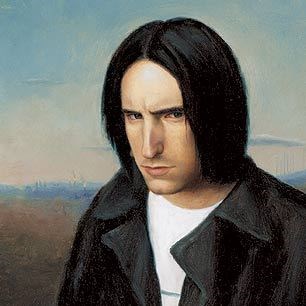
When the gods of nasty sounds tacked audition cards to the trees around town encouraging the brutes of industrial rock to brawl for the crown, a small lad with a tuba was probably not what they had in mind for a contender. His name was Michael Trent Reznor, and he also played sax and piano and learned early in life how to engineer a recording-studio console. He produced a terrific debut album called Pretty Hate Machine. Melodically oriented — and, because of record-company contractual problems, supported by what became a three-year tour — it birthed the first real mainstream breakthrough for industrial rock, selling over a million copies.
Following Brian Eno's example, Reznor unpacked his synth and threw away the manual. In making The Downward Spiral, he encouraged the computer to misconstrue input, willed it to spew out bloated, misshapen shards of sound that pierced and lacerated the listener. As a companion piece to Baudelaire's "To the Reader" — the preface to his Flowers of Evil — and second to the Velvet Underground, there has never been better soul-lashing in rock.
I had a strange dream a few years back. Lou Reed, myself and a friend known as Warren Peace were having dinner in one of those old-style Greenwich Village places where Pollock was supposed to have fought other painters. Our meal was served by one of the members of Einstúrzende Neubauten. I slowly became aware of the house music and that it was infuriatingly familiar. Our waiter, Blixa Bargeld, leaned in to me and whispered, "The music is a birthday surprise for Lou. Trent Reznor remixed this version of Metal Machine Music as a present."
As he said this, strands, splodges and blots from a Pollock early-Fifties "drip" painting materialized in front of our faces. While the music got louder, the paint hurtled around us faster and faster till we ran nauseous from the cafe, chased by infernal screaming lavender, blue and black snakes.
And that is it, really. Trent's music, built as it is on the history of industrial and mechanical sound experiments, contains a beauty that attracts and repels in equal measure: Nietzsche's "God is dead" to a nightclubbing beat. And always lifted, at the most needy moment, by a tantalizing melody.
I cannot believe that Spiral was released nearly 20 years ago now. It still sounds incredible today. And, no, no one ever calls him Mickey.