The 4th Ring Road (Chinese: 四环路; pinyin: Sìhuánlù) is a controlled-access expressway in Beijing, China which runs around the city, with a radius of approximately 8 kilometers (5.0 mi) from city center. The total length of the road is 65.3 kilometers (40.6 mi). There are 147 bridges and viaducts that run the length of the Ring Road.
The first section, the northern corridor, was completed in preparation for the 1990 Asian Games. The Ring Road was 'enclosed' in a full circle in June 2001, with standard controlled-access expressway throughout.
Route
The 4th Ring Road runs within the confines of the city of Beijing, more like a rectangle than a circle.
The route travels past: Siyuan Bridge - Chaoyang Park Area - Sihui - Sifang Bridge - Shibalidian - Dahongmen - Majialou - Yuegezhuang Bridge - Fengtai Area - Sijiqing Area - Zhongguancun Area - Jianxiang - Asian Games Village Area - Wanghe Bridge - Siyuan Bridge
The entire express road is complete and open to traffic.
History
Already in the early 1990s, the northern stretch of the 4th Ring Road from Zhongguancun to Siyuan Bridge existed as a ring road, albeit with far narrower road conditions and with traffic lights. Only three flyover viaducts—those at Jianxiang, Anhui Bridge and Siyuan Bridge—existed.
To commemorate the 50th anniversary of the People's Republic of China, the eastern stretch of the 4th Ring Road was opened from Siyuan Bridge to Shibalidian around October 1, 1999. This was the first part of the ring road to be opened as an 8-lane expressway (4 lanes per direction, not including an emergency line).
The northern part of the 4th Ring Road from Jianxiang to Siyuan Bridge was converted to an 8-lane expressway in late September 2000. Later that year, the southern part from Shibalidian through to Fengtai opened to traffic, as was the case with the northwestern part.
By June 2001, the entire 4th Ring Road had been converted into an expressway-standard thoroughfare.
In early 2004, the speed limit was reduced to a unified 80 km/h (minimum speed limit: 50 km/h).
In September 2004, the 4th Ring Road underwent a massive sign change. Exit numberings were unified at last—bidirectional (this was previously not the case).
A new overpass in the northern stretch was put into operation in October 2004, near the Beichen area.
Speed Limit
Previously: first lane, min. 80 km/h, max. 100 km/h; second lane, min. 70 km/h, max. 90 km/h; third lane, min. 60 km/h, max. 80 km/h; fourth lane, min. 50 km/h, max. 80 km/h; auxiliary road, uniform max. speed limit of 70 km/h. Readjusted in 2004 so that all lanes have a uniform min. speed limit of 50 km/h and a max. speed limit of 80 km/h; aux. road max. speed limit of 70 km/h remains unchanged.
Signs
When it was opened by 2001, the 4th Ring Road's signs were plagued by inconsistency. Mixing of Hanyu Pinyin and English on the signs confused drivers, but what was most confusing was the exit numbering. It so happened that the same exit had two different exit numbers—one for each direction of the ring road.
Beijing authorities had three years' lapse before they dealt with the problem. Old signs were progressively replaced by newer signs which had standardized English and, finally, a new exit numbering system was in place. A sketch map of each exit, formerly only for expressways and isolated spots, was also introduced along with the new sign numbering.
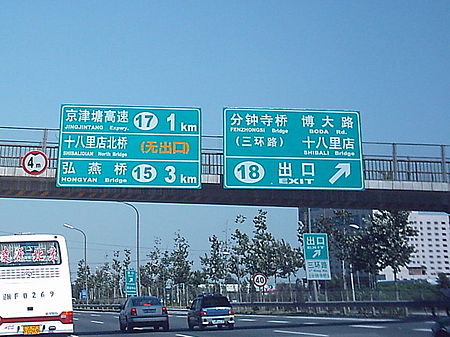
Another change was the use of traffic sign language to signal traffic regulations instead of relying completely on Chinese Hanzi. Some bridge names (e.g. Sihe Bridge) are also getting a name change at the same time.
The project was somewhat Herculean since 441 signs were to be replaced. Of those, exit and entrance signs formed 202 signs; other, mainly larger-sized signs, formed the remaining 239 signs. Earlier in the summer of 2004, similar measures for the 5th Ring Road (which had an absent-to-chaotic exit numbering system) were announced.
In a show of speed, within the first 100 hours, new exit numberings were put up for almost all of the western stretch of the 4th Ring Road (despite new/old signs being alternated on a different stretch of the ring road).
Reaction to the new signs are mixed. There is a definitive plus side: the exits are now matched with their equivalent exit/bridge names on the 3rd and 5th ring roads. Unfortunately, many complain of an information overkill. Signs are now complex enough to hold five different directions (on some bridges). Meanwhile, the mixing of lowercase and uppercase English in small font sizes is another concern.
On both the 4th Ring Road and the 5th Ring Road, some speed cameras were put into place, along with the general sign changes.