NOTE: Do not do this cache from the freeway - Use the trailhead supplied!
Did you know that Blackjacks, often considered the curse of the geocacher, are edible? If not, read on. 

Blackjack (Bidens pilosa)
Blackjacks
Scientific name
Bidens pilosa.
Common names
Blackjack, Spanish needle, hairy beggar ticks, farmer's friend, cobbler's pegs, pitchforks, kichoma mguu (Kiswahili), labika (Acholi), muceege (Kikuyu), ononot (Lango)
Description
The fresh or dried tender shoots and young leaves are eaten in some cultures, especially in times of food scarcity. It is used as a medicinal plant in many regions of Africa.
Bidens pilosa is an annual herb with an erect habit to 1.5 m in height (Stanley and Ross 1983-1989). It is easily recognised by the elongated fruits that bear hooked bristles (burrs) that embed themselves in people's clothing as they brush past the stems.
Stems are square in cross section (quadrangular), mostly hairless and green to purplish in colour. The leaves are oppositely arranged with leaf stalks (petioles) 1-6.5 cm long. Their margins have forward pointing teeth (serrated). Leaf blades vary in shape. At the base of the plant, leaves tend to be simple and more or less oval in shape, higher up the plant leaves are mostly compound (pinnate) with 3-7 egg-shaped with broad end at base (ovate) leaflets, and the uppermost leaves are smaller and simple or with 3 leaflets (trifoliolate). Leaf or leaflet size varies from 1.5-7 x 0.5-3.5 cm.
Flower-heads are 7-8 mm across with yellow central (tubular) florets. Some plants have flower-heads with white or cream 'petals' (ray florets) up to 1.5 cm long, however these 'petals' may be absent or quite small. Heads are arranged in branched inflorescences at the ends of the branches. Flowering occurs over most of the year. The seeds are black, flattened, linear in shape (0.4-1.6 cm long) with a row of two to four barbed awns (2-4 mm long) at one end.
Reproduction and dispersal
Bidens pilosa normally behaves as an annual weed but at least one form, B. pilosa var. radiata, may behave as a perennial. One isolated plant can produce over 30,000 seeds, which are generally highly viable. Seeds germinate on the soil surface or in shallow soil (to a depth of 1 cm). Seeds at greater depths remain viable in the soil for many years. There is usually a great flush of germination after tillage of the soil. Seeds are widely dispersed through the fruits hook-like bristles that embed themselves in clothing and the fur of mammals and feathers of birds. They are also spread by wind, water and soil.
Economic and other uses
The fresh or dried tender shoots and young leaves are eaten in some cultures, especially in times of food scarcity. It is used as a medicinal
The Cache
In order to find the cache, Read the large sign at the published coordinates. On the sign you will find (besides a company name) 8 descriptions of various components, placed in 2 columns of four rows. Consider these as blocks 1 - 8, as per the diagram below (Left to Right, then top to bottom)
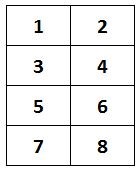
The cache is located at S29 4A.BCD and E30 5W.XYZ.
Use A=1; B=2 etc
Where
A = Block 1 Letter 3 divided by 2
B = Block 8 Letter 4
C = Block 2 Letter 7
D = Block 6 Letter 2
W = Block 4 Letter 2
X = Block 7 Letter 4 divided by 8
Y = Block 5 Letter 7 minus Block 8 Letter 10
Z = Block 2 Letter 5
References (for more information)
Weeds Data
Blackjack Bredie
Wiki