
Geocache Identification Permit Approval Number: SSP20161028173
Permit Expires on: 10/28/19
The Morris Canal series of caches are placed along the canal towpath in partnership with the Waterloo Village Historic Site and the Canal Society of New Jersey to showcase the important early transportation across New Jersey. The Morris Canal connected the Delaware and Hudson Rivers and facilitated development of cities and industry in New York and New Jersey.
For much of the mid-19th century, the anthracite canals of New Jersey, New York, and Pennsylvania played a vital role in the industrial revolution and the development of our region.
By the early 1800’s wood for heating homes and making charcoal for the iron industry became scarce and expensive. They used charcoal made from trees from local forests and it took 1,000 acres of trees to power one iron forge. As a result, iron furnaces and forges were shutting down. A new fuel was needed. Hard coal, called “anthracite,” was discovered in Pennsylvania. It became the major fuel in our region for the next 100 years.
A system of six canals was built to move this coal to the markets:
- The Delaware & Hudson Canal in Pennsylvania and New York
- The Lehigh Canal in Pennsylvania
- The Delaware Canal in Pennsylvania
- The Schuylkill Canal in Pennsylvania
- The Delaware & Raritan Canal in New Jersey
- The Morris Canal in New Jersey
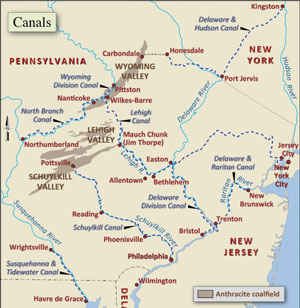 Anthracite Coalfields and Canals
The construction of this canal system resulted in establishment and growth of towns and cities along the canals. It revived the iron industry, made possible the rapid expansion of industrial and economic enterprises, and fostered the advance of technology. Without anthracite canals, the development of our region would have been delayed many years until the railroads matured enough to transport these bulk goods.