Three Butte-ful Sisters EarthCache
Please note Use of geocaching.com services is subject to the terms and conditions
in our disclaimer.
The Three Sisters are a series of three very distinctive hills near Victoria West in the Northern Cape Province of South Africa. The farm on which they are situated and the nearby railway siding are also named Three Sisters (Wikipedia, 2016). This Earthcache aims to tell you a little more about the origins and formation of this famous Karoo landmark. At the listed co-ordinates you will be able to safely pull over off the N1 to view these landforms.
The Three Sisters are classical examples of a geological formation that is called a butte [pronounced byu:t ] and defined as an isolated hill with steep, often vertical sides and a small, relatively flat top. The word butte comes from a French word meaning “small hill” (Wikipedia, 2016). Buttes are created by continual erosion of a mesa.
A mesa is an isolated table-land area with steep sides, the result of a horizontal capping of hard strata having resisted erosion (Whitten & Brooks, 1972). The word mesa is taken from the Spanish word meaning “table” (Wikipedia, 2016). In the course of time, with continual erosion of the sides, a mesa is reduced to a smaller flat-topped hill – a butte. Mesa’s themselves are derived from the erosion of a plateau; which is a broad, flat area of appreciable elevation above its surroundings (Press & Siever, 1974).
The figure below illustrates how plateaus are eroded over time, often leaving behind mesas and buttes.

Buttes eventually erode even further to become pinnacles, and ultimately when eroded to the point where it can no longer support itself, the pinnacle falls down and all that is left is a small hill or mound. This too will finally be eroded down to the level of the surrounding plains, leaving no trace of it whatsoever.
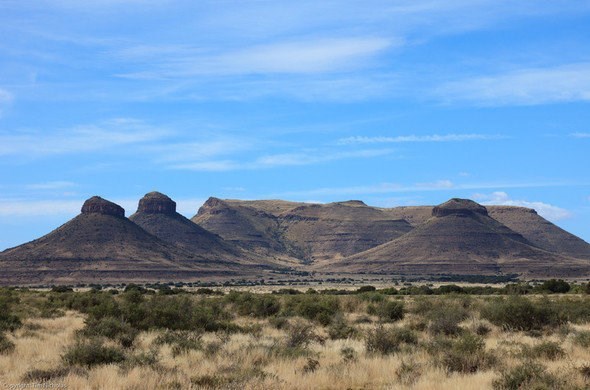
What made the formation of The Three Sisters possible is the resistant layer of dolerite that caps the softer Beaufort Group sedimentary rocks in the region. The Beaufort Group is a sequence of mainly mudstones and shales with some interbedded sandstones that were deposited in the ancient Karoo Basin during the Permian and Triassic geological periods some 220-300 million years ago. Then, about 182 million years ago, a massive outpouring of lava occurred bringing the Karoo sedimentation to an end and forming what we know today as the Drakensberg. Associated with this volcanic era were the intrusion of many dolerite dykes and sills within the Beaufort Group. It is the hard dolerite sill that caps the sedimentary rocks of the Beaufort Group here that led to the formation of a plateau from which the mesas and buttes that we see today have formed.
In order to qualify to log this Earthcache, please send your answers to the following questions to the CO by email or using the message board within a reasonable time frame after logging your find.
QUESTIONS
1. The Three Sisters are a classic example of what type of geological formation?
2. How many of The Three Sisters are visible from GZ?
3. Describe one of The Three Sisters as you see it (ie. Estimate its height and describe its shape).
4. Although optional, it would be great if you could post a picture of yourself at GZ with one of The Three Sisters visible in the background.
Additional Hints
(Decrypt)
Cyrnfr erzrzore gb fraq lbhe nafjref!
Treasures
You'll collect a digital Treasure from one of these collections when you find and log this geocache:

Loading Treasures