Please note in order to answer one of the questions you will require a measuring tool, such as a tape measure or you could get creative and use something else to measure with.
*******************************************
There are three main types of rock, Igneous, Sedimentary and Metamorphic. The differences among them have to do with how they are formed.
Igneous
Igneous rocks get their name from the Latin word Ignis, meaning fire. They form by magma cooling and crystallising, from where it has been kept liquid by high temperature and high pressure. At volcanoes, hot magma reaches the surface and erupts, where the lava cools down and solidifies, forming generally smaller crystals. Magma doesn't always reach the surface - sometimes it is trapped underground in the earths crust. In this case the magma cools down more slowly forming larger crystals and coarser-grained rocks. How the rocks form will depend not only on the different cooling temperatures of the magma but also its chemical composition.
Sedimentary
Sedimentary rocks are formed on the surface of the Earth, either in water or on land. They are called sedimentary because they often result from the accumulation of small pieces broken off from pre-existing rocks. Most sedimentary rocks become cemented together by minerals and chemicals present when they are formed and others are held together by electrical attraction. Some however remain loose, crumbly and unconsolidated.
Metamorphic
Metamorphic rocks are formed from either Sedimentary, Metamorphic and/or Igneous rocks which were subjected to more intense pressure or heat and as a result underwent a complete change. Metamorphic rocks generally form deep within the Earths crust. The process of metamorphism does not melt the rocks, but transforms them into other rocks which are denser and more compact. New minerals are created either by the rearrangement of a mineral's components or by reactions with fluids that enter the rocks.
*******************************************
Gritstone
Gritstone is a coarse-grained sandstone. Gritstone dates from the Namurian Stage of the Carboniferous Period. The Carboniferous Period was a time when world sea-levels were generally low, combined with glaciation and mountain building. At times of higher sea-level, silt and mud accumulated within the Pennine basin. Whilst at times of low sea-level major deltas expanded into the seas, their legacy being the thick sandstone beds. So alternating layers of sand, mud and grit become compressed and ultimately Gritstone was formed.
*******************************************
Surface Discolouration
Over time, stones used for building can become discoloured. The three main reasons for this are biological soiling, particle soiling and staining. Stone can become biologically stained when organisms such as algae, lichen and bacteria begin to grow on and in the stone. Particle soiling occurs when pollution, fumes etc accumulate on the stone, discolouring the surface. Finally, staining occurs when darker minerals present in the rock gradually reach the surface.
*******************************************
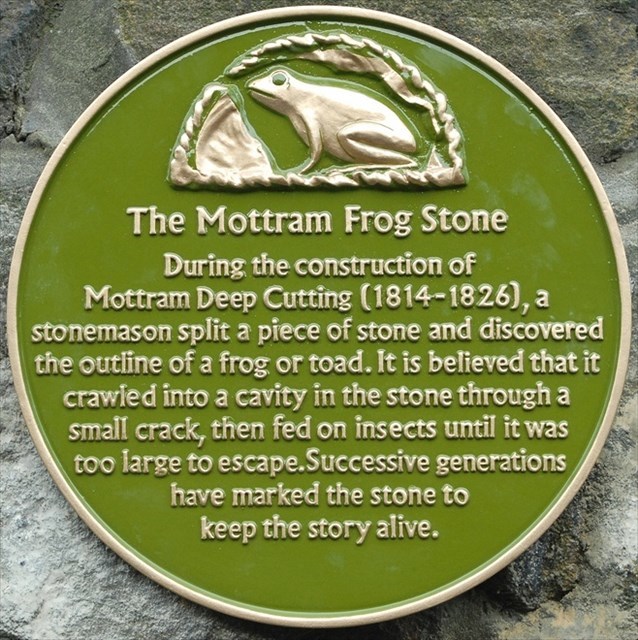
The Mottram Frog Stone
During the construction of Mottram Deep Cutting (1814-1826) a stonemason split a piece of stone and discovered the outline of a Frog or a Toad. It is believed that it crawled into the cavity in the stone through a small crack, then fed on insects until it was too large to escape. Successive generations have marked the stone to keep the story alive.
*******************************************
To complete this Earthcache
Please message me using the Geocaching Message Center or email me via my User Profile with the following information:
- Which type of Rock does Gritstone belong to Igneous, Sedimentary or Metamorphic?
- Measure the Height and Width of the largest stone between the Frog Stone & the Plaque?
- Examine the stones between the Frog Stone & the Plaque. Describe the colours you see. Please explain which colour(s) you believe the stone’s natural colour was and which colour(s) were caused by surface discolouration (if any discolouration is present)?
As an optional task, it would be nice if you could post a photo of yourself with the Mottram Frog 🐸.
Although the cache site is wheelchair accessible, wheelchair users will require help obtaining the answers.