Are you ready for a palaeo-adventure? Come out to the free fossil hunting sites in Richmond and we guarantee you will find a fossil!
The posted coordinates have you at Free Fossil Pit 2, we were successful here (see pics at the bottom of the page), The additional waypoint shows Pit 1, where there is a toilet and a shelter with a table for lunch.
Many of the fossils in the Richmond area are among the best preserved for their kind in the world.
The fossils of these hunting sites were deposited around 100 million years ago when Richmond and most of inland Australia were covered buy an ancient inland sea.
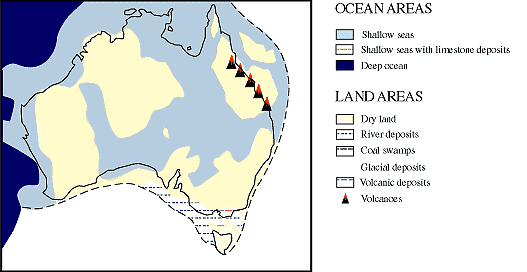
Between 125 – 98 million years ago, fluctuations in global sea levels repeatedly flooded Australia’s Great Artesian basin with a series of four shallow marine incursions known as the Eromanga Sea. During this time different types of sediment accumulated on the bottom of the Eromanga Sea. This can be seen in the multiple geological formations of the Rolling Downs Group. These formations are arranged stratigraphically and sometimes contain different fossil types.
The rocks that you will be looking amongst at the free hunting sites are from the Toolebuc Formation. Based on the presence of index fossils used for dating rocks, the Toolebuc formation is 100 million years old which places it in the Albian stage of the Early Cretaceous period, the last flooding of the Eromanga Sea.
There are two distinctive sedimentary rocks in the Toolebuc formation that are easily seen at either site.
Shale can be seen as thin layers of find grained rock which is rich in organic material. Fossilised remains of plankton, molluscs and vertebrates are contained.
Coquina is seen as rock composed mostly of tightly packed shells and often contains remains of large biavalves.
One thing all the fossiliferous shale and coquina have in common is they contain calcium carbonate. An easy test is to drop a small amount of vinegar on a rock, the acid in the vinegar will react wit the calcium carbonate producing fizzing.
If you have read ahead and noticed the questions we do require you to find a fossil at either Site 1 or 2, we promise it isn’t as hard as you think, there are fossils everywhere!
You don't require any digging tools, most people don't have any equipment and still manage to make great finds but we assure you if you go out without any tools you will be soon searching around in the car for a screwdriver or hammer, the temptation to split shale is fairly high!
Most people who visit here will be on holidays and only have limited ‘tools’ with them. We had two sets of tools; a hammer and large flat screwdriver and a pick hammer. The screwdriver was the most used tool and is what Geo mum used to find her mandible.
Sitting and splitting Shale is a good method and can be done easily with a screwdriver and hammer. Unless you are specifically targeting Bivalve’s we suggest you look for shale rather than Coquina. When you have split a piece of shale inspect both sides and look for any changes in colour or texture.
A small brush or a dab of water can help to remove dirt but be careful not to use too much water it can make things quiet sticky and muddy. To assist yourself and in consideration of others who will follow you place overburden in an orderly fashion behind you when you are done with it.
It is also possible to simply walk through the sites looking for fossils that are already exposed, after rain is a great time to do this, as the rain will have washed dirt away. Geo son found a fish element in someone else’s discarded pile.
Which ever method you use please be safe, use sun or protective glasses for your eyes and remember it can get quiet hot, so take plenty of water and sun protection. Watch out for things that bite, don’t take any unnecessary risks and consider others. See below for the local fossil hunting code.


Examples of what can be found in the area.
![]()

This is a mandible (lower jaw) from a prehistoric fish that Geo mum found in an area that had already been dug.

These are other bits and pieces Teamthommo found while at the site, Fin element, shells, fish scale, Colquina and ‘fish mash’.
![]()
To log this Earth Cache we require you to wander around and look at the area, consider the information given and perhaps if you need to do some research of your own, then message us with the following answers to the best of your ability;
1. Find a fossil, there are so many here that we are sure you will find one quiet quickly, examine it, and tell us what you think it might be?
2. Find a piece of Shale and a piece of Coquina if you can and tell us the difference in the appearance and texture of each?
3. BONUS QUESTION - we realise not everyone will have vinegar easily accessible but if you do, put a few drops on some rock from the area and observe what happens, explain why you think the reaction did or didn’t occur.
4. A photo of your team or GPS ‘hunting’. (Optional)
You are welcome to log your answers straight away to keep your TB's and Stats in order but please message us with your answers within 24 hours. Cachers who do not fulfil the Earth Cache requirement will have their logs deleted.
Source: Wikipedia, Kronosaurus Korner,

