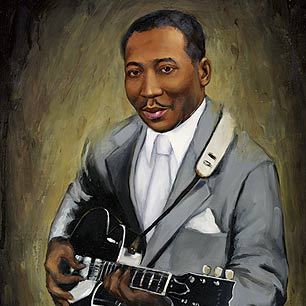
Muddy and his band opened for ZZ Top on a tour in 1981. This was over 40 years after his first recordings, and that band could still play the blues, not just as seasoned pros but with the same enthusiasm Muddy had when he started out. When he sang that his mojo was working, you could tell his mojo had not slowed down at all. He was satisfied, composed, self-contained. If he had an opinion on a subject, he didn't allow a whole lot of latitude to be convinced otherwise. If he was bitter about the way he'd been treated by record companies, he never showed it. We talked to him a lot as we traveled, when he wasn't chasing young girls through the airport. He told us a story once about his friends Freddie King and Little Walter walking from Dallas to Chicago. I've always had that image in my mind of two guys walking from the South to the North. Everyone else in the great migration took the train. I hope they weren't carrying their equipment.
People call his sound raw and dirty and gritty, but it wasn't particularly loud. It just sounded that way. A guitar amplifier in the Fifties was maybe the size of a tabletop radio. To be heard over a party, you had to crank that thing as loud as it would go. And then you left behind all semblance of circuit design and entered the elegant field of distortion that made everything so much deeper. If you didn't have a big band with 20 guys, you had 20 watts.
I first heard Muddy Waters through two friends of mine, Walter Baldwin and Steve Roberts, in junior high in 1962 or '63. We grew up together and jumped on every piece of musical madness we could find. Most people in my generation probably discovered Muddy backwards from the Rolling Stones, who got their name from a Muddy song. I heard him just before the Stones got here, but it was all good, whether you discovered it backwards, forwards or sideways.
Anyway, I picked up the guitar because of Muddy Waters as much as anyone. Jimmy Reed, Howlin' Wolf, T-Bone Walker, Albert King, B.B. King, Freddie King — they all had an impact too, but they all followed Muddy Waters. He started out in Mississippi playing acoustic, using his thumb to play the bass line and a real bottleneck slide for melody on the upper strings. The slide guitar got the nuance of the human voice better than any other instrument. Basically, it was a Robert Johnson thing, and Muddy took it to Chicago, electrified it, added a bass player and a harp with a good backbeat, and you had a party. His bands were always powerhouses, and his voice had an amazing depth.
The remarkable thing is that the blues never died out, ever. It's been rediscovered every 10 years since the Twenties. Nobody can do what Muddy did, but his energy is still fueling that fire. You can hear his enthusiasm in bands like the White Stripes or the Black Keys. I'd recommend his first album, The Best of Muddy Waters, with the early Chess singles, to anyone. Every track is worthy. The albums Johnny Winter produced in the late Seventies, Hard Again and I'm Ready, are also terrific.
It was all supposed to be disposable. Just noise on a shellac disc. And here we are in the 21st century still trying to figure out how such a simple art form could be so complicated and subtle. It's still firing brain synapses around the world. You've got the Japanese Muddy Waters Society corresponding with fans in Sweden and England, and his music can still propel a party in the U.S. He made three chords sound deep, and they are.