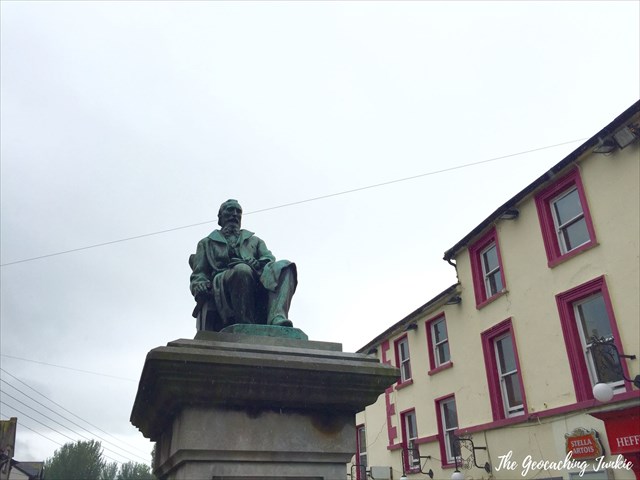
In 1898, this life-sized bronze statue of Kickham was unveiled in the centre of Tipperary town. The plinth describes him as a 'poet, novelist and above all, patriot.'
Irish Limestone - Cretaceous or Carboniferous
Limestone is formed when sediments of mostly calcite and aragonite are layered on top of each other and compressed down over long periods of time to form the rock. The minerals are mostly the skeletal remains of marine organisms such as molluscs and coral. Many of these skeletal fragments are still visible in the limestone, even after millions of years.
40% of the island of Ireland is underlain by limestone. The vast majority of this limestone comes from the Cretaceous or Carboniferous periods. Carboniferous limestone is normally hard and grey to black in colour, and found in every county of Ireland apart from Antrim and Wicklow. Cretaceous limestone, or chalk, is somewhat softer and normally white in colour, and can be found only in Ulster.
Fossiliferous Limestone
Limestone can be described as fossiliferous when it contains an abundance of visible fossils or fossil traces.
Fossils appearing in limestone
- Bivalves can vary in shape and size but commonly look like circles or 'C' shapes. They are cross sectional views through the valves of shelled organisms (like mussels and clams).
- Coral fossils are identified by a series of 'dots' in a group.
- Brachipods are similar to bivalves but usually have one valve bigger than the other
To log this EarthCache as a find
Please send the answers to the below questions to me via the message centre:
1. Examine the limestone and describe its colour and texture.
2. From your observations, what period do you think this limestone is from: Carboniferous or Cretaceous?
3. Give at least one reason for your answer to number 2.
4. On the front of the plinth, there are two prominent fossils above the words 'J KICKHAM': what type of fossils are these?
5. Approximate the diameter of the prominent fossil over the 'J'.
Do not wait to log your find; I will contact you if there is any issue with your answers.
Please do not post any spoilers of the plinth, but feel free to photograph the statue itself!
HAPPY EARTHCACHING!
| I have earned GSA's highest level: |
 |