The ancient Kirk of Cruden dates back to 1012 A.D. when a battle took place between the Danes and the Scots under King Malcolm II. It may well be that the name Cruden comes from Croch Dain - the slaughter of the Danes. After the battle a pact was made and the Kirk of Cruden (dedicated to St Olaf, the patron saint of Norway and Denmark) was founded by the Scottish King to mark the spot where the fallen warriors on both sides were buried. The Danish Stone is a large flat slab of marble that lies inside the east gate of the graveyard and is said to have been sent over from Denmark to mark the grave of a Danish prince slain in the battle. The marble is grooved and it is thought that an inscribed plate of copper had once been inserted into it.
The first church was built on a sandy plain near the sea - now part of Cruden Bay golf course. It was overblown by sand and another church was built on a slightly higher piece of ground although it is no longer possible to locate precisely the site of the first church.
A relic remains from this period of time. It is an old Baptismal font said to have been dug out of the sands near the old church when the Episcopalians were ejected from the Parish Church and used by them while they worshipped at Sandend. It can now be seen at St James' Episcopal Church.
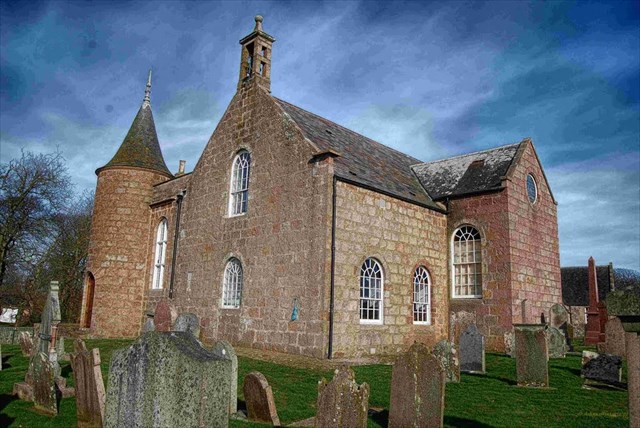
The present church is probably the third on this site. The nucleus of the present building is an orthodox rectilinear structure erected in 1776, built of local pink granite and with a birdcage bellcote at the west end. The symmetrical west front with its centre gable was added in 1834, the architect was John Smith of Aberdeen. The twin conical-roofed stair towers give access to the galleries which increased the capacity. The session house (now vestry) was added in 1840 and the organ chamber in the centre of the south side was built out in 1913, the architect was George Bennett Mitchell of Aberdeen.
Information courtesy of the Cruden Parish Church website.
****************** ********************
For full information on how you can expand the Church Micro series by sadexploration please read the Place your own Church Micro page before you contact him at churchmicro.co.uk
See also the Church Micro Statistics and Home pages for further information about the series.
****************** *******************