Is Richmond Australia’s Dinosaur Capital?
The reason why Richmond has produced so many high quality fossil finds that are amongst the best preserved for their kind in the world relates to both geology and geo-politics.
Put simply, Richmond sits on-top of three major fossil bearing geological units termed the Toolebuc Formation, Allaru Mudstone and Mackunda Formation. These rocks have been known since the 1860’s to be some of the best Mesozoic fossil deposits in Australia. However these rocks (and their constituent fossils) aren’t just found around the township of Richmond, they extend all the way from Hughenden to Boulia in a broad arc.

So the question then becomes, why Richmond and not any of these other townships?
The discovery, in 1989, of the Richmond “pliosaur” (actually a polycotylid) and “Minmi” (recently renamed Kunbarrasaurus) at Marathon station, near Richmond, lead to the creation of a museum in this small local town to display these amazing discoveries. This museum (Kronosaurus Korner) has subsequently had both visitors and volunteers which have found more fossils in the region over that last 20 years, leading to a huge increase in the number of specimens known from around the town. The other areas (e.g. Nelia, Maxwelton, Julia Creek and Cloncurry), on the other hand, have had relatively few people searching for fossils as they don’t have a museum (with the exception of Hughenden and Boulia, although they both lack a trained palaeontologist). Hence they have remained relatively static in terms of their fossil discoveries over the past decade.
The fossils in the Richmond area were deposited 100 million years ago when Richmond and most of inland Australia were covered buy an ancient inland sea.
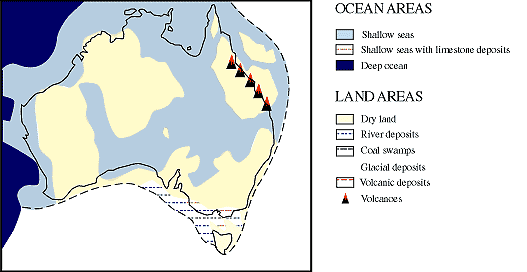
Between 125 – 98 million years ago, fluctuations in global sea levels repeatedly flooded Australia’s Great Artesian basin with a series of four shallow marine incursions known as the Eromanga Sea. During this time different types of sediment accumulated on the bottom of the Eromanga Sea. This can be seen in the multiple geological formations of the Rolling Downs Group. These formations are arranged stratigraphically and sometimes contain different fossil types.
The rocks that you will be looking amongst at the free hunting sites are from the Toolebuc Formation. Based on the presence of index fossils used for dating rocks, the Toolebuc formation is 100 million years old which places it in the Albian stage of the Early Cretaceous period, the last flooding of the Eromanga Sea.
To successfully log this Earth Cache we require you to visit the museum and consider the information given, then message us with the following answers to the best of your ability;
1. In your own words what makes this area prime fossil ground?
2. Name three major and outstanding fossil finds from this area either by the scientific name or by their affectionate name.
3. A photo of your team or GPS getting eaten by Kronosuarus queenslandicus. (Optional)
You are welcome to log your answers straight away to keep your TB's and Stats in order but please message us with your answers within 24 hours. Cachers who do not fulfil the Earth Cache requirement will have their logs deleted.

