Glacier fast facts
Glaciers are large masses of densely packed ice that are constantly moving due to their surface slope, pressure and gravitational forces. A glacier forms over many years when snow and ice builds up faster than it is removed. The removal of snow and ice is called ablation and includes processes such as melting and evaporation. Glaciers grow and shrink in response to changing climate. Typically, glacier movement occurs over long periods of time (hundreds to thousands of years), but within historic memory, such transformations in fewer than 100 years are not unknown.
Presently, 10 percent of land area on Earth is covered with glacial ice, including glaciers, ice caps, and the ice sheets of Greenland and Antarctica. Glaciers store about 75 percent of the world's fresh water.
Glacial ice can range in age from several hundred to several hundreds of thousands years, making it valuable for climate research. To see a long-term climate record, scientists can drill and extract ice cores from glaciers and ice sheets. Ice cores have been taken from around the world, and are continuous records providing scientists with year-by-year information about past climate. Scientists analyze various components of cores, particularly trapped air bubbles, which reveal past atmospheric composition, temperature variations, and types of vegetation. Glaciers preserve bits of atmosphere from thousands of years ago in these tiny air bubbles, or, deeper within the core, trapped within the ice itself.
Glaciers and climate change
Scientists are also finding that glaciers reveal clues about global warming. How much does our atmosphere naturally warm up between Ice Ages? How does human activity affect climate? Because glaciers are so sensitive to temperature fluctuations accompanying climate change, direct glacier observation may help answer these questions. Since the early twentieth century, with few exceptions, glaciers around the world have been retreating at unprecedented rates. Some scientists attribute this massive glacial retreat to the Industrial Revolution, which began around 1760. In fact, several ice caps, glaciers and ice shelves have disappeared altogether in this century. Many more are retreating so rapidly that they may vanish within a matter of decades.
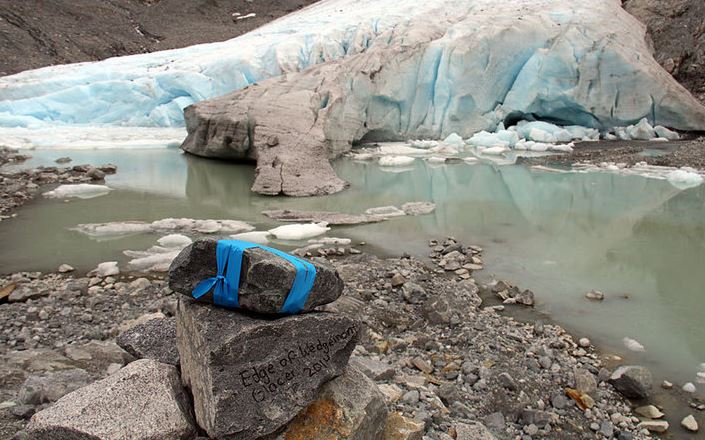
In 1973, Wedgemount Glacier was floating on the lake. By 1991 the glacier terminus was back to the lake shore. Then it began receding fast, and a minor bedrock ridge (called a riegel) was exposed. A second, bigger riegel was exposed soon after, and in the last few years an ice cave with a small pond developed at the terminus behind the bigger riegel, the terminus now being almost 300 metres from the lake shore. Since 1991 the average recession has been 13.6 metres per year.
Blue Ice
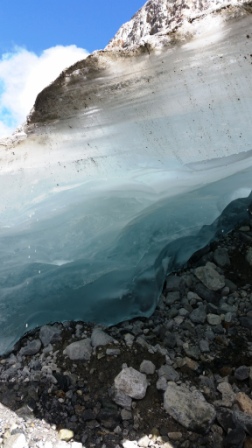 The blue ice is a result of an overtone of an oxygen-hydrogen (O-H) bond stretch which absorbs light at the red end of the visible spectrum. Blue ice occurs when snow falls on a glacier, is compressed, and becomes part of the glacier. Air bubbles are squeezed out and ice crystals enlarge, making the ice appear blue. Small amounts of regular ice appear to be white because of plenty of air bubbles inside them. In glaciers, the pressure causes the air bubbles to be squeezed out increasing the density of the created ice.
To log this earthcache:
01. The coordinates will bring you to the mouth of an ice cave, September 2016. Is the glacier retreating or growing? How far away from the entrance do the coordinates now bring you?
02. Please post a picture of the glacier today, ideally with you or something indicating you were there. There are many beautiful shots of glaciers taken by many professional photographers, though I have seen none with your particular panache. Please add it!
03. What would happen if you broke off a big chunk of ice from a glacier and put it in your glass of water? Would it be any different from the ice in your freezer at home? What would happen to all those air bubbles that have been trapped under pressure?
04. Why is the ice at the base of the glacier a deeper blue than that above it?
05. At Waypoint 1 and Waypoint 2, near the glacier, you will find some interesting rocks. How are they different from the surrounding rocks and terrain? How do you think the glaciers played a role in the formation of these rocks?