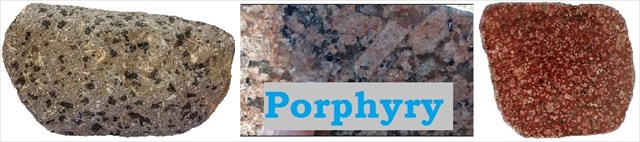
Porphyry Formation
The term 'porphyry' describes a specific texture found in igneous rocks, where they contain larger crystals of certain minerals (especially feldspar or quartz), these being surrounded by a composite of minerals that have a much smaller sized crystal. The larger crystals are called 'phenocrysts' or 'sprinkle grains'. Porphyritic structures are characteristic of lavas and the igneous rocks found in dykes and sills. The phenocrysts are separated by the slower cooling of magma at depth, while the smaller-sized matrix is caused by a more rapid cooling after the magma is squeezed into a crack in the Earth's crust and/or it has reached the Earth's surface.
Porphyry deposits are formed when a column of rising magma is cooled in two stages. In the first, the magma is cooled slowly deep in the crust, creating the large crystal grains with a diameter of 2 mm or more. In the second and final stage, the magma is cooled rapidly at relatively shallow depth or as it erupts from a volcano, creating small grains that are usually invisible to the unaided eye.
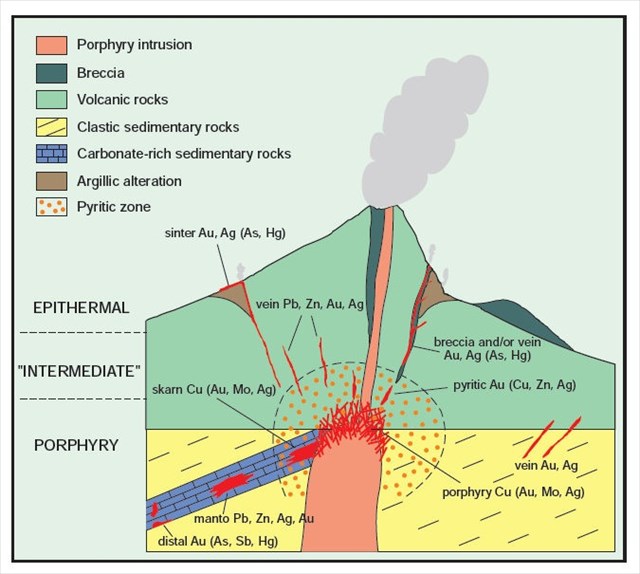
Minerals
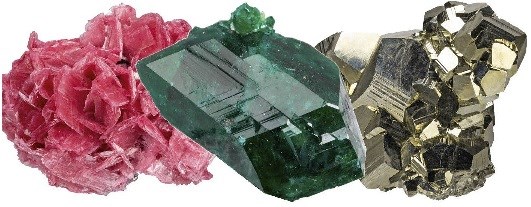
Minerals, naturally occurring elements and chemical compounds having characteristic physical properties such, crystal shape, color, line color, gloss, hardness, cleavage, fracture, density and optical conditions.
You will in this stone find especially the minerals feldspar or quartz.
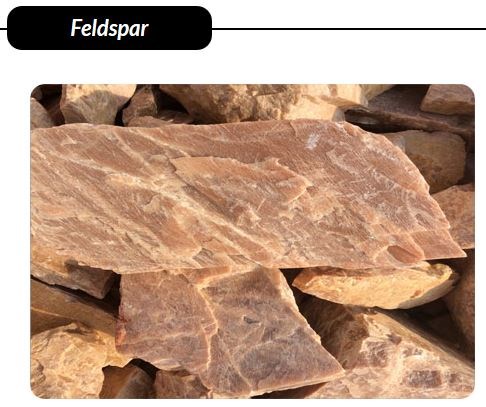
Feldspar, a very important group of minerals that comprise approximately 60% of the rocks in the crust, and which forms the basis for the classification of igneous rocks. They are characterized by two good gap directions which are approximately perpendicular to each other. Hardness 6, the color varies from white and gray to reddish, greenish, bluish towards black.
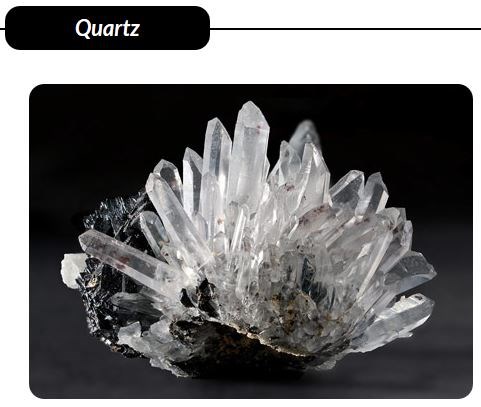
Quartz, a mineral consisting of silica, SiO2. It is so hard that it scratches glass and there is no cleavability.
Quartz is second only to feldspar the most prevalent mineral in Earth's crust and occurs both in igneous rocks (granite, granite pegmatite), in metamorphic rocks (gneiss, quartzite), in sedimentary rocks (sandstone, quartzite conglomerate) and in sediments (sand). The mineral besides occurs hydrothermal at times, in voids and cracks in many rocks and in deposited from hot springs.
To log this cache.
To get to log this cache you will have to visit and answer the questions which are related to the coordinates given the earthcache.
When answers are collected, send them to CO for verification.
As I own about 50 earthcaches there are MANY mails/messages to answer back on, and I will not always be able to answer right-back, BUT I READ ALL SENT ANSWERS AND LOGS, so if anything is not correct or need an upgrade, you will indeed hear back from me.
Thanks for your understanding, and for picking one of my caches.
You can log immediately answers are sent CO. If there are any questions about your answers CO will contact you.
Logs without answers to CO or with pending questions from CO will be deleted without any further notice.
Please do not include pictures in your log that may answer the questions.
Questions
1. Answer the questions under by visiting the Coordinates.
A. What is it that is special for what you see is in this stone at gz?
B. Describe what you see that is in front of you in the stone, and what mineral is it that makes up what you have answered in question A?
C. Is this stone cooled in one stage or more than one? Tell me how you know this answer?
D. Are there any difference in the vertical and horizontal stones that has been used here?
2. Take a photo of yourself, the group or your GPS when logging the cache.
Without revealing any answers!
(It’s voluntary to post a photo in your online log)
