This Earthcache is about times when Oldmeldrum area layed about 15 degrees south of the Equator. They were Silurian (444 to 416 mya) and Ordovician (488 to 444 mya) eras. These 50 million years were times of dramatic changes (at least in geomorphological sense). From one side magma accumulated at depth, and rising, cooled to form granites, but from other side a bit later colliding volcanic arcs and continents formed a chain of mountains on the edge of the old Laurentian continent. Old, Dalradian sediments left here after shallow seas of previous eras were deeply buried, compressed and heated, transformed into metamorphic rocks and deformed into spectacular folds.
This period resulted in variety of igneous and metamorphic rocks and here, at GZ you can see examples of three of them.
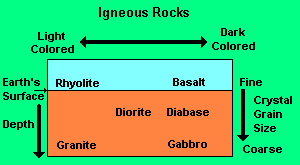
Above the graph explaining origin and appearance of Igneous Rocks (including Granite and Gabbro)
First of them is Granite and everybody in Aberdeen Area knows how Granite looks like. Preaching Aberdonians about Granite is an insult but let me say a few words to people like myself who are not so fortunate to be raised between rivers Dee and Don.
G first - Granite
Granite is a light-coloured (red, pink, gray, or white) igneous rock with grains large enough to be visible with the unaided eye. It forms from the slow crystallisation of magma below Earth's surface. Granite is composed mainly of quartz and feldspar with minor amounts of mica, amphiboles, and other minerals. These are the minerals that give the rock this colourful sparks on the surface. Here in Aberdeenshire most popular is gray and pink granite and specially the first one is commonly used in construction.
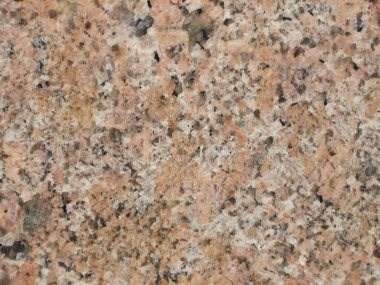
Example how granite may look like.
G second - Gabbro
Another rock, pretty similar to Granite and sometimes even called “black Granite” is Gabbro.
Gabbro is a coarse-grained, dark-coloured, intrusive igneous rock. It is usually black or dark green in colour and composed mainly of the minerals plagioclase and augite. It is the most abundant rock in the deep oceanic crust. Gabbro is commonly used in the construction industry.
Gabbros similarly to Basalts are composed mainly of plagioclase feldspar, micas, amphiboles, and olivine.
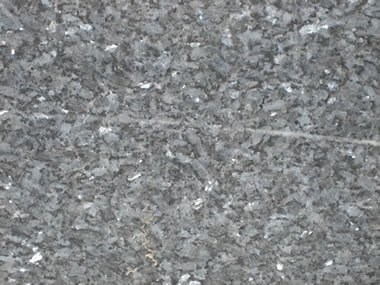
Sample of Gabbro
G third - Gneiss
The only example of metamorphic rock in our group is Gneiss. It’s a rock that can be easily identified especially in a company of Granite and Gabbro and this thanks to its bands and lenses of varying composition, while other bands contain granular minerals with an interlocking texture. Other bands contain platy or elongate minerals with evidence of preferred orientation.
Gneiss usually forms by regional metamorphism at convergent plate boundaries and you may remember that these processes were mentioned at the same beginning of Earthcache description. Gneiss is a high-grade metamorphic rock in which mineral grains recrystallised under intense heat and pressure. You probably noticed that this is third out of three types of rock today that were created deep below Earth surface. This alteration increased the size of the mineral grains and segregated them into bands, a transformation which made the rock and its minerals more stable in their metamorphic environment.
Gneiss is not defined by its composition but in an interlocking texture most specimens have bands of feldspar and quartz grains. These bands are usually light in colour and alternate with bands of darker-coloured minerals with platy or elongate habits. The dark minerals sometimes exhibit an orientation determined by the pressures of metamorphism.
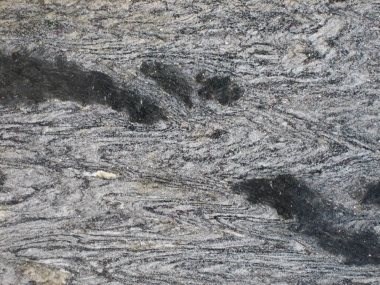
Example of Gneiss
Tasks
To count the Earthcache please answer following 3 questions. Replies should be sent via the contact form. Please do not publish them in your log. You do not have to wait for my permission to log your visit; if your answers will be wrong I'll contact you.
1. There are three stone balls: small, medium and large. Based on description above, please tell what material has been used for each of them. Please justify your answer.
2. What’s the true colour of the green vein shown in the picture? How it was formed?
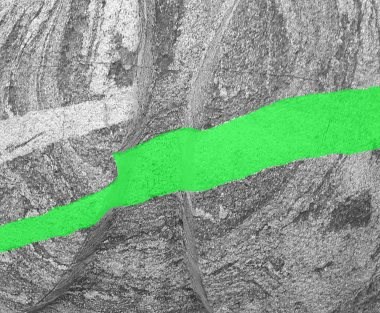
3. What other rock you can see at coordinates (it wasn’t described above and it’s not in a form or rocky ball)?