地球史上属于侏罗纪末到古近纪初,也就是2亿1千万年到6500万年前的这段时间,在中国区域范围内发生了广泛的地壳运动。由于北京附近的燕山是典型的代表,因此这个地壳运动被称为燕山造山运动。这期间地壳因为受到强有力的挤压,褶皱隆起,成为绵亘的山脉。而且岩浆活动频繁,它对花岗岩的侵入活动造成了各种特殊的岩层。伟晶岩脉就是这样产生的。
名称来源
伟晶岩这个词来源于希腊语πεγνυμι(pegnymi),含义是“凝结”,它一般是以石英、长石和云母等形式出现在花岗岩中。
伟晶岩是一种全晶质的由火山岩浆侵入体组成的环环相扣的晶体,具有粗粒或巨粒结构,通常大于2.5 cm(1英寸),整个晶体最大可以达到数米甚至十米以上长,一般颜色较浅,是一种浅成岩,但常产于深成岩的体内或周围,其包含的晶体经常是有价值的矿物。对于其产生的原因,有多种解释,有的理论认为是由于火山残余的溶浆缓慢结晶而成,也有认为是由于高压造成的强烈扩散条件影响,目前尚没有一致公认的理论。
伟晶岩具有很单一的特征,大尺寸晶体结构是判断所有伟晶岩的标准。伟晶岩与其寄生的岩体相比通常都算是很小尺寸的,因为岩体通常都是几十甚至几百米量级的。与典型的火成岩相比,伟晶岩的存在是相当不均匀也不连续的。
岩石学
在地球地壳的压力下,伟晶岩中的晶体生长速率很慢。基于化学、高热及特殊条件这三种假设理论概括了伟晶岩的形成原因:
*高温高压的蒸汽和水,有助于提高扩散系数,可以迫使少数的大晶体优先生长;
*在岩浆或蒸气中,高浓度的元素如硼、锂等因为温度降低而凝固;
*相对的低温,再加上周边岩石的高温,可以解释伟晶岩为什么仅在绿片岩中产生。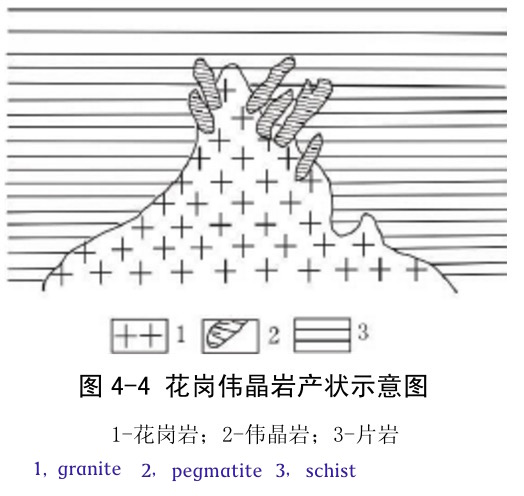
矿物学
伟晶岩矿物在大多数情况下,是以某种形式的长石为主,通常是云母或者石英。除此之外,可能还与大多数花岗岩相关,然而它是无法量化的。这是因为在岩石中的矿物颗粒的计数和采样非常困难,有可能会有从厘米到米的跨越。
地球化学
伟晶岩的特点往往是由矿物化学所定义的单矿物组成的岩脉。由于组成伟晶岩的晶体尺寸太大,想采集到合适的伟晶岩样品是非常困难的。通常情况下,一些50至60公斤的岩石样品必须被打碎,以获得一个有意义的、可重复采样的样品。
根据其成分不同,伟晶岩可以分为:
*伟晶辉石岩,黑色或绿黑色,主要由辉石的巨晶组成;
*辉长伟晶岩,灰色或灰黑色,主要生长在辉长岩中;
*花岗伟晶岩,灰白色、肉红色或浅灰绿色,主要由石英和长石组成,多有石榴石、绿柱石、黄玉等矿物;
*正长伟晶岩,灰白色或浅肉红色,几乎全部由碱性长石组成;
*霞石正长伟晶岩,灰白色或浅绿色,主要由霞石和碱性长石组成。
经济的重要性
伟晶岩是世界上非常重要的矿产资源,因为它常常含有稀土矿物和宝石,如绿柱石、电气石、黄玉、萤石、磷灰石、刚玉等等,并且还经常伴随着锡、钨等矿产。
你的任务:
为了登记这个地理宝藏,你必须要进行一小段爬山路程,但并不困。你可以先log,然后将以下三个问题的答案发到我的邮箱里,以确保您的log是真实有效的。如果在两个星期内没有收到你的邮件,我将会删除您的log。
1.你能测量或估算一下最宽的伟晶岩脉宽度吗?
2.你认为这里的伟晶岩的成分是什么?
3.含有伟晶岩的岩石和周围的岩石有什么不同?
请不要将问题答案写在您的log里。
山脚下有一个停车场,不过我还是建议你乘坐公交车前往。563,698,505,318,360,714,696,331等都可以到达。
From 210 million to 65 million years ago, belong to the end of the Jurassic in the history of the earth,in a wide range of crustal movement have taken place in China area. Due to the near Beijing Yanshan, is a typical representative of the so called Yanshan movement . During this period the earth's crust due to strong extrusion, fold uplift, become the way across the mountains. Another frequent magmatic activity, granite intrusion activities caused various special strata. Pegmatite are produced in this way.
A pegmatite is a holocrystalline, intrusive igneous rock composed of interlocking phaneritic crystals usually larger than 2.5 cm in size (1 inch); such rocks are referred to as pegmatitic.
The word pegmatite derives from Homeric Greek, πεγνυμι (pegnymi), which means “to bind together”, in reference to the intertwined crystals of quartz and feldspar in the texture known as graphic granite.
Most pegmatites are composed of quartz, feldspar and mica, having a similar basic composition as granite. Rarer intermediate composition and mafic pegmatites containing amphibole, Ca-plagioclase feldspar, pyroxene, feldspathoids and other unusual minerals are known, found in recrystallised zones and apophyses associated with large layered intrusions.
Crystal size is the most striking feature of pegmatites, with crystals usually over 5 cm in size. Individual crystals over 10 metres (33 ft) long have been found, and many of the world's largest crystals were found within pegmatites. These include, spodumene, microcline, beryl, and tourmaline.
Similarly, crystal texture and form within pegmatitic rock may be taken to extreme size and perfection. Feldspar within a pegmatite may display exaggerated and perfect twinning, exsolution lamellae, and when affected by hydrous crystallization, macroscale graphic texture is known, with feldspar and quartz intergrown. Perthite feldspar within a pegmatite often shows gigantic perthitic texture visible to the naked eye.
General description
The single feature that is diagnostic to all pegmatites is their large size crystal components. Pegmatite bodies are usually of minor size compared to typical intrusive rock bodies. Pegmatite body size is on the order of magnitude of one to a few hundred meters. Compared to typical igneous rocks they are rather inhomogeneous and may show zones with different mineral assemblages. Crystal size and mineral assemblages are usually oriented parallel to the wall rock or even concentric for pegmatite lenses.
Petrology
Crystal growth rates in pegmatite must be very slow to allow gigantic crystals to grow within the confines and pressures of the Earth's crust. Thus, the possible growth mechanisms in a wide variety of known pegmatites may likely involve a combination of the following processes;
· Low rates of nucleation of crystals coupled with high diffusivity to force growth of a few large crystals instead of many smaller crystals
· High vapor and water pressure, to assist in the enhancement of conditions of diffusivity
· High concentrations of fluxing elements such as boron and lithium which lower the temperature of solidification within the magma or vapor
· Low thermal gradients coupled with a high wall rock temperature, explaining the preponderance for pegmatite to occur only within greenschist metamorphic terranes
Despite this hypothesis on likely chemical, thermal and compositional conditions required to promote pegmatite growth there are three main theories behind pegmatite formation;
Metamorphic:pegmatite fluids are created by devolatilisation (dewatering) of metamorphic rocks, particularly felsic gneiss, to liberate the right constituents and water, at the right temperature。
Magmatic:pegmatites tend to occur in the aureoles of granites in most cases, and are usually granitic in character, often closely matching the compositions of nearby granites. Pegmatites thus represent exsolved granitic material which crystallises in the country rocks。
Metasomatic:pegmatite, in a few cases, could be explained by the action of hot alteration fluids upon a rock mass, with bulk chemical and textural change。
Metasomatism is currently not well favored as a mechanism for pegmatite formation and it is likely that metamorphism and magmatism are both contributors toward the conditions necessary for pegmatite genesis.
Mineralogy
The mineralogy of a pegmatite is in most cases dominated by some form of feldspar, often with mica and usually with quartz, being altogether "granitic" in character. Beyond that, pegmatite may include most minerals associated with granite and granite-associated hydrothermal systems, granite-associated mineralisation styles, for example greisens, and somewhat with skarn associated mineralisation.
It is however impossible to quantify the mineralogy of pegmatite in simple terms because of their varied mineralogy and difficulty in estimating the modal abundance of mineral species which are of only a trace amount. This is because of the difficulty in counting and sampling mineral grains in a rock which may have crystals from centimeters to meters across.
Geochemistry
Pegmatite is difficult to sample representatively due to the large size of the constituent mineral crystals. Often, bulk samples of some 50–60 kg of rock must be crushed to obtain a meaningful and repeatable result. Hence, pegmatite is often characterised by sampling the individual minerals which comprise the pegmatite, and comparisons are made according to mineral chemistry.
Geochemically, pegmatites typically have major element compositions approximating "granite", however, when found in association with granitic plutons it is likely that a pegmatite dike will have a different trace element composition with greater enrichment in large-ion lithophile (incompatible) elements, boron, beryllium, aluminium, potassium and lithium, uranium, thorium, cesium, et cetera.
Economic importance
Pegmatites are important because they often contain rare earth minerals and gemstones, such as aquamarine, tourmaline, topaz, fluorite, apatite and corundum, often along with tin and tungsten minerals, among others.
Nomenclature
Pegmatites can be classified according to the elements or mineral of interest, for instance "lithian pegmatite" to describe a Li-bearing or Li-mineral bearing pegmatite, or "boron pegmatite" for those containing tourmaline.
There is often no meaningful way to distinguish pegmatites according to chemistry due to the difficulty of obtaining a representative sample, but often groups of pegmatites can be distinguished on contact textures, orientation, accessory minerals and timing. These may be named formally or informally as a class of intrusive rock or within a larger igneous association.
While difficult to be certain of derivation of pegmatite in the strictest sense, often pegmatites are referred to as "metamorphic", "granitic" or "metasomatic", based on the interpretations of the investigating geologist.
Rocks with similar texture to pegmatites are called pegmatitic.
Occurrence
Worldwide, notable pegmatite occurrences are within the major cratons, and within greenschist-facies metamorphic belts. However, pegmatite localities are only well recorded when economic mineralisation is found.
Within the metamorphic belts, pegmatite tends to concentrate around granitic bodies within zones of low mean strain and within zones of extension, for example within the strain shadow of a large rigid granite body. Similarly, pegmatite is often found within the contact zone of granite, transitional with some greisens, as a late-stage magmatic-hydrothermal effect of syn-metamorphic granitic magmatism. Some skarns associated with granites also tend to host pegmatites.
Aplite and porphyry dikes and veins may intrude pegmatites and wall rocks adjacent to intrusions, creating a confused sequence of felsic intrusive apophyses (thin branches or offshoots of igneous bodies) within the aureole of some granites.
Your task:
To log this Earthcache, you have to make a hill climbing hike。 You can immediately log and then send the answers of the following three questions to my email or message to make sure your log is valid. If I did not receive the mail or message within two weeks, I will delete your log。
1.Can you measure or estimate the width of the pegmatite?
2.What do you think is the pegmatite composition?
3.What is the difference about containing pegmatite rocks and rocks around?
Please do not write the answers in your log.
There is parking at the foot of the hill, but I suggest you go there by bus。Example Bus 563,698,505,318,360,714,696,331。