Over my year of geocaching, I have been repeatedly overcome by how geocaching reminds us that there is much more to the world we live in than what we see. Geocaching has shown me that it is important to look closer to find the things that blend in to their environments. This is fun when looking for containers and log books but even more fascinating when the items that blend in were once living organisms, as they are here, in the walls of this historic building.
This building, once known as the North Toronto railway station, was the first building in the city to be constructed of Tyndall limestone from Manitoba. This limestone was supplied by the Wallace Sandstone Quarries. The material is noted for its weather resistance, embedded fossils, and striking colour pattern.
Being a famous, beautiful stone from Manitoba that can withstand Canada's tough climates, it has been used in the construction of many notable buildings in our country, such as the Canadian Parliament Buildings in Ottawa, the Saskatchewan Legislative Building in Regina, the Federal Public Building in Edmonton, the Canadian Museum of History in Gatineau (see Earthcache GC2F770), the Manitoba Legislative Building in Winnipeg, the Empress Hotel in Victoria, les Apartements Le Chateau in Montreal (see Earthcache GC2JEH6), and many others.
Noted features of Tyndall limestone:
- Colour and durability: It is generally light tan or cream in colour, but heavily mottled with a reticulated network of darker stone that contributes structural reinforcement as well as an attractive appearance.
- Fossilization: During the time geologists refer to as the Ordovician Period, estimated at about 450 million years ago, the area currently known as southern Manitoba was south of the equator and was occupied by a shallow tropical sea. Many types of marine life lived here, mostly on or near the seabed. When these organisms died, they became incorporated into the mud, and the calcium carbonate in their skeletons provided lime that contributed to the transformation of the mud into limestone. Their shapes live on in the hardened stone.
Tyndall Stone contains two different types of fossils. Most numerous are the networks of darker stone found throughout. These are actually “trace fossils” – traces of the passage of organisms, in this case burrowing through the mud of the seabed (fossilized dinosaur tracks are another example of trace fossils). The burrows are similar to those made in more recent times by mole shrimp, but the fossil record for such crustaceans does not extend as far back as the Ordovician Period, so what organisms created the burrows is currently unknown. Whatever created the burrows, their existence led to the formation of a different type of stone as magnesium-rich waters penetrated the burrows (but not the surrounding sediment) and formed dolomite, which is more durable than limestone and thus adds structural strength as well as an interesting colour pattern to Tyndall Stone.
The other type of fossil in Tyndall Stone is what most people more commonly think of as fossils – “body fossils” that are casts of organisms themselves, most commonly gastropods, brachiopods, cephalopods, trilobites, corals, stromatoporoids, and others. The identity of the burrowing organisms is not known, but fossil burrows of this type have been given the name Thalassinoides.
Some possible examples of fossils commonly found in Tyndall Stone:
- Gastropods: These include your typical snails, as well as other forms such as slugs. Fossils of both tall spiral shells and more broadly rounded ones may be found in Tyndall Stone.
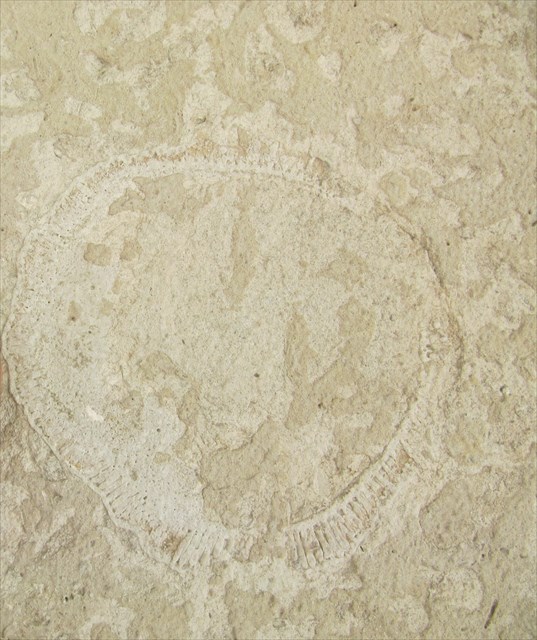
- Horn Coral: Most commonly seen in cross section, this type of solitary coral appears circular with ridges extending radially from the centre towards the perimeter. They are also sometimes exposed in longitudinal section (lengthwise), in which case it becomes obvious how they got their name.
- Chain Coral: This colonial coral, seen in cross section, appears to form chains that wind about, joining and splitting in an irregular way. Sometimes rough (as opposed to smoothly cut) stone provides a more three-dimensional view of these corals, in which it can be seen that the “chains” are actually cross sections of structures more like walls or palisades.
- Sunflower Coral: Aptly but inappropriately named, this is actually a calcareous alga rather than a true coral. Like a true coral, however, it secretes a calcium carbonate skeleton that, in a cross-sectional fossil, forms a regular grid pattern in a broad circular band around a large central “hollow”.
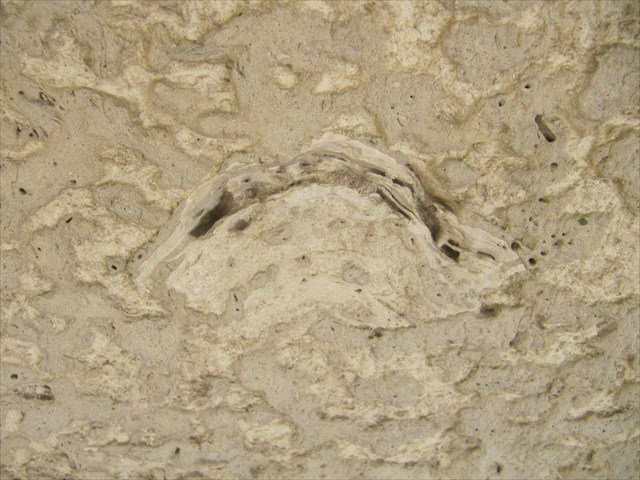
- Cephalopods: These are relatives of today’s octopods, squids, and the “living fossil” nautilus. Like the existing nautilus they have a shell composed of a series of separate chambers. The shell may be curved (like the nautilus) or straight, but straight ones are much more commonly seen in Tyndall Stone.
The building is protected under Part IV of the Ontario Heritage Act, since October 13, 1976. A Heritage Easement has been placed on the property since December 5, 1997. The City of Toronto also lists the building as part of the South Rosedale Heritage Conservation District.
This earthcache is named "Half and Half" because a portion of the building's walls is made from the original limestone that still stands today, over 100 years after the building's initial construction. This "half" is heavily fossilized and represents an authentic Tyndall Stone experience. The other "half" of the building is part of a later restoration of the building where, according to the building's owners, the material used is a newer stone that was modified to match (as much as possible) the original famous, fossilized Tyndall limestone.
Visit the building at the posted coordinates and examine the exterior walls on all sides. (North, South, West, and East) noting which sides used the original stone from 1915 and which sides used modified stone.
To log this earthcache, send me an e-mail with the answers to the following questions:
- 1. For EACH side of the building (north, west, south, and east) note which walls feature the original, heavily fossilized Tyndall Limestone, and which ones use the modified stone at the later construction dates?
- 2. On which side of the building did you find the two fossils pictured here:
I will respond quickly to all e-mails with permission to log. Feel free to post a NON-SPOILER photo of your GPS or smartphone (and yourself, if you so choose) near any OTHER fossil on the building's limestone wall to your Found It log.
Thank you for visiting my earthcache!
Additional References:
- Past Lives: Chronicles of Canadian Paleontology: Tyndall Stone (Geological Survey of Canada). http://www.collectionscanada.gc.ca/webarchives/20071122213207/gsc.nrcan.gc.ca/paleochron/17_e.php
- Tyndall Stone: Fact sheet. (Geological Association of Canada) https://www.gac.ca/PopularGeoscience/factsheets/TyndallStone_e.pdf
- Manitoba’s Tyndall Stone (Mario Coniglio, Department of Earth Sciences, University of Waterloo). http://www.whaton.uwaterloo.ca//waton/s9911.html
- Fossils of the Tyndall Stone (Douglas Paterson, former Research Geologist for the Government of Saskatchewan). http://dfp.mediacooks.com/fossils/
Special thanks to NeoDorset for his permission to used some of the text from his Tyndall Stone earthcache in Gatineau, Quebec (GC2F770) for this cache.
This earthcache has been placed with the approval of the land owner.