In Hillfield Gardens there are several man-made, historical structures well worthy of a visit as well as thoughtfully planted “sensory” garden which makes a lovely rest point.
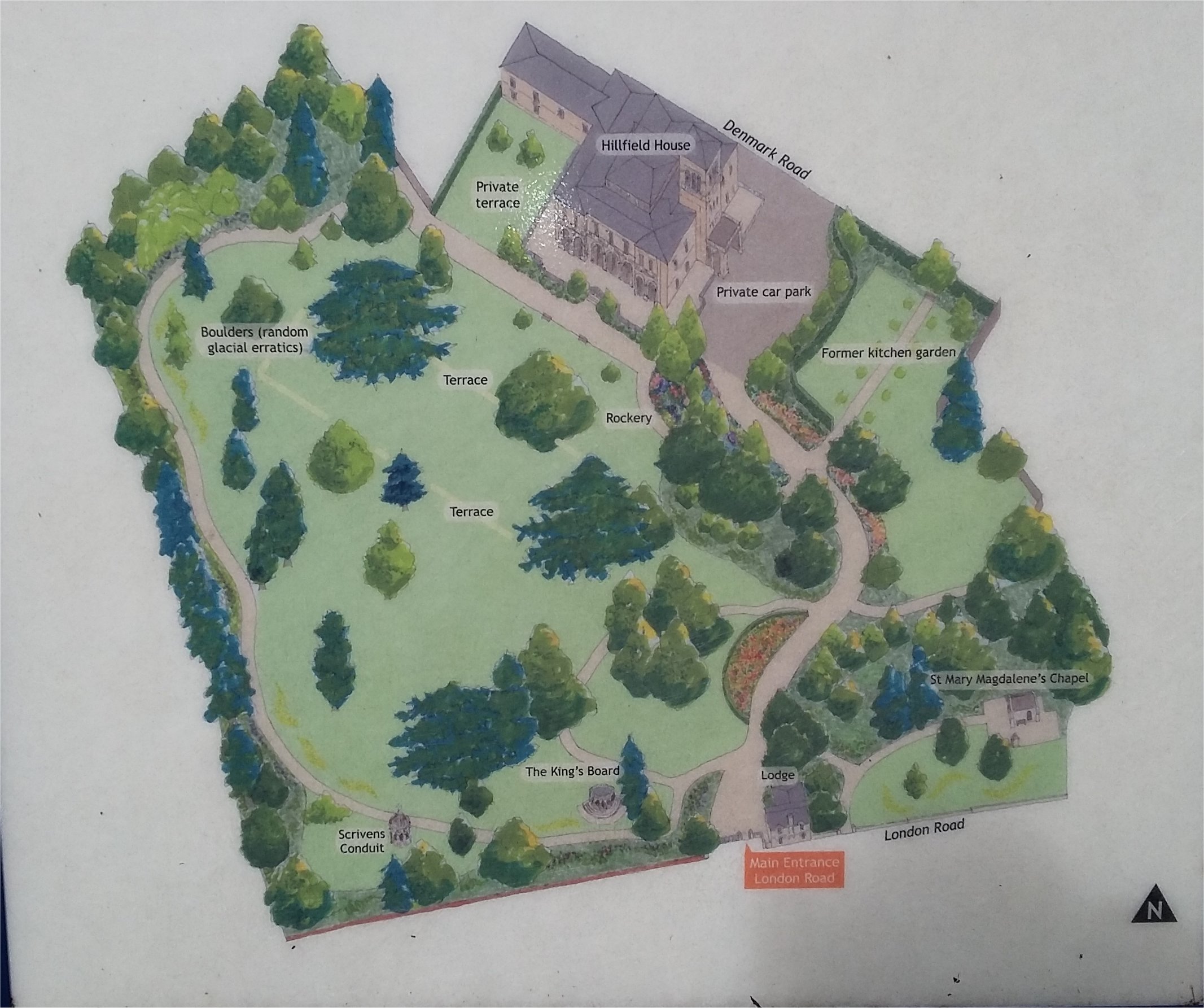
What is often not noticed is that by the paths around the gardens, there are several rocks or boulders sticking up out of the grass. These are not points of rock jutting above their bed-rock but are identified on the Park Information Board as “random glacial erratics”
Types of Rocks
Rocks are not all the same!
The three main types of rock are sedimentary, metamorphic, and igneous
Sedimentary
Sedimentary rocks are formed from particles of sand, shells, pebbles, and other fragments which accumulate as sediment in layers and over a long period of time hardens into rock. Generally, sedimentary rock is fairly soft and may crumble easily. It is usually the only type that contains fossils. An example is limestone.
Metamorphic
Metamorphic rocks are formed under the surface of the earth under intense heat and pressure. These rocks often have ribbon layers and may have shiny crystals, formed by minerals growing slowly over time, on their surface. An example is marble.
Igneous
Igneous rocks are formed when molten rock (magma) cools and hardens. Sometimes the magma cools inside the earth, and other times it erupts onto the surface from volcanoes (lava). When lava cools very quickly, no crystals form and the rock looks shiny and glasslike. Sometimes gas bubbles are trapped in the rock during the cooling process, leaving tiny holes and spaces in the rock. An example is basalt
The Ice Age and Erratics
An ice age is a period during which the temperature of the Earth persistently falls resulting in ice formation. The ice sheet over Britain reached down from the north as far south as London, and in places the ice was three miles thick.
The most recent ice age (ie the most recent period of repeated glaciation) occurred in the Pleistocene Epoch - the time period that began about 2.5 million years ago and lasted until about 11,700 years ago. when temperatures began to rise and the glaciers retreat. We are currently in a warmer interglacial period called the Holocene Epoch.
Geological evidence for ice ages comes in various forms, including glacial erratics
Glaciers
A glacier might look like a solid block of ice, but it actually is moving very slowly. It moves because pressure from the weight of the overlying ice causes it to deform and flow. As it flows it will gouge and carry rocks from in its path.
With greater snowfall and lower temperatures the ice will build-up and the glacier will grow.
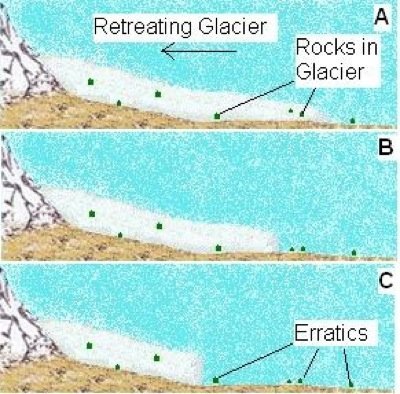
If the temperature rises the glacier will begin to shrink.As it shrinks the encased rocks are freed to fall to earth.
Glacial Erratics
Two characteristics largely define a glacial erratic.
First is that it must be transported a significant distance by a glacier.
And second, the erratic is typically a different type of rock than its surroundings.
Erratics can be huge boulders or little pebbles. They can be any shape but are often are often very rounded because the rough edges are eroded while the erratic is transported within the ice.
A glacier erodes large rocks and boulders and incorporates them into ice. As the glacier moves, the rocks and boulders move with it. When the glacier retreats, the ice melts leaving the boulder behind as a glacial erratic
In the Gardens it is hard to find areas of exposed base rock for comparison under the landscaping. However the several old historic structures in the park are constructed from the local Painswick stone ie Scriven's Conduit, the King's Board and the chancel of the 12th century leper chapel of St Mary Magdalene.
Painswick Stone
Painswick stone was very popular for monuments as it was/is easy to carve. It is typically pale grey and finely grained with ooliths.
![]()
Ooliths are so called because they look like little spheres or eggs. the form as layers of calcite deposit around a core. Oolitic limestone is finely grained as the ooliths are always small (less than 0.8mm diameter)
The "erratic rocks" appear arranged quite artistically in the grass. Without serious excavation it is not possible to confirm how they arrived in position. The questions for this earthcache reflect this uncertainty.
Questions to answer
1. Describe the colour, shape and texture of the rocks
2. What type of rock do they seem to be - igneous, sedimentary, metamorphic? Give a reason for your answer.
3.There is no base rock exposed so look at the old buildings nearby. Do you think that this worked stone is the same as the rocks?
4 From your observations, do the rocks appear to be true glacial erratics or wishful thinking on the part of a past landscaper?
5 What do the words Pleistocene and Holocene mean
5 If possible post a photo of yourself or GPS at the Park (optional).
As this is an Earth Cache there is no physical container to find. Instead answer the questions and send them to me via email or message centre using the link on my user profile at the top of the page.
You may post a found log without receiving a response from me. Any found logs without a corresponding email or message will be deleted and any with significant errors will be contacted for further checks.