The Chalybeate Tavern
The underlying geology of the New Forest is referred to as belonging to the Bracklesham Group and the Barton Group. These are a series of clay beds deposited in a shallow sea round about 40 million years ago, during the Eocene period and are found across southern England including the Hampshire and London Basins. A factor affecting the shallow seas of the New Forest during the Eocene was the hot Poole Delta. This is well-known for its palm leafs and palm fruits (Nipa) etc. fossils found at Bournemouth, and for its pipe clay and pottery clay near Poole. The delta had subtropical plants and in the later Eocene, crocodiles whose remains are found on the Hampshire Coast and in the New Forest. The climate then cooled but all the Eocene strata of the New Forest were deposited before the development of the major Arctic ice sheet.
To the east of the Poole Delta zone, in the New Forest, there are significant mineralogical deposits. These include the pyrite found on Brownsea Island in Poole Harbour, and siderite ironstone also found at Hengistbury Head. Although the siderite exists in the New Forest, it is not easily seen. In addition, the clay mineral glauconite is found around Brook and Bramshaw, and is assumed to be in the strata leading to this site. Glauconite weathers near the surface to leave brown iron-rich sediments.
Where heaths and woodlands are found it is difficult to see the evidence of the Eocene sands except where they have been exposed by streams or artificial excavations. Traces of siderate in suspension via natural spring water oxidises and produces these ferruginous springs at Fritham, and also those near Burley and Latchmore Brook. This type of spring is known as “Chalybeate” (pronounced “Karly-be-at”) or “Iron Spring”. These mineral waters are said to have restorative properties especially for bad legs, sore eyes and leprosy. In the past, the spring at Fritham was known as Lepers Well. However, research by Geocacher d’awsomes shows the well is still relevent today:-"From lepers to mangey dogs is a considerable change, but this change has occurred in the curative uses of the water at Iron's well. We have no longer lepers, but we have dogs afflicted with the mange, a disease which causes the hair partly to fall off. Iron's well, by common repute, is useful in curing these dogs. The spring has a little wooden structure over and round it, with a board wanting at the top, by which you may drop your dog into the chalybeate water, and a convenient arrangement exists, by which, after he has finished his ablutions, he may scramble out on the other side." There is only the Forestry England fence now, probably erected to keep Commoner’s stock out, but you can still throw your mangey geo-hound in for a dunking, if required. For muggles and other humans, the best known chalybeate spa is Tunbridge Wells, in Kent.
Iron Bacteria are bacteria that derive the energy they need to live and multiply by oxidising dissolved ferrous iron. The resulting ferric oxide is insoluble, and appears as brown gelatinous slime. They are known to grow and proliferate in waters containing as low as 0.1 mg/l of iron. However, at least 0.3 ppm of dissolved oxygen is needed to carry out oxidation. Bacteria known to feed on iron include Thiobacillus Ferroxidans and Leptospirillum Ferroxidans.
It is not known for how long the area around this spring has been infected with Iron Bacteria, but it has set in train reactions which may prove harmful to invertebrates in the area and therefore requires monitoring. Your visit will be part of that process.
The spring is beside a gravel track which once carried gunpowder from the nearby Schultze Gunpowder factory. The factory was a major supplier of explosives during the First World War and closed in 1921.
To claim the cache, and to help with monitoring, you should complete the following:-
Take a sample of the water from as close to the source as possible.
1. Describe its appearance. (Clarity, turbidity, etc.)
2. What does it taste/smell like? (We can not recommend drinking, whatever the claims made by the Victorians!)
3. Can you see any invertebrates in the area close to the source?
4. State what mineral has weathered to give the brown colour to the hard surfaces the water is passing over. Iron is not in the answer.
5. Describe how you can tell the difference between the areas showing traces of the brown sediments and those affected by Iron Bacteria.
Take a further sample from immediately below the area visibly affected by the bacteria
6. Don’t Taste the second sample, but describe the difference from the first – smell, tubidity etc.
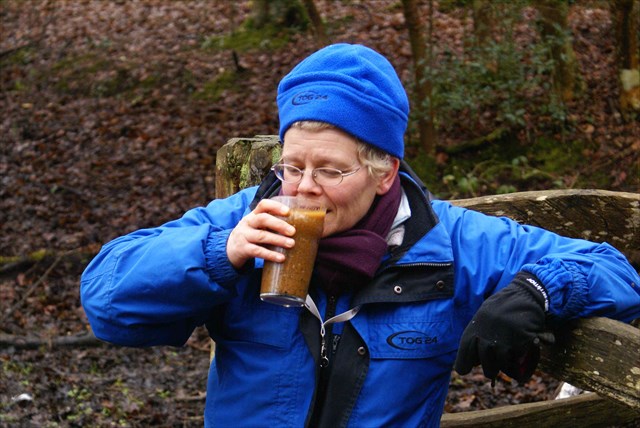
NO! DON’T DRINK THIS!
7. This is important for ongoing monitoring. What is the length and breadth of the area affected by the bacteria? Describe where it starts and finishes.
8. To prove you have been here, what is on the small sign on the south west fence post?
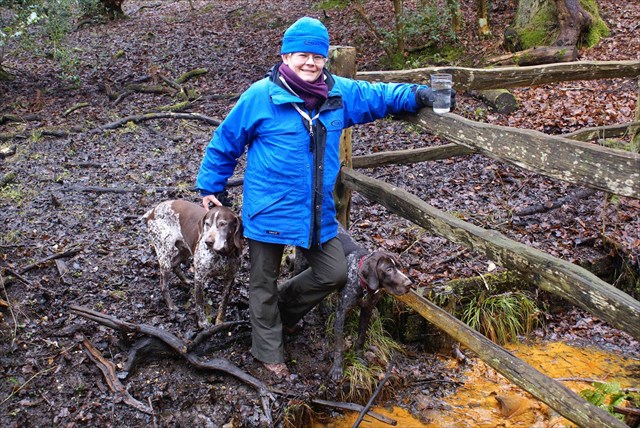
9. Optionally, we always welcome photos of your visit, but please do not include answers to the questions above.
Please send your answers to us by clicking “Message this owner” at the top of this page. Type your answers in the message area and then click “Send”. Log your find in the usual way, and I will contact you to let you know how you scored. Only logs with very poor scores or unvalidated logs will be deleted.
Congratulations to “HummingbirdLady” and “The HappyPanda” who have the joint FTF honours as they arrived just an hour after this cache was activated. We can see from their logs that the Forest was in all its Autumn Glory, and we hope many more cachers come to enjoy this tranquil location. We believe it is always worth the trip, whatever the season. Welcome!
This cache is dedicated to the memory of “Coordin8z” who created the original Earthcache at this site, and so many of the other more memorable caches in the New Forest National Park. Although now officially disabled, most of his caches are still there to be discovered.
Geocaching on Forestry Commission land in the New Forest
Some of this is important, so please don't skip it!
1. You may see warning signs regarding forestry operations. It is easy to disregard these as many have been abandoned after the work is completed. However, Geocachers are smart enough to use their common sense. Don’t go close to areas where machinery is being used - the workers will not know you are there. Do not climb on stacked timber! Despite appearances, it can sometimes move easily and cause horrendous injuries.
2. In October the stags are rutting. A bit noisy at times, and best observed from a discreet distance.
3. If you see dead or injured livestock, note the position and please call the Forestry Commission on 023 8023 3141. The owner will be thankful for your care and concern.
4. For this cache, there is no physical cache as specified in the GAGB Agreement with the Forestry Commission, but in all other respects, it is fully compliant. The Agreement specifically forbids wading through water, or climbing trees.
5. Please note night caching is not allowed in the New Forest.
Ancient Wells and Springs Series
If you would like to expand the Ancient Wells Series by adding a cache of your own please contact LizMar2010 via Geocaching Messenger or email ancientwellsl@yahoo.com, and you will be given a number for your well or spring. The series encompasses ancient and non-ancient wells, springs, and other water features which are worth a visit.